Category Archives: Events

Countdown to Comic Book Apocalypse!

Orion tells it like it is, from NEW GODS #10 (Aug. 1972)

Comic Book Apocalypse: The Graphic World of Jack Kirby opens at the CSU Northridge Main Gallery in just six days, on Monday, August 24, 2015—exactly in time for the launch of the new CSUN semester, and just days before Jack Kirby’s 98th birthday.

The CSUN Art Galleries team and I have been working like mad to ready this show: the first CSUN exhibition devoted to original comic art, the first university exhibit anywhere dedicated to Kirby, and, we believe, the US’s largest Kirby show ever. We’re also working to get the word out—across campus, in the press, and at local shops. At the same time, I’m figuring out how to make this exhibition the centerpiece of my teaching this semester.

This is a busy time. 🙂

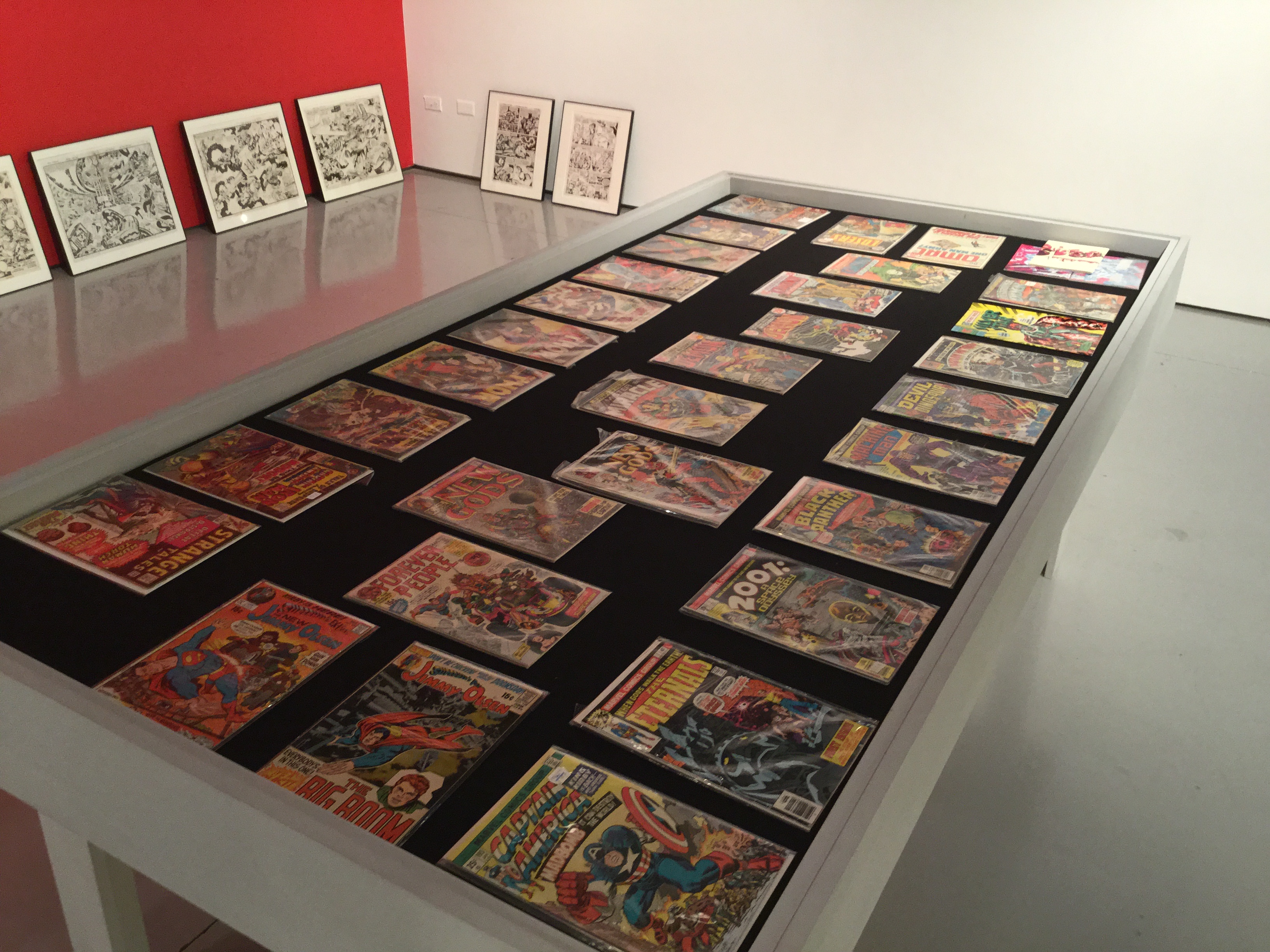
Display case, Comic Book Apocalypse

Far from a final layout—this was two weeks ago!

Comic Book Apocalypse includes over 100 original artworks by Kirby, as well as scores of his published comics. It focuses on Kirby from the mid-1960s on, but gives an overview of his career (including the Simon & Kirby era) and features work from as early as 1943. Highlights include the originals for two complete Kirby comic books, plus unpublished pencils, Kirby’s 1975 painting Dream Machine, more than a dozen of his trademark double-page spreads, five collages, and walls devoted to The Fantastic Four and The Fourth World. Tablet displays provided by the Jack Kirby Museum and Research Center will enable viewers to see even more art than the Gallery’s walls can hold.

Doesn't that red wall look...enticing?

Thanks to Gallery Director Jim Sweeters and his team, plus the help of a great many others, this exhibition is a dream come true. I hope you can join us for our opening reception on Saturday, August 29, from 4 to 7pm; it’s free, informal, and open to the public. Also, on Monday morning, August 31, at 10am we’ll be presenting a gallery talk with Kirby biographer Mark Evanier, and on Saturday, Sept. 26, at 1pm we’ll be doing a panel discussion with Scott Bukatman, Doug Harvey, Steve Roden, and Ben Saunders. Please come!

Unfinished Boom Tube graphic on Main Gallery wall

Things are starting to happen. Again, far from final…but a hint.

PRESS ALERT: check out this article on the exhibit at CSUN Today, as well as this this teaser from the LA Weekly! And thanks to Meltdown Comics for featuring us on their homepage!

A final note: please help celebrate Jack’s 98th birthday by contributing to Kirby4Heroes!

BIG NEWS: Comic Book Apocalypse, a Jack Kirby Exhibition in Los Angeles!

Splash from Silver Surfer #18 (Sept. 1970), by Kirby & Herb Trimpe, adapted by Louis Solis

From Silver Surfer #18 (Sept. 1970), by Kirby and Herb Trimpe (RIP), adapted by Louis Solis

A major Jack Kirby exhibition in Los Angeles, curated by Charles Hatfield, the author of Hand of Fire!

California State University, Northridge Art Galleries

August 24 to October 10, 2015

Public reception:
Saturday, Aug. 29, 4-7pm

Curator talk:
Monday, Aug. 31, 10am

Panel discussion:
Saturday, Sept. 26, 1pm

ONE OF THE BIGGEST EXHIBITIONS OF KIRBY’S WORK EVER!

I’m proud to announce that the CSU Northridge Art Galleries will be presenting, this Fall semester, the exhibition Comic Book Apocalypse: The Graphic World of Jack Kirby. This show will consist of roughly a hundred original artworks by the King, with a focus on his comics in the late 1960s and in the 70s (but also including works from the 1940s-50s and the 80s). Curating this show has been a dream come true.

Comic Book Apocalypse will highlight Jack’s penchant for superheroes, myth fantasy, and science fiction, along with his visions of the cosmic, the primitive, and the futuristic—and of course dazzling examples of “Kirbytech.” From The Fantastic Four and Thor to The Fourth World, Kamandi, 2001, and Silver Star, this show will capture some of Jack’s grandest themes and images. The exhibition will include two complete comic book stories, a great many more comic book pages and spreads, a handful of Jack’s signature collages, and a couple of images never published in his lifetime.

To celebrate this show, we at CSUN will hold three special events within the Gallery. First will be an opening reception on Saturday evening, August 29—a chance to see and chat about the show in the company of other fans! Then I’ll give a gallery talk two days later, on Monday morning, Aug. 31. Finally, we’ll hold a panel discussion with artists and scholars on Saturday afternoon, Sept. 26. All these events are free and open to the public!

Comic Book Apocalypse will be the first solo Kirby exhibition at a university, and one of the largest Kirby shows yet assembled (comparable in scale to the Words & Pictures Museum show in 1994, and exceeded only by the Fumetto show in Switzerland in 2010). In fact it may be the biggest Kirby exhibition yet mounted in the US—and I hope it will inspire other shows and tributes to Jack over these next couple of years, leading up to his centennial (2017).

Curating this show has been, again, a waking dream for me, both a sequel to Hand of Fire and a plunge into a new way of working. It couldn’t have happened without the support of CSU Northridge’s Mike Curb College of Arts, Media, and Communication, the CSUN College of Humanities, and the CSUN Art Galleries program, the help of Mark Evanier and the Jack Kirby Museum & Research Center, and the generosity of many Kirby collectors.

Comic Book Apocalypse opens in time for the launch of the Fall 2015 semester at CSUN, and will be up for seven weeks. It will include a Kirby collage by Geoff (Jetpack Jr.) Grogan , and will be accompanied by a lavishly illustrated catalog featuring some twenty essays about Jack’s work, co-edited by me and Prof. Ben Saunders of the University of Oregon. This companion book will feature a once-in-a-lifetime mix of comics creators, media professionals, and scholars! (Check back here in the weeks ahead for more details about the catalog.)

This exhibition will kick off a year of comics studies events at CSU Northridge, including a conference in Spring 2016. For a decade now, CSUN has run a very popular course on comics that I founded, and I believe now is the time to trumpet (and expand) our commitment to this vibrant, fast-growing field of study!

I can’t think of a better way of doing that than exhibiting the work of the great Jack Kirby. Readers, I hope you can come out and see the show!

NOTE:

If you’re attending Comic-Con International in San Diego this week, do come to the Annual Jack Kirby Tribute Panel assembled and moderated by Mark Evanier. That’s happening on Sunday morning, July 12, from 10:00 to 11:15 a.m. in Room 5AB. It’s a great tradition. I’ll be announcing Comic Book Apocalypse there! Also, drop by the booth of the Jack Kirby Museum & Research Center—that’s by Lobby B1 in the main Exhibit Hall, in the Gold and Silver Pavilion (see this map). I may see you there.

Talking Kirby at ZAPPCON!

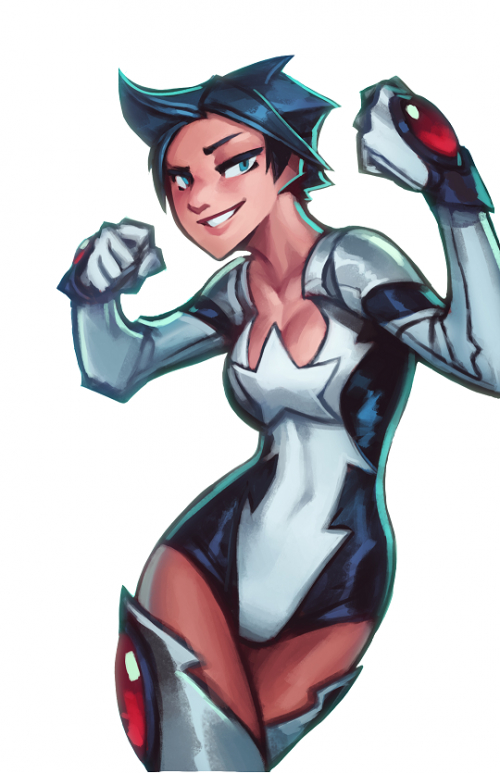
Her name is Zapp!

This weekend I’m in Fresno, CA, presenting and signing books at ZAPPCON Year One: the first go-round for what promises to be an annual Central Valley comics/gaming/cosplay/fan culture convention. Thanks to my brother Scott Hatfield, who brought me on board, my wife Michele Hatfield, who makes everything better, my collaborator Alison Mandaville of Fresno State, who will be joining me at the podium tomorrow, and ZAPPCON’s David Holland, who scheduled my appearances and made it possible for Scott and I to arrange our exhibitors’ table!

ZAPPCON is happening at the Convention Center’s Valdez Hall. Tomorrow, Sunday, Oct. 19, I’ll be signing at our “Educators’ Corner” table on the exhibitors’ floor between 10am and 4pm, except when I’m doing these panels:

10:30-11:30am: The Superhero Reborn—or, How Jack Kirby Co-Authored the Marvel Universe (and More) from His Drawing Board (Sanger Room)

1:30-2:45pm: Comics in the Creative Classroom: Students and Teachers Doing Things with Comics (Sanger Room)—a roundtable with Alison Mandaville (CSU Fresno), John Beynon (CSU Fresno), Jennifer Crow (Arne Nixon Center for the Study of Children’s Literature), Josh Walker (Coalinga Middle School), and me.

If you’re at ZAPPCON, why not take in these events, and/or drop by our table to talk comics, Kirby, education, the works? Today, Saturday, was a blast, and tomorrow promises to be even more so!

Kirby Day: What a Blast!

Kirby4Heroes

Two days ago, Thursday, August 28, was Kirby Day—that is, Jack Kirby’s birthday. It brought a delightful outpouring of remembrance and appreciation that spilled over into Friday. The Kirby4Heroes campaign took the occasion to raise money for The Hero Initiative—I hope they were able to raise a lot!

It’s never too late to donate to The Hero Initiative. 🙂

I was glad to contribute to Kirby Day in my own small way: with a posting at Acts of Geek (also run here on my blog), and by taking part in the big two-part (one, two) celebration over at Comics Alliance.

I went a little Twitter crazy on the 28th, tweeting links to online examples of top-notch Kirby scholarship, Kirby appreciation, and Kirbyana. For the record, here are the things I linked to (besides those mentioned above):

Requiem for Jack Kirby (2001)

Of course I also followed the #WakeUpAndDraw campaign on Twitter, which you see here:

(Dig this Hollywood Reporter article about #WakeUpAndDraw!)

Congratulations to Jillian Kirby and her family for leading the charge on Kirby Day! As far as I’m concerned, it’s now a genuine holiday. 🙂


Kirby’s Second Act (in honor of Kirby Day)

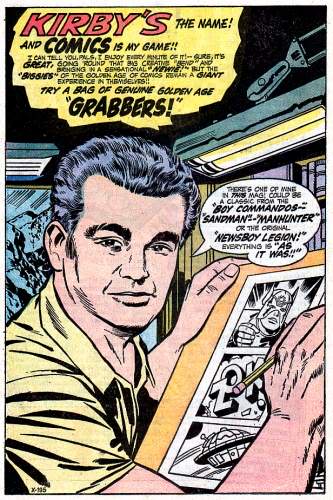
Kirby self-portrait from DC

Tomorrow, Thursday, August 28, would have been the 97th birthday of the great Jack Kirby. I call August 28 Kirby Day because I believe Kirby’s birthday ought to be a holiday for comics fans!

When tomorrow comes, I hope my readers will celebrate Kirby Day by helping the Kirby4Heroes campaign raise funds for The Hero Initiative. You can read more about the campaign in my post of August 11, here. Supporting the Initiative means supporting veteran comic book creators in need—a cause Kirby himself would have championed.

In honor of Kirby Day, I’m posting the following mini-essay, which I’ve adapted from two different sources. One is my reading script for a panel I co-presented with my colleague Ben Saunders at the Emerald City Comicon in Seattle in 2013. The other is the script for a video presentation I contributed to the “Echoes of ’82” panel at Heroes Con 2012 organized by my colleagues Craig Fischer and Ben Towle. I was proud and happy to do both events!

(The cover images are courtesy of the Grand Comics Database. Aptly named!)

Kirby’s Second Act

Jack Kirby changed comic books more than once. If he hadn’t drawn another page of comics after 1950, he’d still be remembered as one of the great comic book artists of the medium’s founding era. If he’d put down his pencil and disappeared from the comic book racks at about age thirty, he’d still be known as one of the giants.

But he didn’t do that, of course. In the 1960s and 70s, when Kirby himself was in his forties and fifties, he picked up the medium by the scruff and carried it along (some more). He changed comics again. In this remarkable second act of his career, Kirby gave his all: an outpouring of generosity and energy that renewed the medium, nudging the foundering industry onward yet again.
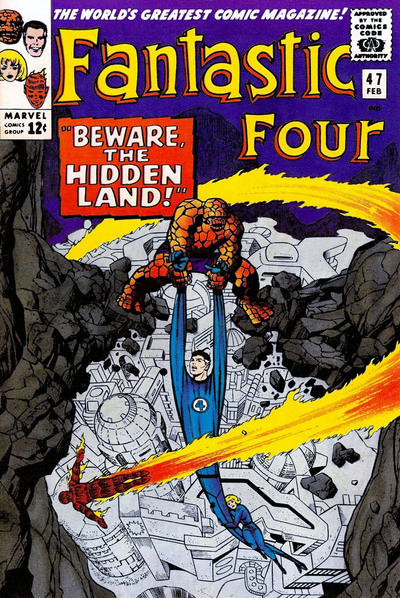
Fantastic Four 47 cover

Starting in the 60s, Kirby gave comic books an expanded canvas. He gave them scope: a sense of larger possibilities. If the superhero comics of that era moved from an episodic to an epic structure—or maybe I should say an epic and episodic structure—Kirby did more to make that happen than any other creator. The fact that superhero comics now so often deal with the apocalyptic—with the revelation, potential destruction, and re-creation of worlds, whole worlds—is testimony to his influence, to his genius for the costumed hero, yet also his impatience with the genre as he found it.

Kirby jacked up the threat level in superhero comics. He broadened the range and scale of the threats. He introduced to the genre a sense of discovery, of secret history, mythic origins, and eschatology—a sense of endings, and new beginnings—making costumed heroics an entryway into larger themes. Kirby’s superheroes addressed the grand, mind-rattling themes of epic fantasy. The fact that so many superhero comics today work at the level of the whole world or universe (or multiverse) is a testament to Kirby’s peculiar gift. Comic books drawn and plotted out by him, such as The Fantastic Four and Thor, and, later, comics entirely written and drawn by him, such as The New Gods and The Eternals, made the superhero genre a bridge between high and low fantasy: the grand and cataclysmic on the one hand, the low mimetic, comical, or absurd on the other; the cosmic and the urban; the epic and the crime story; the sublime vista and the lowly, grotesque caricature. Kirby knitted it all together, crazily, vitally, giving the superhero genre an infusion of energy that enabled it to survive and seduce further generations of fans.
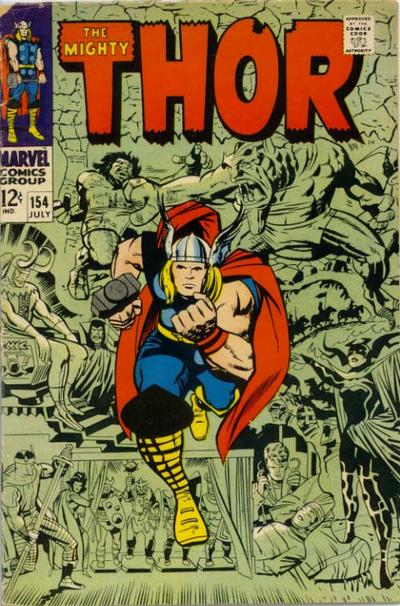
Thor 154 cover

An important thing to remember about Kirby is that he was not an illustrator but a cartoonist—meaning an artist who developed stories and characters through the act of drawing. It was Kirby’s narrative drawing that made Marvel Comics work: he was Marvel’s busiest cartoonist, and its visual guide. He gave Marvel its momentum. He dreamed up and designed more concepts for the company than any other artist. Besides the comics that Kirby penciled himself—which he typically plotted, in effect co-wrote—he also laid out and plotted stories for many other artists, guiding and inspiring them. Most of Marvel’s other artists were urged to follow his lead.

In a great, mad rush between 1961 and the mid-decade, Kirby laid the foundations of what we now call the Marvel Universe. His drive and design chops provided most of the raw material for this new world. And now, half a century later—about 53 years after the launch of The Fantastic Four, about 51 after the launch of The Avengers—Marvel Entertainment is reaping the spectacular harvest of that effort. Graphically and conceptually, the foundation of Marvel’s success (in comics and movies) was laid in the basement of the Kirby family’s Long Island home between 1961 and 1966; yet, incredibly, during that period, in fact throughout the 60s, Kirby was only a freelancer for Marvel. During all the time he designed so many properties and spun so many stories for Marvel, he didn’t have a solid contract there. He didn’t have a contract at all.

The gap between what Kirby gave Marvel and what he got in return was enormous. He produced all these wild new concepts for a flat page rate; he had no salary, no security, no benefits, no assurances of long-term well-being. He just drew, drew, and drew, dreaming up new characters and ideas for Marvel several times a month for years on end. He worked unbelievably hard. When Marvel was sold to a new owner in 1968, Kirby sought a fair contract with the company that would take care of his family, but couldn’t get one. The new owners put faith in Stan Lee’s editorial savvy but did not understand Kirby’s vital role.

Of course Kirby got angry and angrier, and lost heart; he began to resent how much he’d given to the company with such slight return. He began to offer Marvel less and less, in terms of new ideas. After all, he couldn’t continue to work himself to the bone for such meager reward; the workload was draining, the situation maddening. So he left, hoping for greater recognition and editorial freedom elsewhere. He left to create the bizarre and visionary Fourth World and other comics for DC in the early 70s, where his imagination once again took flight and fans were able to see less diluted Kirby comics, comics “edited, written, and drawn” by Jack.

New_Gods_Vol_1_1_001

There’s nothing in the annals of so-called work-for-hire that can compare with Kirby’s run at Marvel in the 1960s—or for the richness of Kirby’s barnstorming second act. There’s nothing about comic book business-as-usual that can account for that miraculous outpouring. “Work-for-hire” does not begin to describe the indispensable, seminal, endlessly inspiring contribution that Kirby made to Marvel. Jack Kirby was the co-author of the Marvel Universe, and ought to be officially recognized as such. Further, Marvel Entertainment ought to establish a healthy relationship with Kirby’s estate by compensating his family and contributing to the study and appreciation of Kirby’s work. ’Nuff said!