Category Archives: Heroes and Humanity

Kirby @ 108

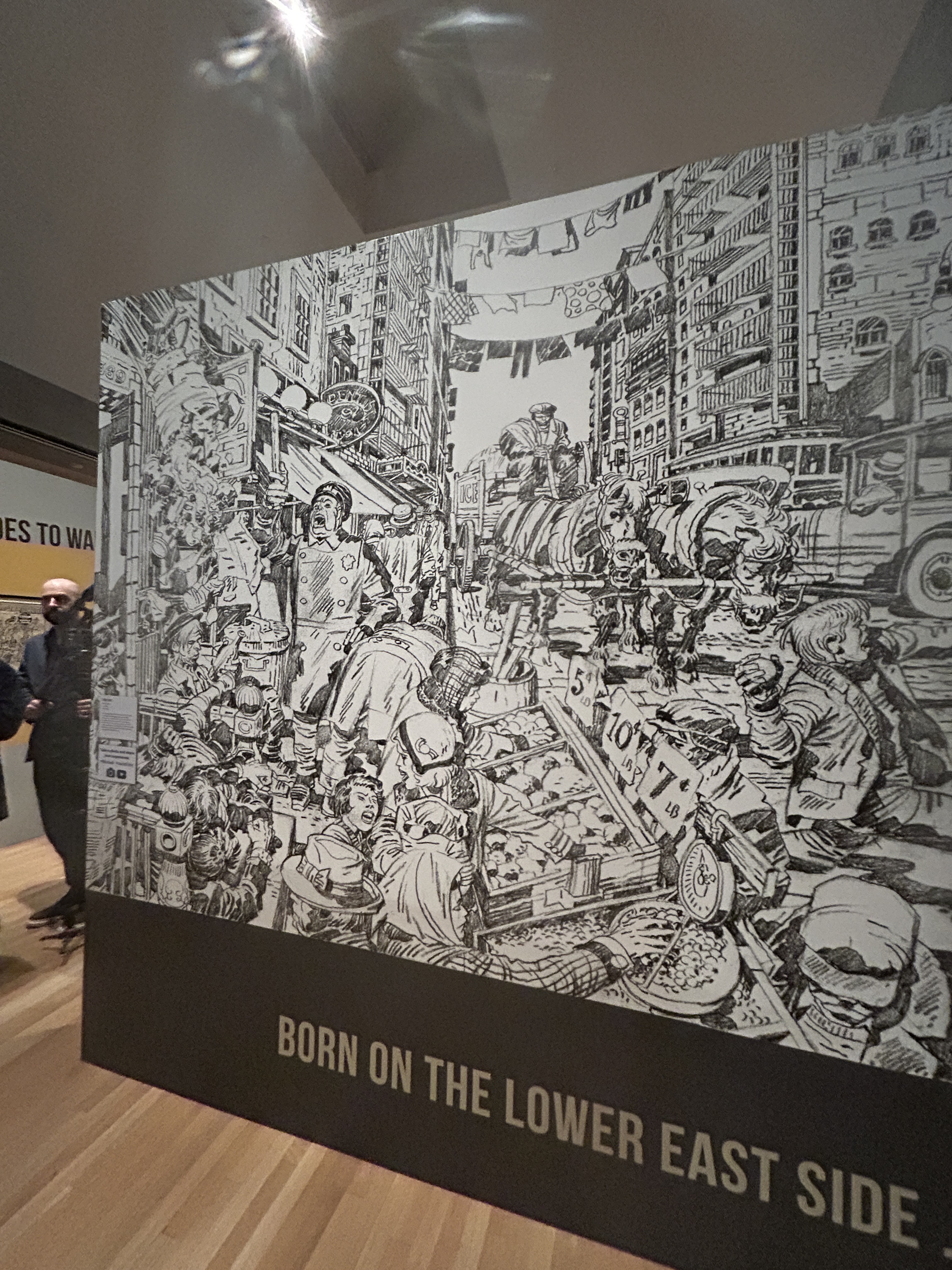
From Street Code, by Jack Kirby (1983). © Estate of Jack Kirby.

Jack Kirby (b. Jacob Kurtzberg, 1917-1994) would be 108 years old today.

Born and raised on New York’s Lower East Side, Jacob, or Jakie, or (later) Jack or Kirby, would live through poverty, eke out a living by writing and drawing, lift himself and his family into a precarious middle-class existence, one he always had to fight for, and, over time, reshape US comic books (and pop culture generally) with his profuse, unstinting, freewheeling imagination. Next to my brother Scott, Kirby has probably influenced my reading and writing life, hence my whole outlook, more than any other creator. I’ve had, and I have, other go-to artists and cultural heroes, but Kirby hit me early on, heavily, seriously, knocking me sideways in the best way. I keep trying to write my way to a better understanding of why Kirby, basically, set me afire, but, well, it’s an ongoing effort. Of course.

My introductory comics studies course at CSU Northridge, Comics & Graphic Novels (a bad name, and I’m to blame for it), is focusing on Kirby this semester. That’s a focus my classes haven’t had since 2015. Why again now? Mainly because of the Skirball’s splendid exhibition, Jack Kirby: Heroes and Humanity, which I’ve written about here before and which my students are required to visit. That exhibit, curated by Patrick Reed and Ben Saunders, is open until March 1 next year, and I’m determined to take classes to it. When you’ve got that kind of resource in town, that big and historic a show, not using would be a terrible waste. So, we’re going there, and that means I’ve had to redesign my course yet again! Glad to do it.

For a few years now, I’ve taught Comics & Graphic Novels as a frankly presentist course focusing on currently popular genres in US comics publishing: graphic novels, graphic memoirs, webcomics (increasingly, webtoons), and translated manga, often alongside a token direct-market comic book serial and some minicomix that I loan out. While reading in those genres, we study comics form and also do some experiments in cartooning, culminating in, usually, a final, comics-making creative project. In the past, oh, seven to eight years the number of required books in the course has dropped from a half dozen or more to, sometimes, just three, maybe four. I’ve developed a habit of teaching about key genres in terms of recent examples, while backfilling a bit with lecture to acknowledge certain canonical heavyweights (so, for example, Thi Bui’s The Best We Could Do became a way to talk about Green, Spiegelman, Bechdel, and the autographics tradition). Along the way, lectures about history have actually become fewer, though more targeted.

But now, it’s back to Kirby again, with a vengeance, and therefore back to history. It’s odd but true to say that, despite my love of Kirby, he hasn’t played a very obvious role in my teaching life, maybe because the one class on comics that I get to teach regularly is taxed with covering a lot of things. I mean, I taught an X-Men course this past spring, and of course Kirby figured there, hugely, at the outset, but that wasn’t an auteurist course. And sometimes I teach a whole semester without talking about Kirby much.

The question that the Heroes and Humanity show posed to me was, is, How do I reconcile my usual present-day focus with this grand opportunity to teach Kirby, and through him, comic book history?

So here’s what we’re doing, or what I expect we’ll be doing, over the next roughly fifteen to sixteen weeks:

We started two days ago with some drawing and icebreaking exercises, a few introductory words about that most recalcitrant of subjects, comics (what the hell are they, anyway?), and a very brief intro to Kirby.

Today, Kirby’s birthday, my students will share their homework, that is, their versions of Kirby’s two-page comic, “Hot Box” (Foxhole #2, 1954), which I gave to them sans text and asked them to fill in with their own words. This will lead to some discussion of text anchoring image (in Roland Barthes’ sense) and the multimodal nature of comic art. I also hope we have time to read “Meet Captain America” (Captain America Comics #1, March 1941). Next week we’ll be reading Kirby’s 1968 recreation of Cap’s origin story, “The Hero That Was” (Captain America #109, Dec. 1968). We’ll also be reading Kirby’s beautiful, haunting “Street Code” (created in 1983, published in 1990 in Argosy #2).

Over the next five weeks or so, we’ll read wartime and postwar Simon & Kirby, including some kid gang and romance classics, dive into Tom Scioli’s graphic biography of Kirby, talk about the early history of comic books in general, right up to the 1950s anti-comics eruption and industry implosion, and get ready to absorb the Skirball show.

After we see the show, we’ll get to the Marvel Sixties, covered very selectively over two to three weeks (with, for example, Ben Saunders’ splendid Fantastic Four volume in the Penguin Classics series), and then we’ll spend a couple of weeks talking about the Fourth World, Kirby’s bold 1970s experiment and, from my POV, the peak of his work in serial comic books. Around that time, students will probably be working on their Visual Analyses: side-by-side studies of pages from Kirby comics and other comics of their choosing.

In the back half of the term, in roughly the last six weeks, we’ll read some contemporary artists who take Kirby’s influence in unexpected, independent directions. Only one of our readings will actually be a corporate franchise comic, Ngozi Ukazu’s intriguing take on Kirby’s Barda (DC). Others will include work by Hugo Canuto (Tales of the Orishas), Charles Glaubitz (Starseeds, and more), and Lale Westvind (Grip). I’m determined not to focus on DC and Marvel IP at the expense of other themes. By the end of term, students will be crafting Final Projects: either research projects based on works encountered at the Skirball, or comics projects reflecting on their entire experience in the course.

This is all an experiment, of course: a way of connecting the dots between the comic books of Kirby’s multiple eras and comics of today. I’m excited to see how it plays out!

It’s fitting that Jack Kirby has given me new ways to converse with my students. Happy Birthday and unending thanks to the artist whose influence ushered me into the work I do and who continues to delight, enthrall, confound, and transport.

PS. The Kirby Museum is once again hosting a walking tour of Kirby’s Lower East Side, this very day. This is a great way to think about the roots of Kirby, and where so much of our comics iconography and pop culture have come from. Check it out: 6:30 pm Eastern on the SE corner of Essex and Delancey, and then ending up at the original location of the Boys Brotherhood Republic, 90 East 3rd St. Would that I could be there in person. ❤

Tagged , ,

Heroes and Humanity: first impressions

Photo by Christina Champlin for WeLikeLA.com.

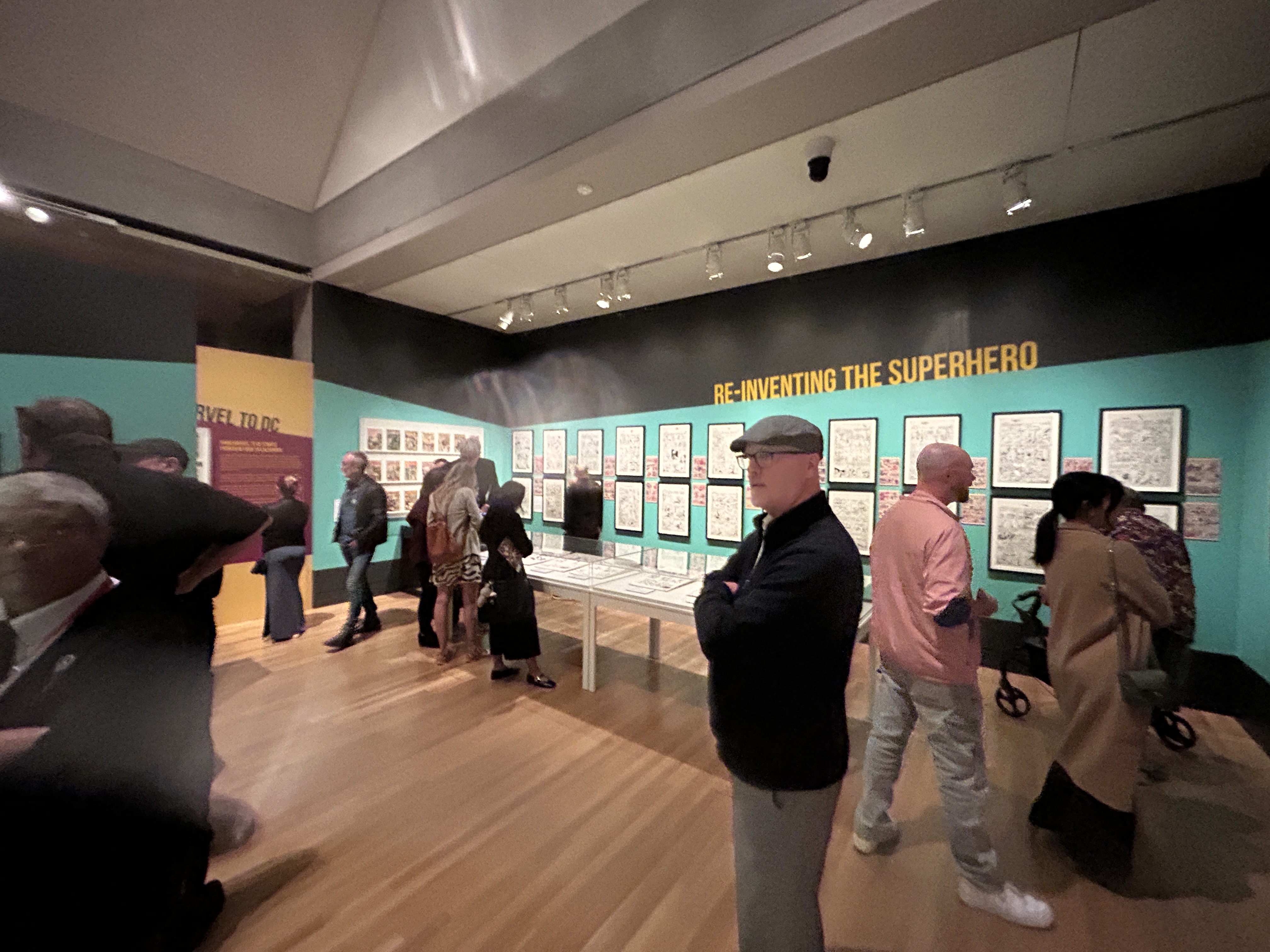
Today, May 1, the Skirball Cultural Center officially opens its career-spanning Jack Kirby exhibition, Heroes and Humanity (on view through March 1, 2026). Last night, the Skirball launched Heroes and Humanity (and its other brand-new exhibition, Away in the Catskills) with a reception and preview for members and supporters. This preview was well attended to the point of congestion: the museum’s courtyard was thronged, and jostling crowds packed the galleries. My wife and my daughter and I were there. So were a great many colleagues, friends, and acquaintances, some I hadn’t seen since the CSUN Kirby show almost ten years ago. In fact, the crowd was a Who’s Who of Kirby collectors and historians. Members of the Kirby family were there too (I spoke briefly to Kirby’s granddaughter Jillian, as well as, to my surprise, Joe Simon’s grandson Jesse). At the night’s end, the Skirball’s staff could hardly get the Kirby crowd out of the museum; as we drove away, the front steps were still teeming with people.

To call the reception a success would be an understatement.

Navigating Heroes and Humanity took me the better part of two hours. This is partly because I kept running into friends, former students, former lenders, and others to whom I desperately wanted to talk (readers of this blog will likely know of Jack Kirby Collector publisher-editor John Morrow and Kirby Museum stalwarts Rand Hoppe, Tom Kraft, and Mike Cecchini — that’s just the iceberg’s tip). Plus there was, again, the crowd, eager, voluble, and large. But beyond that, there was so much to look at and take in. Honestly, I couldn’t get close to every bit of exhibitry, every wall, installation, case, or monitor, and I didn’t try. I knew I’d be coming back (I will be going back) repeatedly. At times, I’d look closely at a work or a wall and rhapsodize about it to anyone who would hear (pretend docent syndrome). At other times, I’d just skirt around. I took no photos for my first hour in the gallery, but waited for the crowd to thin slightly before I rewound, restarted, and snapped some pix. I need to get better shots.

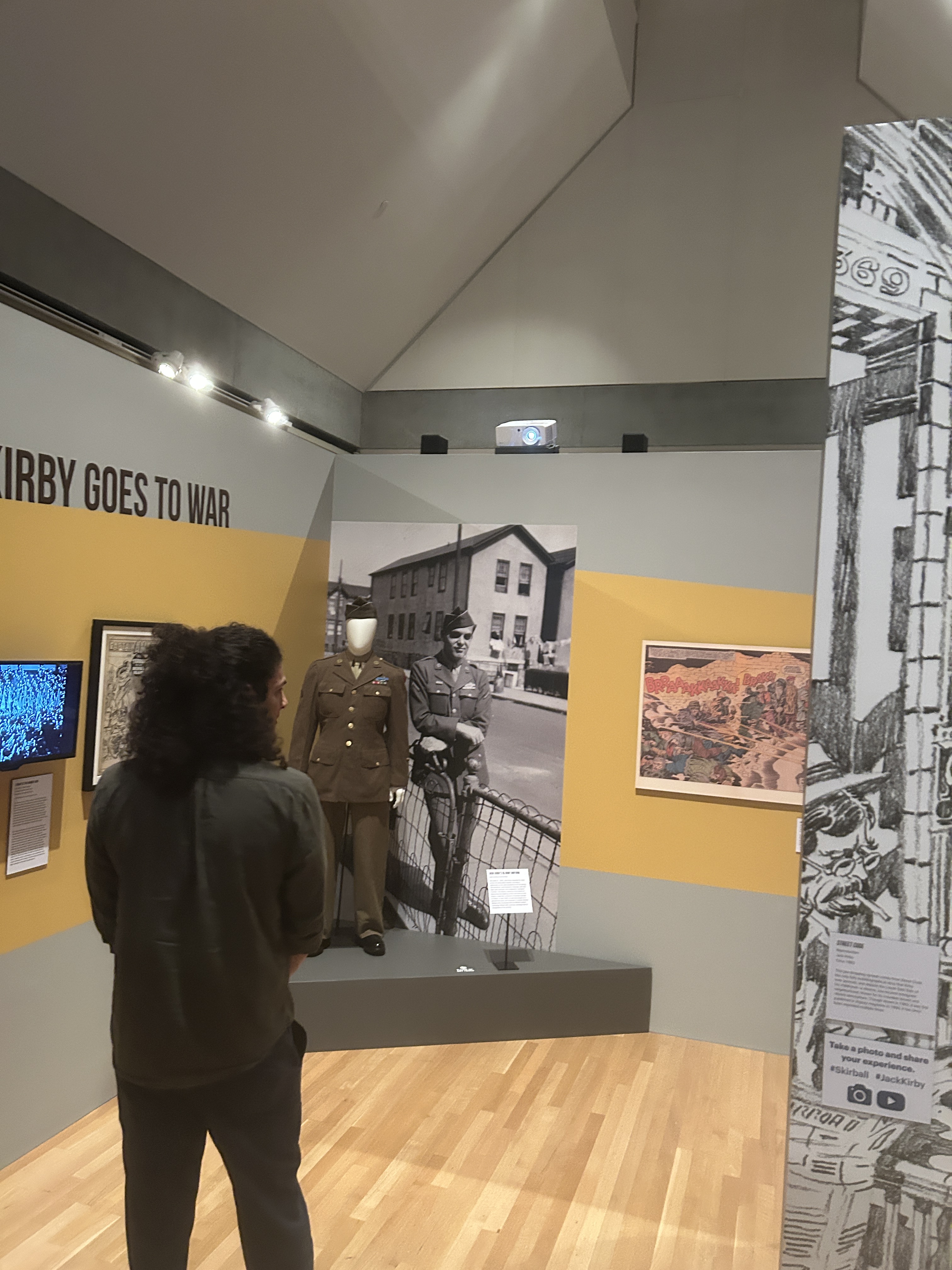
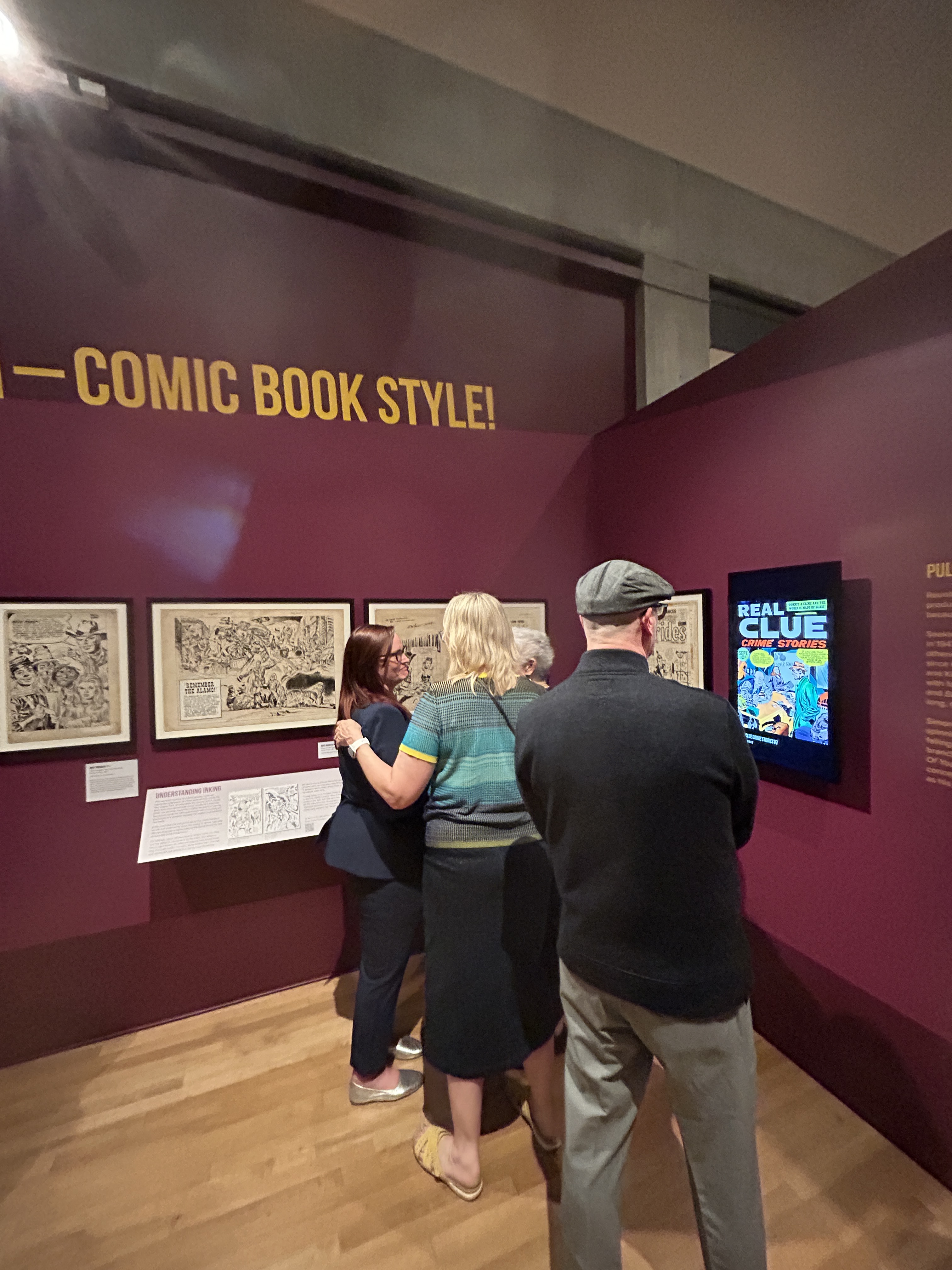
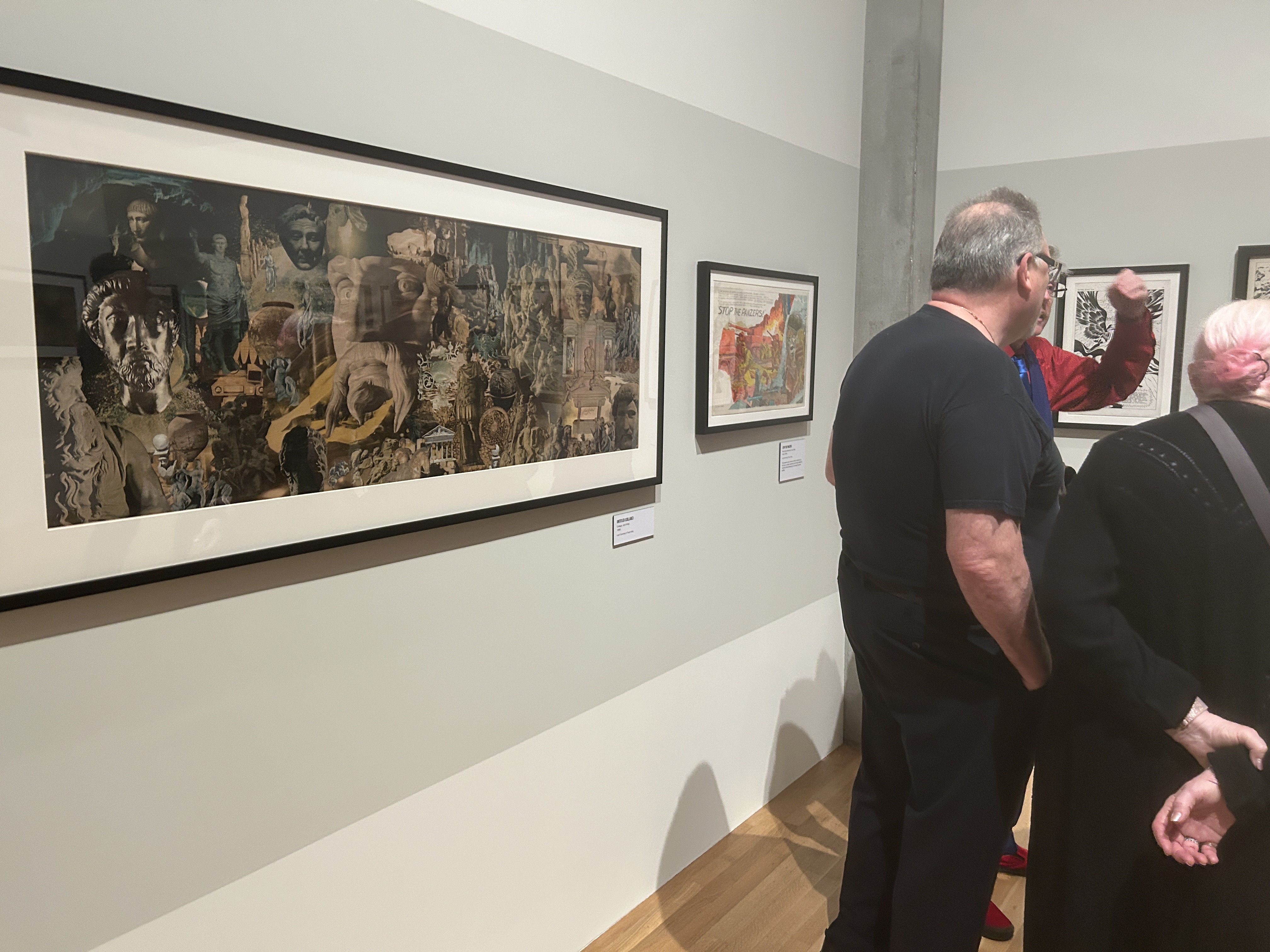
My photos (most taken just before closing time) underplay the size of the crowd:

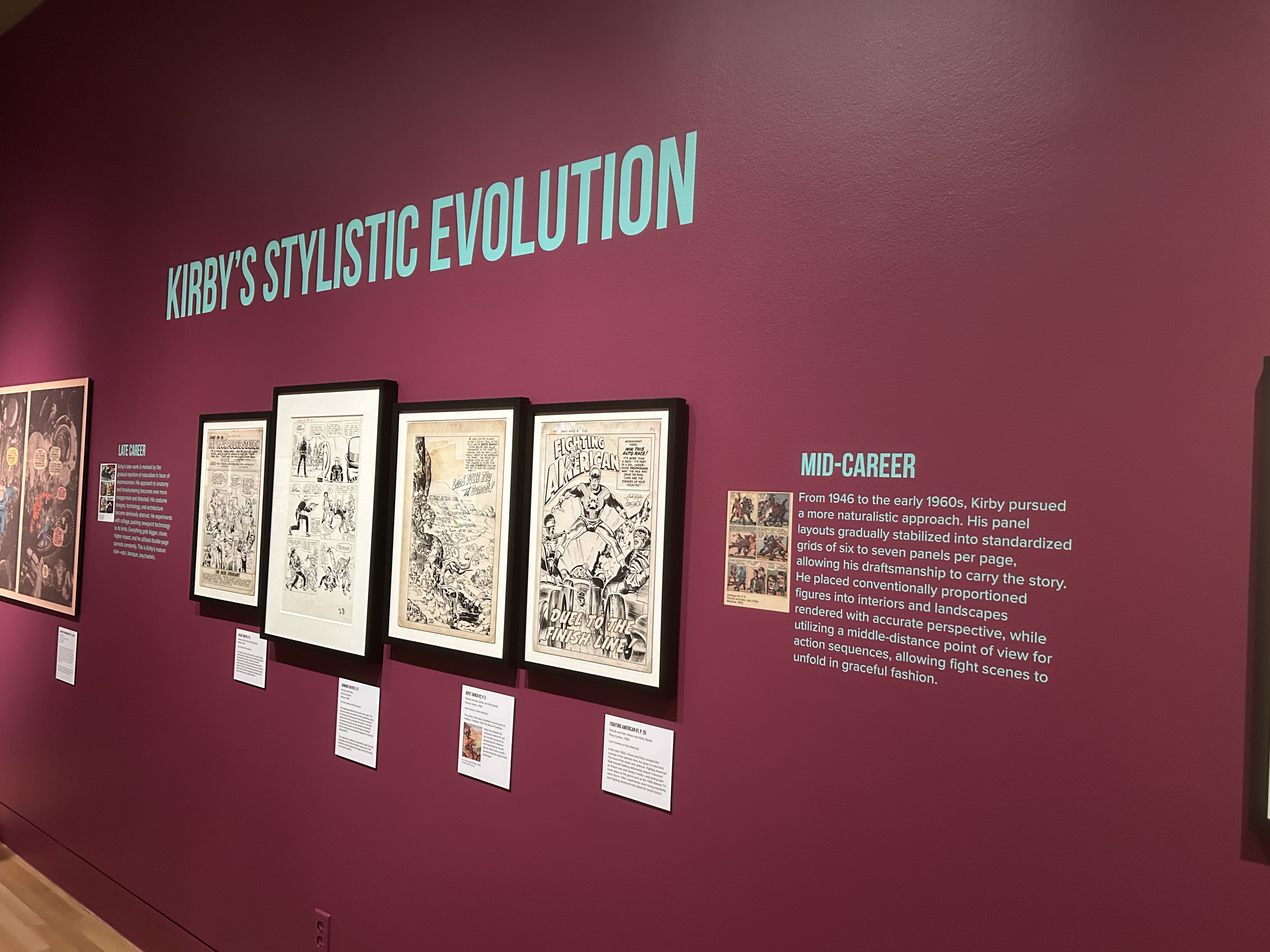
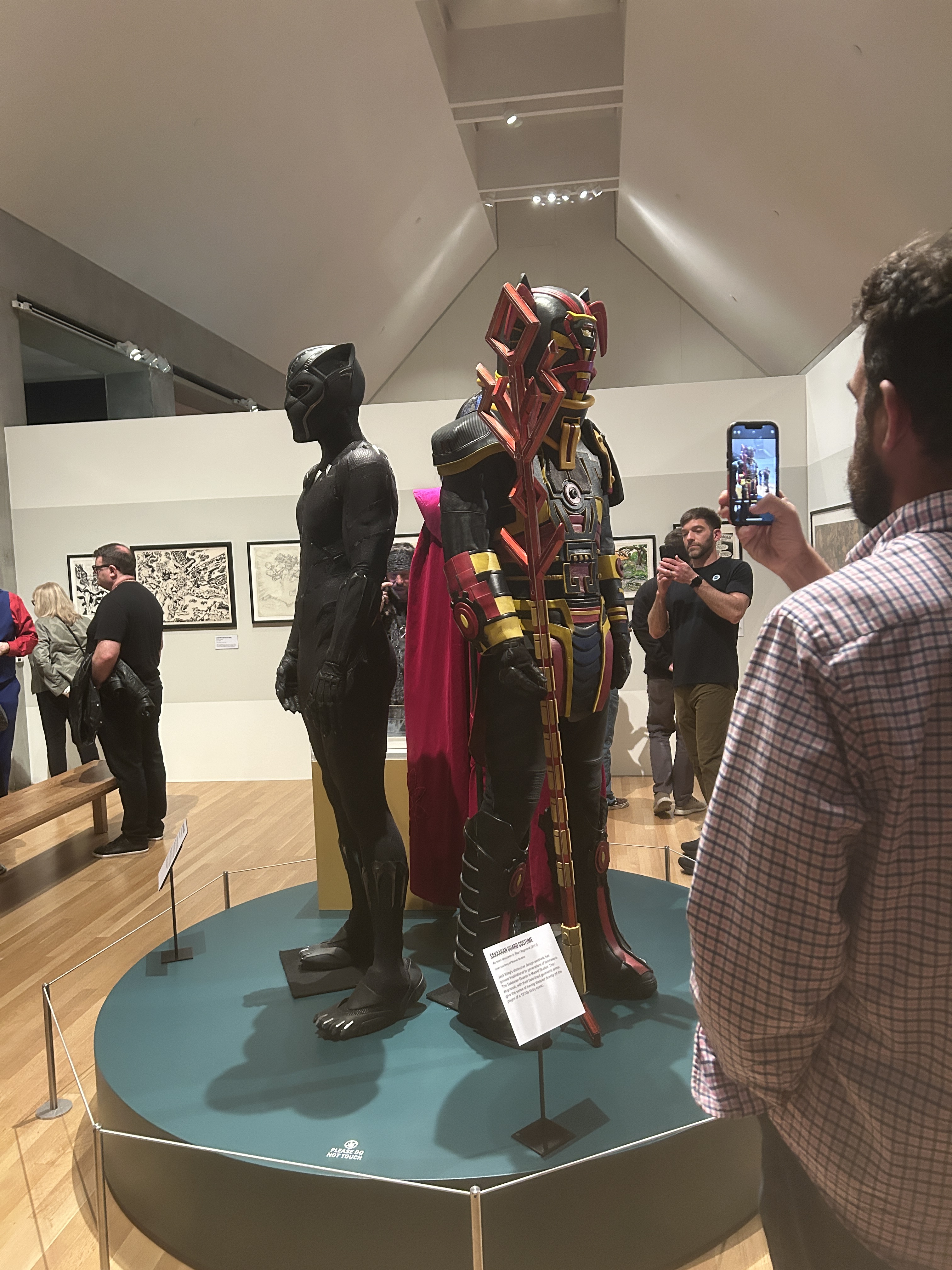
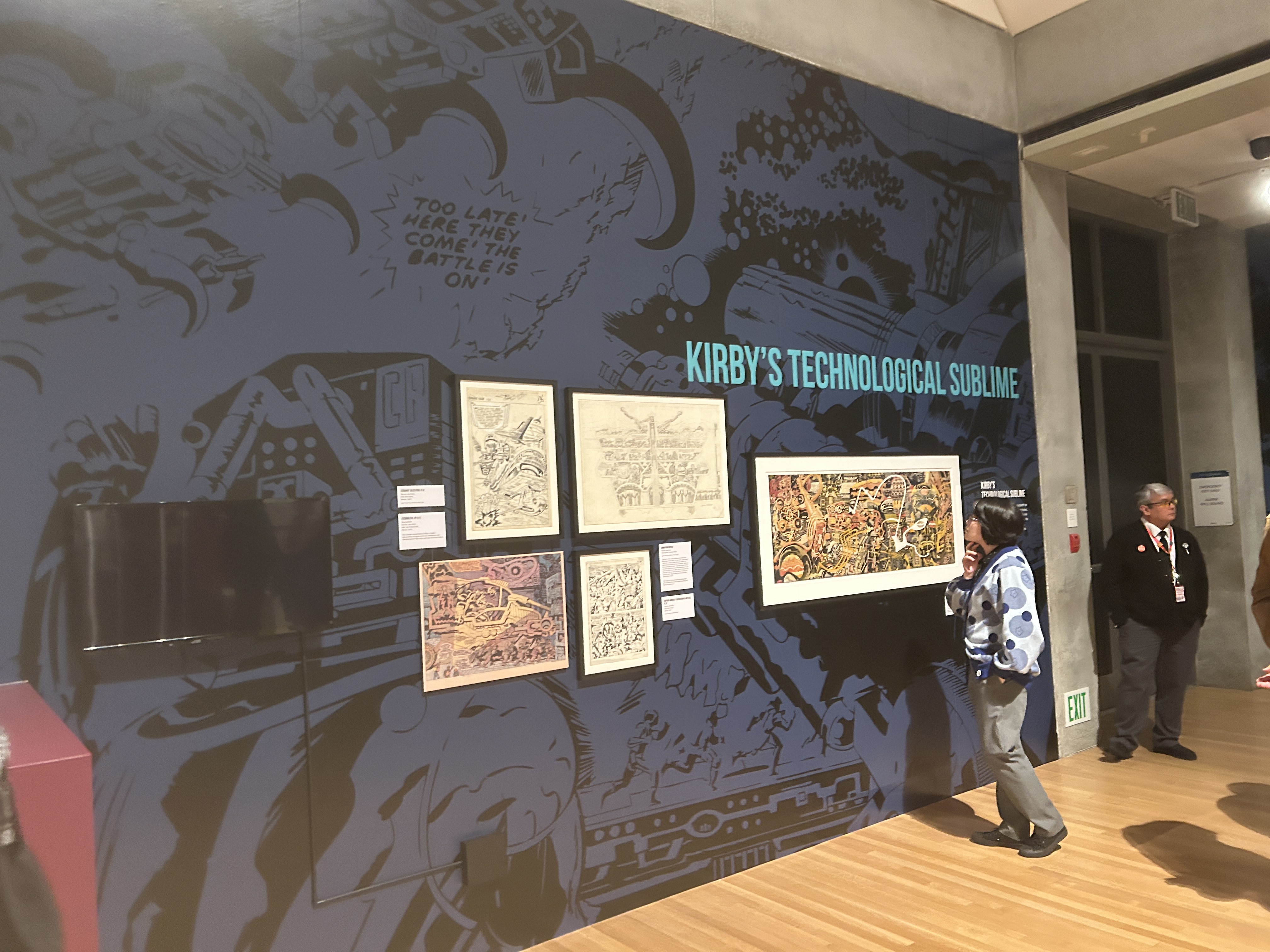
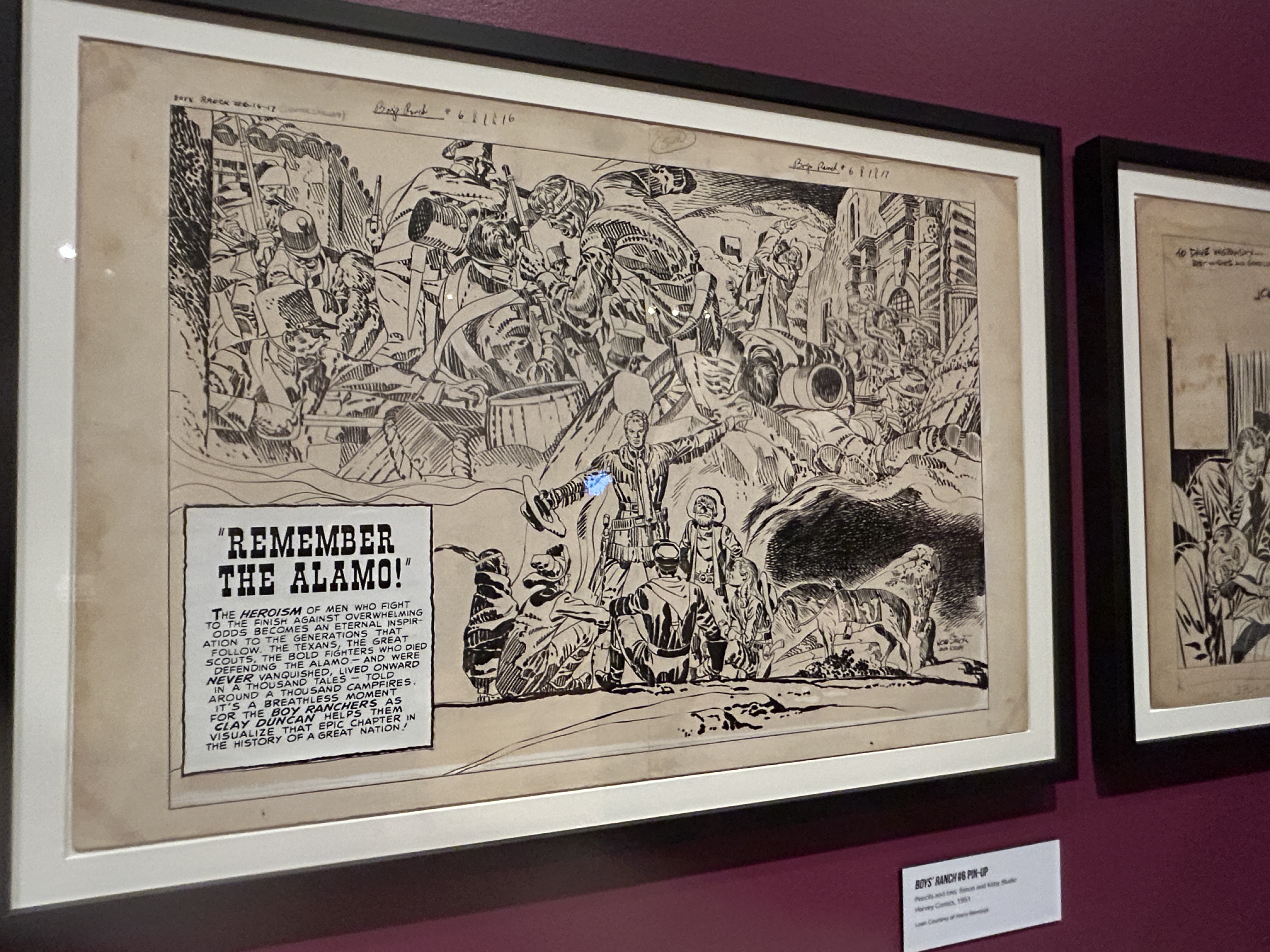
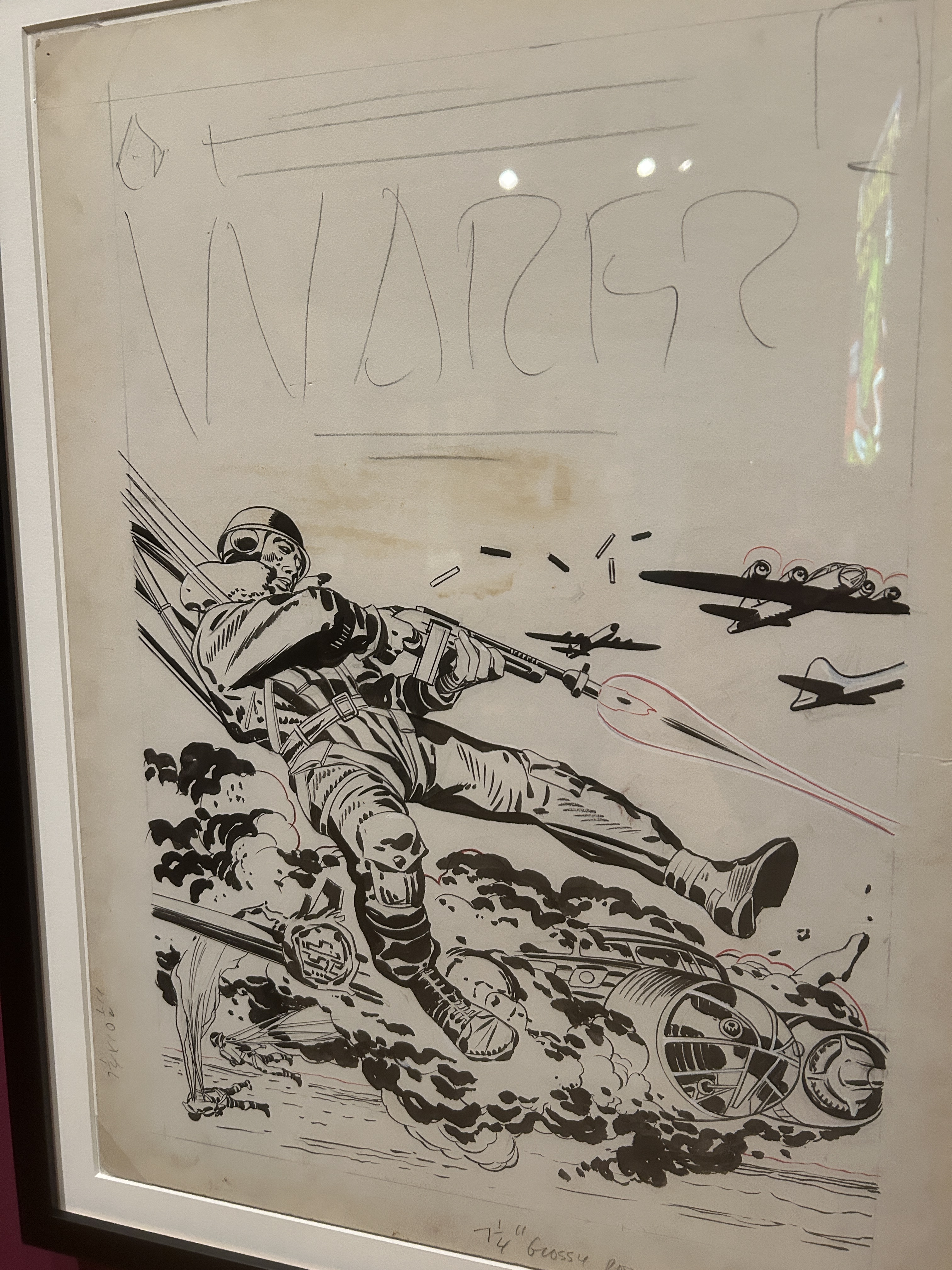
I will have to return to the exhibition to spend more time with favorite elements. Here are a few works that had me goggling or verklempt:

I can’t pretend to be objective about this show, and my memories of last night are a blur; again, I’ll need to return and take it all in again, at my leisure. Writing a full review may be beyond me, as I’m somewhat compromised: co-curators Ben Saunders and Patrick Reed are friends, and I know that this has been a passion project for them just as 2015’s Comic Book Apocalypse was for me. But here are a few impressions:

  • This show is properly Kirby-focused, that is, art-focused, not character, property, or brand-focused. There are nods to Kirby’s influence and the spread of his designs beyond his drawing board, and of course the show has a lot to say about Marvel, but it’s Kirby as artist, storyteller, worldbuilder, and visionary that towers over it all.
  • The comic art on view unsurprisingly leans toward the latter half of Kirby’s career, given the sheer spectacle of his late work and the greater availability of originals after 1960. However, this is a true career-spanning effort, unlike Comic Book Apocalypse‘s narrower, late Sixties to mid-Seventies take. I loved seeing a fair amount of Simon & Kirby work on the walls.
  • That said, I would have liked (I would always like) to see more of Kirby’s kid gang work of the early Forties, including the semi-autobiographical Newsboy Legion and millions-selling Boy Commandos. I think those comics are an underrated, very important part of Kirby’s output, and say a lot about him.
  • I would also have liked to see more romance work — the great underserved area in Kirby studies, frankly. This show does acknowledge romance, with multiple examples, but I’d have liked to see more, perhaps a whole installation. I don’t know how much of the peak-period romance art (late Forties to early Fifties) has survived, and I know that most of it lacks the spectacular, wall-sized oomph of late-career Kirby, but man, that part of the story does warrant spotlighting.
  • The selection on unpublished, personal work by Kirby knocked me right out. Beautiful, widescreen collages, the stunning drawing of Jacob wrestling the angel (scripture as SF, or vice versa), an explosively colored drawing of warfare: eye-boggling, revelatory work. I got to see a few pieces I’ve never seen before, even in reproduction.
  • The exhibition was sharply designed and beautifully mounted, though perhaps too dense for easy absorption. That doesn’t bother me (as I said to my wife Mich, I lose all objectivity when I’m looking at stuff I love — give me excess of it), but wow, were those spaces packed! More for me to enjoy on the return trips, I’m thinking.

In sum: go! If you love or are curious about the history of the American comic book, if you want to know how a once-moribund genre, the superhero, bounced back and became something different, if you are curious about the design roots of the Marvel Cinematic Universe, if you just love narrative drawing, if you want to have the top of your head blown off with sheer visual pleasure (as mine was at about age ten, and has been over and over throughout my life), then GO.

One of my last pix of the night: the leaders of the curatorial team:

(L-R) Co-curator Ben Saunders, Skirball Museum Deputy Director Michele Urton, co-curator Patrick A. Reed, and consultant and curatorial collaborator Rachel Pinnelas. Thanks, folks.
Tagged , , , , , , ,

Heroes and Humanity at the Skirball!

This Thursday, May 1, the Skirball Cultural Center here in Los Angeles opens its exhibition Jack Kirby: Heroes and Humanity, co-curated by Patrick Reed and Ben Saunders in collaboration with Michele Urton, the Skirball’s Museum Deputy Director. This exhibition, the first career-spanning Kirby show in an American museum,

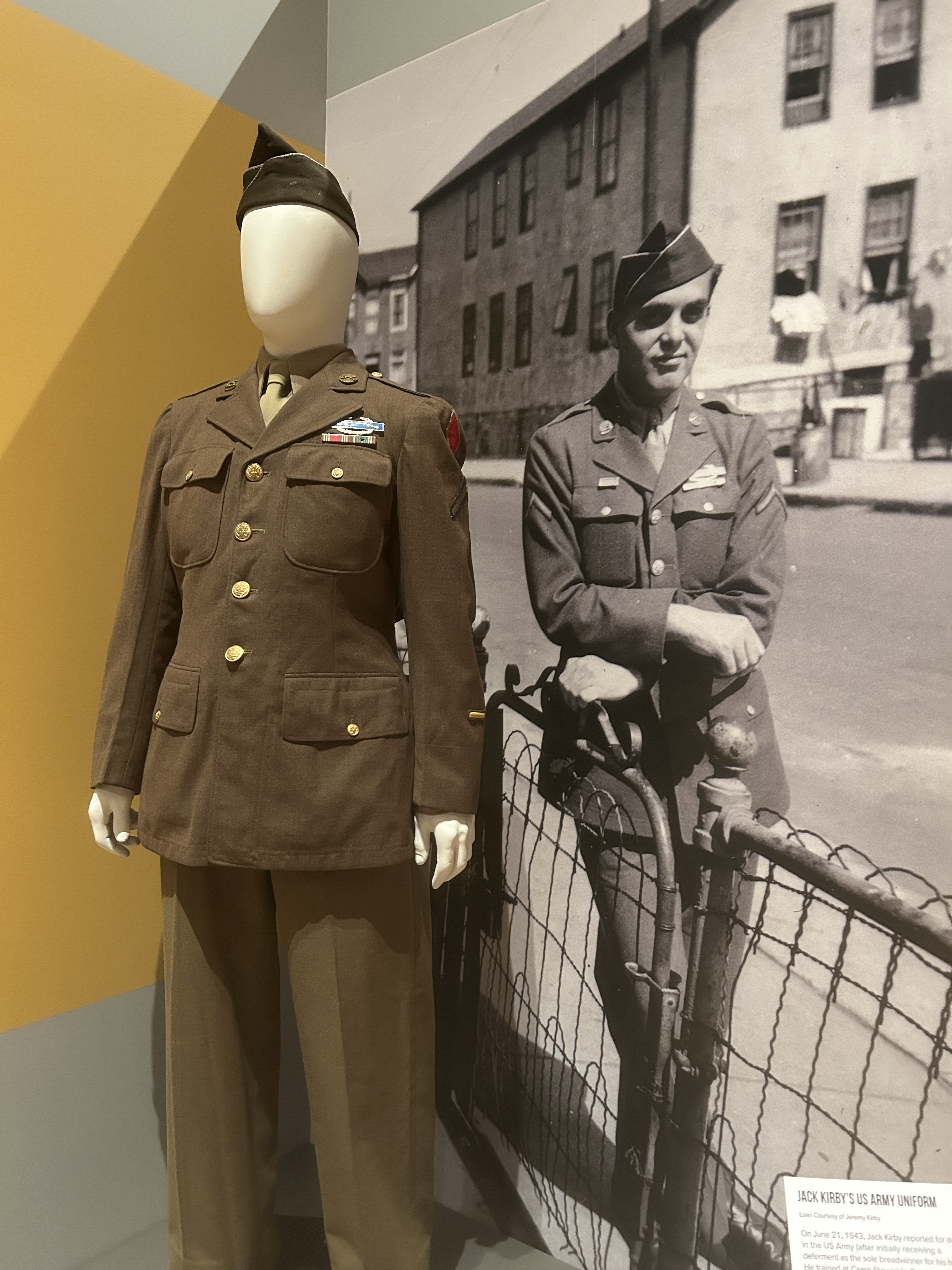
The show, which runs through March 1, 2026, promises a mix of “rare original comic book artwork and print comics, fine art, and commercial work,” including many pieces never before exhibited. For example, the complete original art for X-Men #7 (Sept. 1964) will be shown. In all, the show incorporates more than 150 objects, including personal artifacts such as Jack Kirby’s US Army uniform and “ephemera that illustrate his life [and] inspirations.” Docent-led tours will begin on May 29. On the night of Wednesday, April 30, just before the show’s public opening, the Skirball offers a member’s preview event that includes a reception and an early look at the exhibition. I will be there!

(Scan the QR code to visit the exhibition’s webpage.)

I’ve known of this project for some time, and recently, at WonderCon 2025, my wife Mich and I were able to take in a panel moderated by Patrick Reed, “Comic Culture in Museums: The World of Pop Media Exhibitions,” that offered a sneak peek (Sunday, March 30). During that panel, Reed announced that Heroes and Humanity is the first of three substantial exhibitions about comics that the Skirball will be showing over roughly the next three years. Joining Reed on the panel were Rachel Pinnelas, comics writer and editor as well as consultant and co-curator on the Skirball projects; Xaviera Flores, librarian and archivist at UCLA’s Chicano Studies Research Center; and Rita Vandergaw, executive director of the Comic-Con Museum. All three discussed their experiences working on pop culture-related exhibitions, and the challenges and joys of crafting exhibitry rooted in comics and zines. It’s exciting to know that the Skirball is going for comics in such a big way!

The Skirball will present various programming events tied into these comics exhibitions, starting with Comics, Cultures, and Communities: The Jewish World in Graphic Novels, a six-week course (May 4-June 15) led by Dr. David Greenfield focusing on graphic books by such artists as Rutu Modan, Joann Sfar, and Joe Kubert.

Having curated the Kirby exhibition Comic Book Apocalypse in 2015, I’m of course keenly interested in all this! Patrick Reed and Ben Saunders, colleagues and friends of mine, have had ample experience creating comics and pop culture exhibitions both individually and together. In fact, Ben and I worked closely together on Comic Book Apocalypse, and co-edited its companion book. Ben significantly shaped that show. I’ve been in awe of his curatorial work; in 2018, I reviewed here a show that he spearheaded, the traveling Marvel: Universe of Super Heroes, and I’ve seen several of his other exhibitions too (check out this stunner for instance). In addition, I’ve seen Patrick and Ben’s jointly curated Spider-Man: Beyond Amazing, which opened at the Comic-Con Museum in 2022 and has since traveled. So, I can’t speak disinterestedly about these things — but, FWIW, I think their record is stellar. Further, the Skirball is a wonderful venue with a history of creating or hosting exhibitions that I’ve loved, so I’m stoked. I hope to take several groups of students to Heroes and Humanities over the next ten months.

Tagged , , , ,