Category Archives: Kirby in Academia

Kirby @ 108

From Street Code, by Jack Kirby (1983). © Estate of Jack Kirby.

Jack Kirby (b. Jacob Kurtzberg, 1917-1994) would be 108 years old today.

Born and raised on New York’s Lower East Side, Jacob, or Jakie, or (later) Jack or Kirby, would live through poverty, eke out a living by writing and drawing, lift himself and his family into a precarious middle-class existence, one he always had to fight for, and, over time, reshape US comic books (and pop culture generally) with his profuse, unstinting, freewheeling imagination. Next to my brother Scott, Kirby has probably influenced my reading and writing life, hence my whole outlook, more than any other creator. I’ve had, and I have, other go-to artists and cultural heroes, but Kirby hit me early on, heavily, seriously, knocking me sideways in the best way. I keep trying to write my way to a better understanding of why Kirby, basically, set me afire, but, well, it’s an ongoing effort. Of course.

My introductory comics studies course at CSU Northridge, Comics & Graphic Novels (a bad name, and I’m to blame for it), is focusing on Kirby this semester. That’s a focus my classes haven’t had since 2015. Why again now? Mainly because of the Skirball’s splendid exhibition, Jack Kirby: Heroes and Humanity, which I’ve written about here before and which my students are required to visit. That exhibit, curated by Patrick Reed and Ben Saunders, is open until March 1 next year, and I’m determined to take classes to it. When you’ve got that kind of resource in town, that big and historic a show, not using would be a terrible waste. So, we’re going there, and that means I’ve had to redesign my course yet again! Glad to do it.

For a few years now, I’ve taught Comics & Graphic Novels as a frankly presentist course focusing on currently popular genres in US comics publishing: graphic novels, graphic memoirs, webcomics (increasingly, webtoons), and translated manga, often alongside a token direct-market comic book serial and some minicomix that I loan out. While reading in those genres, we study comics form and also do some experiments in cartooning, culminating in, usually, a final, comics-making creative project. In the past, oh, seven to eight years the number of required books in the course has dropped from a half dozen or more to, sometimes, just three, maybe four. I’ve developed a habit of teaching about key genres in terms of recent examples, while backfilling a bit with lecture to acknowledge certain canonical heavyweights (so, for example, Thi Bui’s The Best We Could Do became a way to talk about Green, Spiegelman, Bechdel, and the autographics tradition). Along the way, lectures about history have actually become fewer, though more targeted.

But now, it’s back to Kirby again, with a vengeance, and therefore back to history. It’s odd but true to say that, despite my love of Kirby, he hasn’t played a very obvious role in my teaching life, maybe because the one class on comics that I get to teach regularly is taxed with covering a lot of things. I mean, I taught an X-Men course this past spring, and of course Kirby figured there, hugely, at the outset, but that wasn’t an auteurist course. And sometimes I teach a whole semester without talking about Kirby much.

The question that the Heroes and Humanity show posed to me was, is, How do I reconcile my usual present-day focus with this grand opportunity to teach Kirby, and through him, comic book history?

So here’s what we’re doing, or what I expect we’ll be doing, over the next roughly fifteen to sixteen weeks:

We started two days ago with some drawing and icebreaking exercises, a few introductory words about that most recalcitrant of subjects, comics (what the hell are they, anyway?), and a very brief intro to Kirby.

Today, Kirby’s birthday, my students will share their homework, that is, their versions of Kirby’s two-page comic, “Hot Box” (Foxhole #2, 1954), which I gave to them sans text and asked them to fill in with their own words. This will lead to some discussion of text anchoring image (in Roland Barthes’ sense) and the multimodal nature of comic art. I also hope we have time to read “Meet Captain America” (Captain America Comics #1, March 1941). Next week we’ll be reading Kirby’s 1968 recreation of Cap’s origin story, “The Hero That Was” (Captain America #109, Dec. 1968). We’ll also be reading Kirby’s beautiful, haunting “Street Code” (created in 1983, published in 1990 in Argosy #2).

Over the next five weeks or so, we’ll read wartime and postwar Simon & Kirby, including some kid gang and romance classics, dive into Tom Scioli’s graphic biography of Kirby, talk about the early history of comic books in general, right up to the 1950s anti-comics eruption and industry implosion, and get ready to absorb the Skirball show.

After we see the show, we’ll get to the Marvel Sixties, covered very selectively over two to three weeks (with, for example, Ben Saunders’ splendid Fantastic Four volume in the Penguin Classics series), and then we’ll spend a couple of weeks talking about the Fourth World, Kirby’s bold 1970s experiment and, from my POV, the peak of his work in serial comic books. Around that time, students will probably be working on their Visual Analyses: side-by-side studies of pages from Kirby comics and other comics of their choosing.

In the back half of the term, in roughly the last six weeks, we’ll read some contemporary artists who take Kirby’s influence in unexpected, independent directions. Only one of our readings will actually be a corporate franchise comic, Ngozi Ukazu’s intriguing take on Kirby’s Barda (DC). Others will include work by Hugo Canuto (Tales of the Orishas), Charles Glaubitz (Starseeds, and more), and Lale Westvind (Grip). I’m determined not to focus on DC and Marvel IP at the expense of other themes. By the end of term, students will be crafting Final Projects: either research projects based on works encountered at the Skirball, or comics projects reflecting on their entire experience in the course.

This is all an experiment, of course: a way of connecting the dots between the comic books of Kirby’s multiple eras and comics of today. I’m excited to see how it plays out!

It’s fitting that Jack Kirby has given me new ways to converse with my students. Happy Birthday and unending thanks to the artist whose influence ushered me into the work I do and who continues to delight, enthrall, confound, and transport.

PS. The Kirby Museum is once again hosting a walking tour of Kirby’s Lower East Side, this very day. This is a great way to think about the roots of Kirby, and where so much of our comics iconography and pop culture have come from. Check it out: 6:30 pm Eastern on the SE corner of Essex and Delancey, and then ending up at the original location of the Boys Brotherhood Republic, 90 East 3rd St. Would that I could be there in person. ❤

Tagged , ,

The Comics of Jack Kirby: Call for Papers

Announcing a brand-new scholarly book project!

The Comics of Jack Kirby: Critical Perspectives on a Legendary Artist

Edited by Craig Fischer, Charles Hatfield, and Susan Kirtley

Under contract to be published in the University Press of Mississippi’s series Critical Approaches to Comics Artists, edited by David M. Ball

CALL FOR PROPOSALS

More than a quarter-century after his death, Jack Kirby (1917-1994) remains one of the most talked-about creators in the annals of the American comic book. Best known as the archetypal superhero artist and visual architect of the Marvel Universe, Kirby in fact went much further, creating diverse other comic books for many publishers as well as working in animation and comic strips and on sundry projects. An imaginative dynamo, he set a standard for the whole comic book industry. By now, Kirby studies is a thriving fan phenomenon: the source of unending books, articles, and commentary across social media. Despite this, Kirby has received little academic attention. This interdisciplinary collection of essays seeks to change that, and to expand the discussion of Kirby’s work beyond the familiar pathways of biography and homage.

Recent work in comics studies has questioned what gets valued in academia, and why. Inspired by that trend, this project aims to give Kirby’s work the critical study it so richly warrants. We seek to include a diversity of voices and approaches, and to move past the contentious claims to credit or ownership and anxieties about status that have preoccupied Kirby studies to date.

We recognize Kirby as both collaborator and distinctive author: a creator who wrote as well as drew stories throughout his long career. We take it as given that he did not simply illustrate but envisioned, designed, plotted, and often scripted work for Marvel and many other publishers. Kirby’s distinctive style and concerns are manifest across his entire body of work, from his early takes on familiar genres in the 1930s, through his romance, kid gang, superhero, and other comics of the 1940s and early 1950s, to his foundational work as writer, storyteller, designer, and house stylist for Marvel in the 1960s, to the auteurism of his late comics. We invite studies of Kirby as collaborator or sole author, as influence and idea.

We seek argument-driven, historically and theoretically informed work on topics such as, though not limited to: 

  • Kirby and romance (one of the most popular genres in comic book history)
  • Kirby’s other genres: war, westerns, science fiction, crime, humor, superheroes, etc.
  • Gender and/or sexuality in Kirby’s work; Gender Studies and queer theory perspectives on Kirby
  • Race and ethnicity in Kirby’s work; perspectives from ethnic studies and critical race theory
  • Childhood or youth in Kirby’s work
  • Kirby vis-à-vis disability studies
  • Kirby vis-à-vis critical animal studies
  • Teaching Kirby: pedagogical perspectives
  • Other works of art in dialogue with Kirby (adaptation, homage, critique, or challenge)
  • Kirby and Kirbyism on screen
  • Posthumanism, transhumanism, and machine life in Kirby
  • Soldiers, super-soldiers, and militarism in Kirby
  • Religion or spirituality in Kirby
  • Simon & Kirby: the partnership, the shop, the brand
  • Collaborative processes across Kirby’s career
  • Kirby in newspapers: his neglected comic strip and panel-cartoon work
  • Aesthetic and formal dimensions of Kirby’s graphic storytelling
  • Kirby’s way with words, i.e., prose style, narrative voice, dialogue
  • Kirby as collagist
  • Kirby in the art gallery or museum
  • Kirby and/in cosplay or fan art
  • Anti-fans of Kirby: the social, ideological, or aesthetic logics behind aversion to his work
  • Kirby as meme; Kirby as character

We prefer contributions that engage with social and historical contexts and attend to visual and aesthetic as well as narrative and thematic dimensions. Proposals for work in alternate formats (beyond that of the academic essay) are welcomed. Again, we aim to include diverse voices and perspectives.

SUBMISSION GUIDELINES

Interested authors should submit an abstract (500-1000 words) and a biography of no more than 200 words to kirbystudies@gmail.com by February 11, 2022. Please note that submission of an abstract or paper does not guarantee publication. All applicants will be notified by April 8, 2022. Completed chapters of 6,000-8,000 words will be due by October 14, 2022, with the goal of publishing the volume by late 2023. The editors will pursue funding to bring contributors together for a Kirby studies symposium (virtual or in-person).

Kirby Day 2019

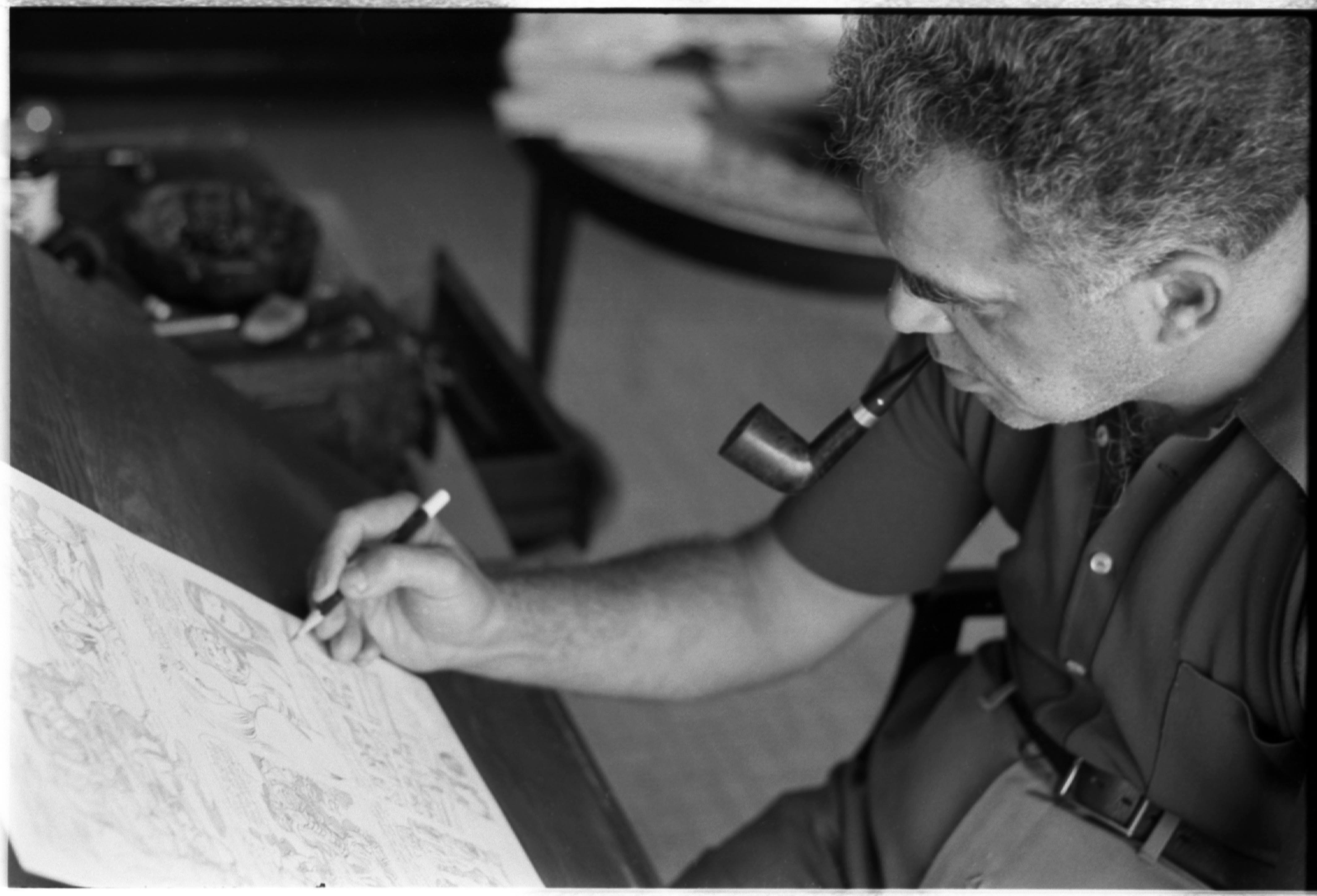
5kirbysept1972

Kirby at work, Thousand Oaks, CA, Sept. 1972. Photo by and (c) David Folkman.

Today, August 28, I call Kirby Day. This would have been the 102nd birthday of Jack Kirby (b. Jacob Kurtzberg, 1917-1994), as inventive and influential a comics creator as the field has ever seen, and one of the under-appreciated architects of what is now 21st century popular culture, both in the US and around the world. On this day, this unofficial holiday, why not donate to The Hero Initiative in support of veteran comics creators in need? Giving back on Kirby’s birthday is a grand tradition that deserves continuing.

Hero Initiative masthead

And, if you’re in or near New York City — not, like me, on the wrong coast — then why not join the Jack Kirby Museum & Research Center this evening on the Lower East Side, Kirby’s point of origin, for their celebratory walking tour and mixer? That sounds wonderful. It’s a free, non-ticketed event (the precise starting point and other info can be found on the Museum’s site at the above link). Kirby belongs to the world, but his roots in NYC deserve to be recognized and retraced. (How about a commemorative plaque at Kirby’s Essex Street birthplace, hmm?)

KIRBY, HYPE & HISTORY

Kirby’s name has now been coopted and rebranded as a “Disney legend,” and is at last gaining traction in entertainment media coverage, with film adaptations of his late-period auteurist works The New Gods and The Eternals looming (from Warner/DC and Marvel Studios respectively). However, his larger career story, beyond what can be harnessed to hype new adaptations, still seems unknown even to many fans of the Marvel Universe — a pop-culture franchise impossible to imagine without Kirby’s foundational work. Happily, the now-touring exhibition Marvel: Universe of Super Heroes (reviewed here on 23 April 2018) casts Kirby as, essentially, cofounder of that universe, and conversations around films like Thor: Ragnarok and the upcoming Eternals have made Kirby and his designs a frequent talking point. I have to admit, I had never expected to see this.

But to me the heart of the story remains (of course) Kirby’s own art and storytelling, and his own improbable record of unstinting creativity against long odds, in an industry that often treated creators like dirt. Thrilling to the latest news of pending screen adaptations ought to be balanced, I think, by a critical awareness that comics, as comics, do not necessarily gain from these things, and that a history of comics that is hostage to the current exploitation of corporate IP is not really history, but hype. Anyone who has published scholarship on comics creators like Kirby is probably familiar with  the odd sensation of seeing scholarly opportunities open up  precisely because of that hype — but I believe we should be wary of pop-culture presentism that repackages, but also occludes, the very history of the things we are researching. Sure, bring on the adaptations, the marketing campaigns, the DVD/Blu-ray extras and all that (I’ll be paying attention to the Eternals and New Gods films), but it’s the conversation around Kirby’s comic art as such that most interests me.

Kirby does not equal Marvel, or DC, and even his work for DC and Marvel ought to be framed in terms other than those of corporate mythology!

KIRBY STUDIES NEWS:

Man, I wish I had been able to go to France this summer. It’s been a feast of comic art exhibitions in France these last few months, and not one but two shows about Kirby have taken place in the Normandy region, coinciding with the 75th anniversary of the Allied invasion of Normandy and subsequent liberation of France. In France, Kirby’s name seems indelibly linked with his part in the liberation as well as his Marvel work, so this seems to have been perfect timing. One of these exhibitions closed just this past weekend, and the other (sigh) closes on September 29. I so wanted to give my passport another workout this summer, but, alas, could not.

I owe most of what I know about these exhibitions to social media posts and, especially, a review essay by comics scholar Jean-Paul Gabilliet (Of Comics and Men) for the International Journal of Comic Art. This thoughtful and detailed essay, by one of the leading historians of the American comic book, is happily available online, pending its publication in a future issue of IJOCA; I recommend it highly:

http://ijoca.blogspot.com/2019/08/about-four-comic-art-exhibits-in-france.html

One of the exhibitions, co-curated by French Kirby biographer Jean Depelley, focused squarely on Kirby’s wartime experience. Titled La guerre de Jack Kirby, l’inventeur des super-héros modernes [The war of Jack Kirby, the inventor of modern superheroes], it reportedly consisted of reproductions of comic book art and photographs, with emphasis on Kirby’s time as a combat infantryman in Nazi-occupied France. This fairly small exhibition ran from June 4 through August 24 at Les 7 lieux, a media library and cultural center in the city of Bayeux (famed in not only military history but also, of course, the history of sequential art).

At the same time, roughly 60 miles away, a very large exhibition titled Jack Kirby: la galaxie des super-héros ran (and is still running, through Sept. 29, having been extended) at Le Musée Thomas Henry, a fine-arts museum in Cherbourg, the famed Normandy port city. Co-curated by Musée curator Louise Hallet and comic art dealer Bernard Mahé, this exhibition is part of the Biennale du 9e art, a biennial event that centers on a big exhibition focused on a major creator. La galaxie reportedly includes more than 200 pieces of original comic art, about three-fourths of which are by Kirby, the other one-fourth being works by, as Gabilliet says, Kirby’s precursors (e.g. Hal Foster; Alex Raymond) and followers (e.g. Steranko; John Buscema). This sounds frankly like an overwhelming feast for the eye and the mind. Dig a couple of borrowed photos:
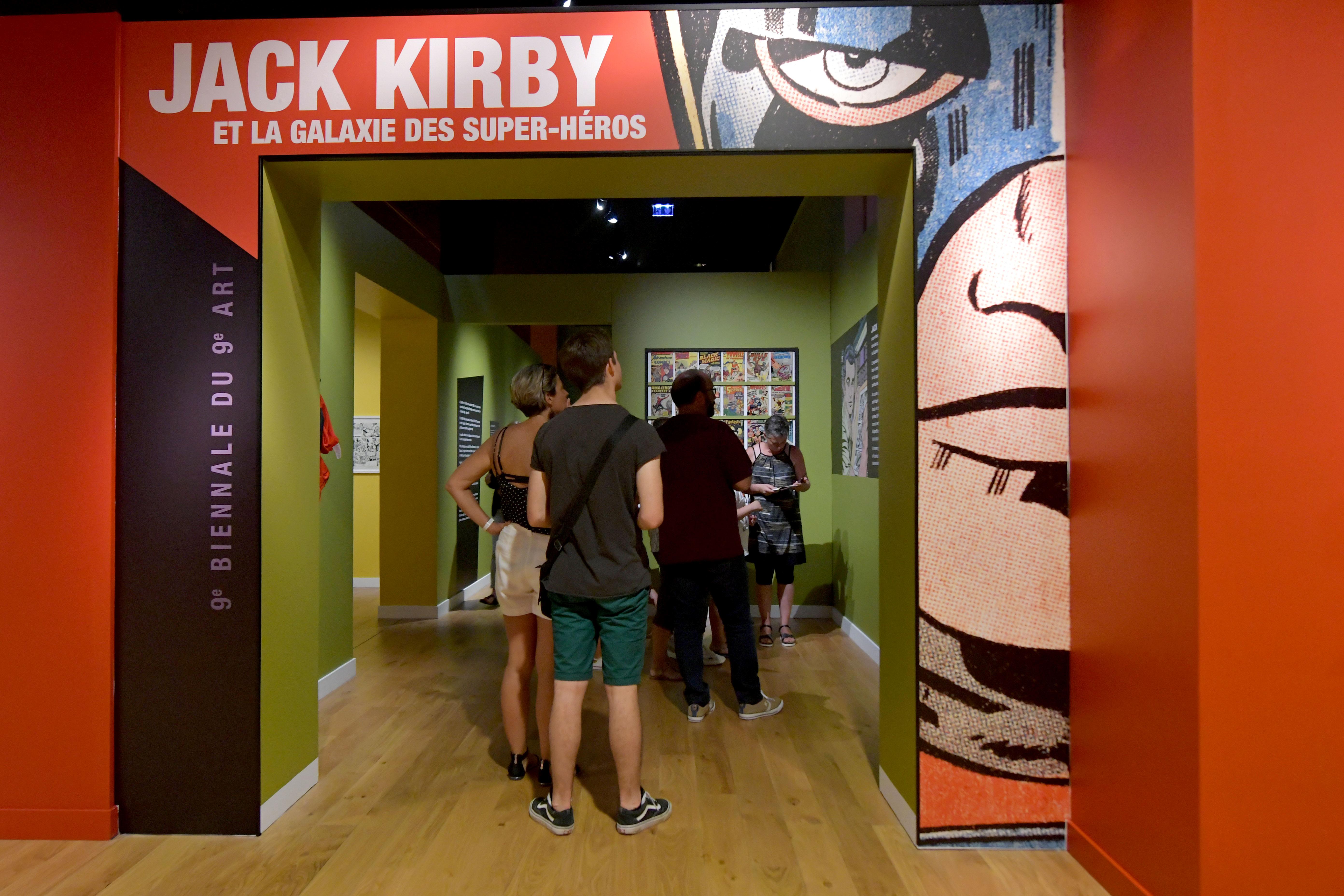
La galaxie exhibit entryway

Jack Kirby: la galaxie des super héros at Le Musée Thomas Henry. Photo: actua.fr, 28 July 2019.

Curator Louise Hallet (and Darkseid) at Le Musée Thomas Henry

Curator Louise Hallet and Darkseid, Le Musée Thomas Henry. Photo: Ouest-France, 22 May 2019.

La galaxie appears to have been one of the very largest Kirby exhibitions ever, comparable in scope to The House that Jack Built (co-curated by Paul Gravett and Dan Nadel for Lucerne’s Fumetto festival in 2010). Gabilliet writes thoughtfully of the exhibition’s pleasures and limitations, in terms that reminded me of the challenges I faced when curating Comic Book Apocalypse for the CSUN Art Galleries (2015). But, ah, just to see the complete “Even Gods Must Die” (New Gods, 1984 series, #6), on view at La galaxie — man, what I wouldn’t have done for that experience. I dearly regret missing these shows, just as I regret missing Mostri, uomini, dei [Monsters, Men, Gods], the Kirby exhibition at Bologna’s BilBOLBul comics festival last fall.

Right now, Gabilliet’s conclusion is ringing in my head:

[C]omic art exhibiting seems increasingly open to a plurality of conceptual and aesthetic possibilities that by far transcend the arguably increasingly humdrum pattern of “career retrospectives,” notwithstanding the genuine satisfaction one is perfectly free to experience while beholding wall-to-wall displays of original comic art drawn by a given creator. While many museums and galleries still regard comic art as “easily accessible” art that will likely attract paying visitors—a legitimate expectation by all means, unfortunately—the full museographic potential of comic art is yet to be tapped. The more imaginative curators will prove, the more alive we will all become to the versatility of our favorite art form.

Yet to be tapped. Absolutely. But things are happening. This puts me in mind of, one, Kim Munson’s forthcoming academic anthology, Comic Art in Museums (UP of Mississippi, 2020), in which I believe I will have a couple of pieces; two, the pending Comic-Con Museum in San Diego; and three, the pending Lucas Museum of Narrative Art in Los Angeles (currently advertising for a comic art curator). It would be reasonable to expect major Kirby-themed exhibitions from either or both of those places.

TWO OTHER NEWS ITEMS:

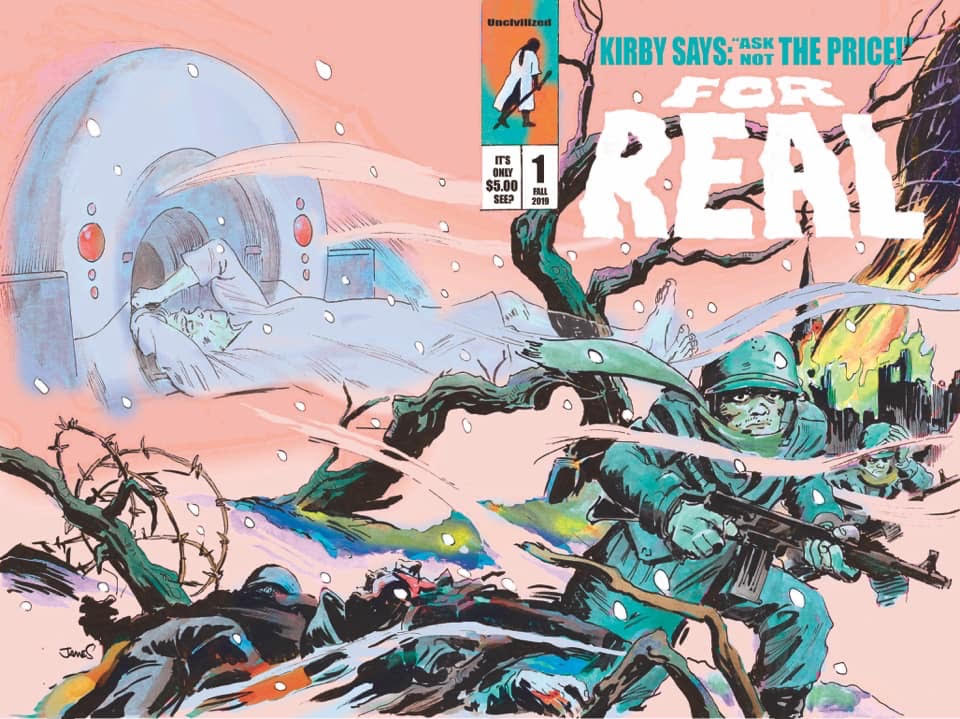
ONE. Speaking of Kirby’s wartime experience, acclaimed artist and Kirby expert James Romberger has a Kirby-themed biographical comic about to drop: For Real #1, promised from Uncivilized Books this November, which will reportedly contain:

“The Oven,” a short comics story that is a fictionalized amalgam of two little-discussed and largely undocumented parts of Kirby’s life: a harrowing encounter with Nazis in World War 2 and his treatment for cancer many years later, a story that touches on themes of PTSD, graphic medicine, courage and empathy; and “The Real Thing,” an accompanying essay by James that clarifies aspects of the story and contextualizes them with the reality of Kirby’s experiences.
For Real cover by Romberger

James Romberger’s anthology series For Real will begin with a comic and an essay about Kirby. In shops Nov. 6, 2019.

This comic book, Romberger says, is “the first issue of what will be a continuing anthology title” that he will edit, to be published by Uncivilized Books.

Romberger will be speaking about this project at the New York Comics & Picture-story Symposium next Tuesday, September 3, at 7pm at Parsons School of Design, University Center, 63 Fifth Avenue, Room UL 105. This event is free and open to the public.

I’m excited about this project, which promises to complement some other recent biographical projects: Tom Scioli’s graphic bio of Kirby (in progress), Scioli and Jean Depelley’s collaboration on “Private Kirby Adventures” (as seen in The Jack Kirby Collector #64, 2014), and Depelley and Marc Azéma’s 2017 documentary film La guerre de Kirby. Romberger is a superb artist, with a great feel for period and place and an abiding interest in Kirby.

TWO. On an academic and theoretical front, Kirby’s work figures in the recently released bilingual (French and English) anthology Abstraction and Comics/Bande dessinée et abstraction, a two-volume slipcased beauty edited by Aarnoud Rommens with the collaboration of Benoît Crucifix, Björn-Olav Dozo, Erwin Dejasse, and Pablo Turnes.

bandedessinéeabstraction

Abstraction and Comics | Bande dessinée et abstraction. La Cinquième Couche/Presses universitaires de Liège, collection ACME, 201

Abstraction and Comics is a project of the ACME research group at the University of Liège in Belgium, and jointly published by La Cinquième Couche and the University Presses of Liège. It totals nearly 900 pages, and includes essays and comics by more than fifty contributors (among them my esteemed colleagues Jan Baetens, Hugo Frey, Gene Kannenberg, Jr., Martha Kuhlman, Pascal Lefèvre, Gert Meesters, and Barbara Postema). Two essays will be of special interest to Kirby scholars and fans: “Jack Kirby: In-between the Abstract and the Psychedelic,” by Spanish scholar Roberto Bartual (author of Jack Kirby: Una Odisea Psicodélica); and “The Kirby ‘Krackle’: A Graphic Lexicon for Cosmic Superheroes,” by Argentinean scholar Amadeo Gandolfo.

There’s a ton to take in and think about in this pair of books. Recommended emphatically! My own research on collage in comics (including Kirby’s) will draw quite a bit from these pages.

It’s great to see Kirby studies flourishing internationally, and so many exhibitions and projects taking up his work. By Halloween I’ll have another such project to announce.

HAPPY KIRBY DAY! Indeed, #K i r b y I s E t e r n a l.

PS. My thanks to the great Paul Gravett for providing me updated and corrected information about the Cherbourg exhibition!

COMICS/POLITICS at Ryerson this weekend!

A67689EF-0EB6-495C-9C79-85EB1666CC41

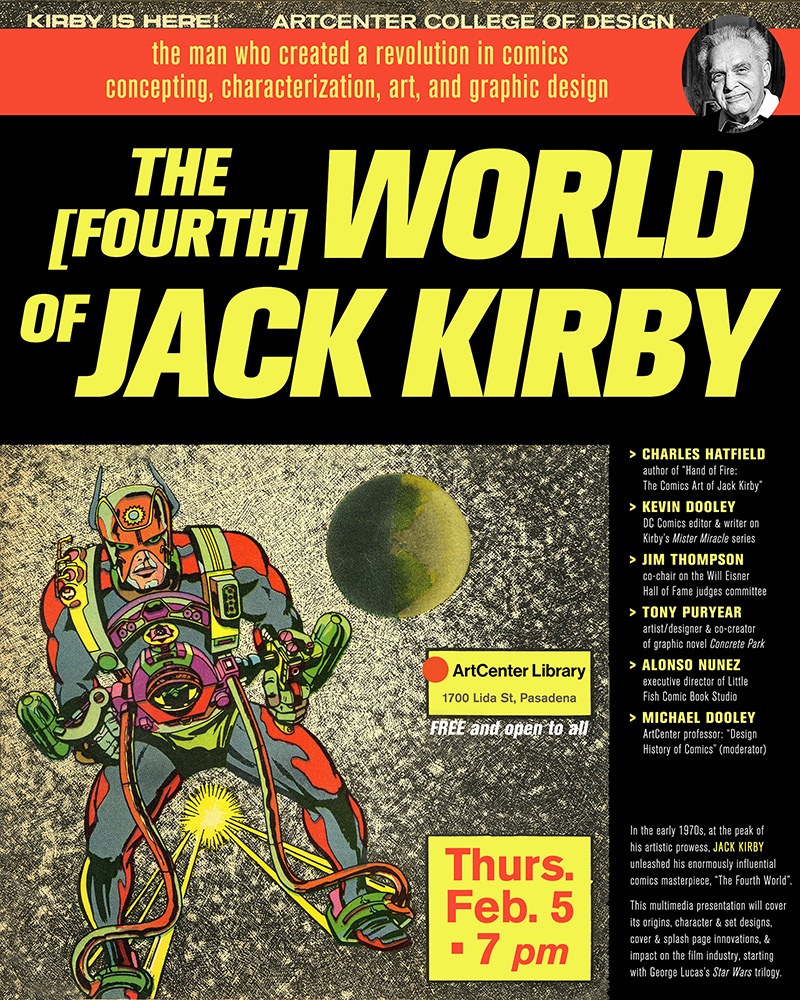
This weekend (Thursday, July 25-Saturday, July 27) Mich and I will be traveling to Ryerson University in Toronto, Canada for COMICS/POLITICS, the 2nd Annual Conference of the Comics Studies Society. Man, I can hardly wait!

I served as Founding President of CSS from 2014 to Spring 2018, and continue to serve happily on the Society’s Executive Board. Brainstorming CSS with colleagues and helping the Society get started has been one of the most rewarding projects of my career — and now I get to go to a CSS conference and present a paper on Jack Kirby. My worlds are colliding. 🙂

This Friday, as part of Panel 7.4, War and Conflict Comics, I’ll be giving my paper, “Kirby’s Visions of War, Early and Late,” an outgrowth of my work at the Université de Lorraine symposium in 2017 and my ongoing interest in Kirby’s kid gang comics. Joining me on that panel will be fellow presenters Kaleb Knoblauch and Shawn Gilmore and moderator Martha Kuhlman—I expect to learn a lot! And ours is but one of many panels, roundtables, plenaries, and other gatherings that altogether will make up a jam-packed conference program. So many scholars, so many exciting perspectives on the art and culture of comics: a panel on indigenous comics with Tara Audibert, Camille Callison, Cole Paul, moderator Amy Dejarlais, and graphic recorder Sam Hester; a conversation with Fiona Smyth, Jillian Tamaki, and Qiana Whitted; a Canadian WW2 comics exhibition opening at the Ryerson Library, with guest speaker Hope Nicholson; a mixer at The Beguiling and Little Island Comics (just hanging out in one of the world’s greatest comics shops, no big deal); tons of papers, talks, and opportunities to interact and learn — yow, this is going to be something, a worthy continuation of the tradition begun last year in Champaign.

Plus, a pre-conference documentary film screening on Wednesday night (Drawn Together: Comics, Diversity, and Stereotypes, dir. Harleen Singh, 2018); a charitable comics drive in partnership with the Canada Comics Open Library; book signings with our plenary artists (and Michael DeForge! and Chester Brown!), thanks to exhibitors Drawn & Quarterly and Bedside Press; and, on Friday, a free and public Artists’ Alley featuring indy creators and publishers! PLUS, on Sunday, after the official close of the conference, a number of us will be making a field trip to the Art Gallery of Hamilton, Ontario, to see the acclaimed exhibition, THIS IS SERIOUS: Canadian Indie Comics!

See why CSS has become one of my yearly “mountaintop” experiences?

2A36C704-2247-485C-A082-BB9A78332B5F.png

If you’re curious about CSS or comics studies, and close enough to get to Toronto, remember that our first day, Thursday, July 25, is Community Day, meaning that the morning events are free and open to the public. Plus, there will be single-day passes on Friday and Saturday for non-CSS members. Come check out what we’re doing!

All credit for the great program, its creativity, richness, accessibility, and relevance, goes to this year’s Conference Organizing Committee, helmed by co-chairs Candida Rifkind, who is CSS President, and Andrew O’Malley, and including Blair Davis, Biz Nijdam (representing the CSS Graduate Student Caucus), Nhora Lucia Serrano, Matt Smith, and past President Carol Tilley—a tireless team that has blended the best of the traditional conference model with new public-facing and creative elements. Looking forward to experiencing the results of their hard work!

Listen to Mythology in Newsprint on KUNV

FD460EDA-D439-4842-BBD6-634D293241A5

News: Audio of my Kirby talk “Mythology in Newsprint,” which I gave at the University of Nevada, Las Vegas, on April 26, is now up for listening online, thanks to KUNV, the Public Radio station at UNLV, and its program UNLV Speaks:

http://kunv.org/april-26-2019/

(Thanks in particular to KUNV’s Kevin Krall and Dave Nourse.)

This talk covers Kirby’s role in the creation of the Marvel Universe, the nature of “Marvel style” comic book production in the 1960s, and the importance of cartooning as narrative drawing (as opposed to illustration). It draws passages from Hand of Fire as well as the introductory essay to the Comic Book Apocalypse exhibit catalog that Ben Saunders and I wrote together. The talk concludes with some thoughts on the self-reflexive, sometimes self-questioning tendency in Kirby’s later work, and in particular a reading of Kamandi #29 (“The Legend,” May 1975), in which Kirby reflects on superheroes as mythic figures.

The talk incorporated scores of images (mostly drawn by Jack Kirby) timed to my comments, and unfortunately those aren’t visible through this radio broadcast — but I hope that the argument is clear and my enthusiasm carries over. At one or two points you can hear me refer to opening remarks by Ben Morse (Visiting Lecturer in Social Media at UNLV, and former Editorial Director of New Media at Marvel), who kindly introduced me. The audio here lasts an hour (though it does not include the post-talk Q&A that the audience and I had together).

This talk was part of the UNLV College of Liberal Arts’ University Forum Lecture Series (and ironically happened on the official opening day of Avengers: Endgame). Thanks to Ben and all who had a part in bringing me to UNLV and hosting me so graciously — including the institutional co-sponsors, UNLV’s Departments of English and History, World Literature Seminar, Great Works Academic Certificate Program, and College of Fine Arts. Most of all, I want to thank, again, my friend and fellow Kirby-head, Jarret Keene, poet, scholar, and Assistant Professor in Residence and World Literature Coordinator for the UNLV English Department. Jarret invited me out and made this gig possible — and his own insights about Kirby are provocative and important. Check out his work, and look forward to more of his writing on Kirby in the years ahead. He’ll open your eyes.

Thanks, Jarret!

PS. As I’ve said on this blog before, I met so many good people during that lightning trip to Vegas. My thanks to them all.