Nov. 11, 2017. Studying Kirby never gets old. These past few days I’ve been in Metz, France, learning new ways to think about him and his work.
Metz lies in France’s northeast corner, in the region of Lorraine, not far from the German border. It belongs to the Département (i.e. administrative region) of Moselle—that is, within the Moselle River valley. It is about an hour and a half’s ride (by super-fast TGV train) from Paris. To me-—to my awestruck American eyes—it seems like a pleasant city that wears its history like a badge. It’s home to the Saulcy campus of the University of (Université de) Lorraine, or UdL, which is where I’ve been these past few days.
To commemorate this, Kirby’s centennial year, the Département of Moselle is paying tribute to him and his work with a series of comics-related events and exhibitions (see kirbysuperheros.fr). That is what brought me to the UdL.
Metz was a pivotal place in Kirby’s life—which is an understatement. As a 27-year-old combat infantryman in World War Two, Kirby took part in La Bataille (Battle) de Metz, which raged in the Moselle from September to December 1944. He was lucky to survive; most of his comrades-in-arms did not.
To be specific, the 11th Regiment of the 5th Infantry Division of Patton’s Third Army came to Metz in early September 1944. From September 8th to 10th, Kirby and some 1200 other soldiers took part in an ill-fated bid to cross the Moselle at Dornot-Corny (Dornot being a village on the west side of the river, and Corny a village on the opposite shore). They were ordered to establish a bridgehead and drive the Germans from the Fort St. Blaise. Opposing them were battle-worn German soldiers reassigned from the Russian front (the Voss battalion), as well as fresh graduates from a SS school (the Berg battalion) and elements of the 17th SS Panzer Grenadier Division. The Moselle had become a heavily defended German frontier, so the Metz campaign was hard-fought and brutal. Dornot-Corny in particular became a disaster. The Americans were poorly informed and ill-prepared; lines of communication were tangled, and roads clogged; rain poured down, and the waters of the Moselle were ice-cold. Expected support did not come, and artillery support, when it came, inadvertently killed Americans (“friendly fire”). The Germans, for their part, rained artillery on the Americans nonstop; shells whistled and howled through the air, explosions ripped up the ground. Many Americans huddled in makeshift foxholes in a small wood that they came to call Horseshoe Wood (named for the horseshoe-shaped pattern of the troops’ movement). Trees were blasted apart—wooden shrapnel flew—and the woods were laid bare.
The roughly mile and a half of territory around Dornot-Corny became a killing ground. Of the 1200 Americans who went into it, 945 were eventually reported lost or wounded. Within days, American troops did establish a bridgehead further south, at Arnaville, but Dornot-Corny was remembered, if it all, as a defeat—the kind of thing armies would prefer not to remember, in fact. Indeed Dornot-Corny been has been described as “une bataille oubliée” (a forgotten battle). The people of Metz, however, have worked to make sure that it is not forgotten, and the events of September 8-10 are now memorialized as “60 hours in hell.”
Jack Kirby lived through that.
I visited Dornot-Corny two days ago. I will say more about that in a later post, and hopefully with a few photos. It was an oddly appropriate Veterans’ Day observance, so to speak. Suffice to say for now that the experience was moving and eye-opening, and I will not forget it. Thank you to Elisabeth Gozzo and the Association Thanks GIs for working so hard to preserve the memory of the soldiers and their sacrifice.*
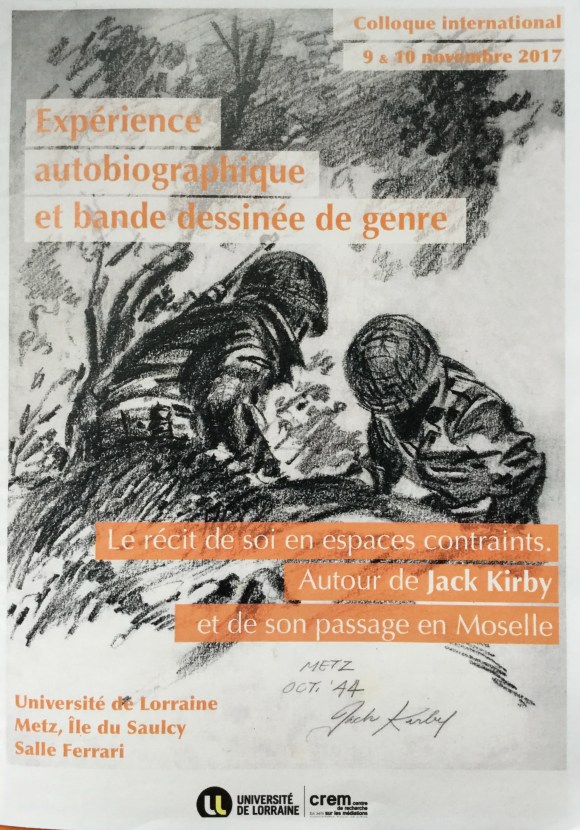
How and why did I get to Metz? I was invited to speak at the colloquy or symposium Expérience autobiographique et bande dessinée de genre: le récit de soi in spaces contraints (Autobiographical Experience and Genre Comics: Self-Narratives in Constrained Contexts), organized by scholar Jean-Matthieu Méon of the CREM (Centre de eEcherche sur les Médiations, or Center for Media Research) at the UdL. The impetus for this colloquy was Kirby’s centenary, as indicated by the subtitle Autour de Jack Kirby et de son passage en Moselle/Traces of Jack Kirby’s War in Moselle—thus the symposium built on Moselle’s larger Kirby tribute. Méon worked generously, tirelessly, to involve me in the symposium, arrange my travel to France, and make sure I understood things despite my language deficit—for which I cannot thank him enough. (Merci mille fois, Jean-Matthieu!)
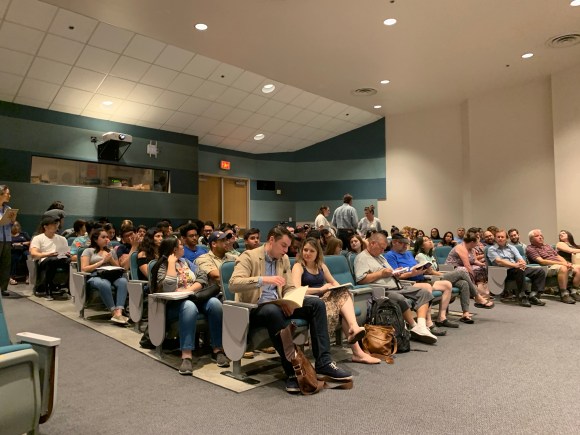
The colloquy consisted of two days’ conversation in the UdL’s Salle Ferrari (a conference room arranged in concentric rings and with microphones everywhere!). Its main purpose, to paraphrase Jean-Matthieu, was to talk about Kirby, his life, his style, and his development, in order to talk more broadly about the category of “autobiographical comics”; or, in other words, to “expand the repertoire of authors, works, and formal strategies to consider when discussing the expression of autiobiography in comics.” As both autobiographical comics and Kirby are deep interests of mine, I was thrilled to have been invited. Moreover, the opportunity to talk about Kirby in a European context was something I had never experienced before—and frankly I had not realized how deeply Kirby’s work has affected so many readers outside of anglophone North America. To see such strong, firsthand evidence of this has been a great experience. Kirby studies is international!
Fourteen scholars gave papers: eight from France, three from Belgium, one from the UK, and two (including myself) from the US. In addition, Jean-Matthieu framed the event with opening and closing remarks, establishing a rich theoretical and historical context for our discussions. Following, in order of presentation, are brief notes about the talks. Some addressed Kirby particularly, while others dealt with different topics at the intersection of comics and autobiography studies:
- Benoît Crucifix of the University of Liège, Belgium (whom I had met before), spoke on autobiographical readings of Frank King’s Gasoline Alley in the archival reprint volumes organized by Chris Ware and Jeet Heer.
- Benoît Tellez spoke on autobiographical dimensions of Winsor McCay’s comics.
- Maaheen Ahmed discussed authorial presence in works situated between autobiography and genre comics, including works by Pratt, Seagle and Kristiansen, and Larcenet, and how those works construct author-personas by invoking memories of past comics as well as memories of other media incorporated by comics.
- Jean-Charles Andries de Levis discussed Alex Barbier’s Lettres au maire de V., and how the image of the werewolf in that and other works takes on an autobiographical function.
- Benoît Glaude explored the phenomenon of pseudo-autobiographical texts attributed to comics characters (Little Nicholas, Corto Maltese, etc.), i.e. “the passage of non-autobiographical comics through the autobiographical literary genre.”
- Pascal Robert spoke on the drawn signatures of cartoonist André Franquin and how those signatures assert the individuality and status of the author and renegotiate the relationship between author and editorial/publishing establishment.
- Bounthavy Suvilay presented on the work of mangaka Hiroyuki Arakawa and how that work, as it conveys the story of a community rather than giving an individual confession, does not subscribe to Western conceptions of autobiography as genre but instead follows models specific to Japan.
- Jean-Matthieu Méon spoke on the autobiographical works of the late Sam Glanzman and how they both conform to and exceed the conventional straits of the war comic genre.
- Hugo Frey (University of Chichester, UK), with whom I have worked but whom I had never met, spoke on Hugo Pratt’s contributions to British war comics (Fleetway’s War Picture Library) in the late 1950s to early 60s, and how hints of Pratt’s later expressionistic style emerge even in these highly conventionalized comics.
- Laura Caraballo (presenting a paper written in collaboration with Roberto Bartual) explored Kirby’s treatment of the sublime and the “concern for pure form” that emerges in the second half of his career, in relation to abstraction, Pop Art, and psychedelic art.
- Éric Maigret presented on contested or fractured masculinity (or conflicts between hegemonic and subordinate masculinities) as the ground of Kirby’s personal and professional struggles, as revealed in diverse works.
- Mathieu Li-Goyette (Université de Montréal, Canada) spoke on how Kirby’s war comics address the self “in a context of brotherhood” and heterogeneity, as analyzed within a schizoanalytic framework informed by the theories of Deleuze and Guattari.
- Steven Brower (Skyping in from the US) discussed Kirby’s late works, particularly OMAC, as prophetic and dystopian “cautionary tales.”
I had the honor of leading off the colloquy with a keynote exploring Kirby’s changing view of war via his depictions of Japanese soldiers in two very different comics, one “The Treachery of Osuki,” a Boy Commandos story from Detective Comics #68 (Oct. 1942), and the other “Bushido,” a Losers story from Our Fighting Forces #154 (April 1975). My goal was to contrast early Kirby and late Kirby regarding the way he imagined the “enemy” and the nature of heroism in war—and to show how Kirby moved from wartime propaganda to more complex views. Along the way, I indulged my growing interest in the “kid gang” genre of comics pioneered by Kirby and Joe Simon in the early 1940s, and sought to place that genre in the context of Kirby’s autobiography as well as popular culture influences.
I wish I could share photos from the actual symposium proceedings, but I did not get any good ones of the speakers speaking—partly because the setting was small and intimate and I didn’t want to make anyone feel awkward, and partly because most of the presentations were in French and I was straining to understand them. The colloquy included both French and English talks, but frankly when it comes to French, I have seulement un trop petit peu (though this trip has given me some practice) and cannot converse in the language, so I relied on notes and impromptu help from colleagues. Fortunately, all presenters used PowerPoint, and most embedded in their slideshows text in whatever language they were not speaking; in my case, for example, I prepared French-language text for my talk. So that meant that I could follow the outlines of arguments in cases where I could not grasp the details of language. But I was keenly aware of my language deficit and working hard to show that I was listening and trying to understand—an occasionally frustrating experience, but overall the group worked hard to realize Jean-Matthieu Méon’s vision of a truly international summit. Everyone was gracious about it. I have to say, it was intense to spend so much energy trying to pick out whatever words I could recognize; fortunately, most presenters explicitly framed their talks in terms of theoretical perspective, methodology, and corpus of study, and those academic habits, which I’m familiar with, helped make up for my lack of fluency in the language. (In all, six presentations were in English and eight in French.)
This was a tremendous intellectual workout for me, and a great social occasion too. I got to make new friends, stretch my understanding, get a renewed feel for French language and culture, and—as I’ve said—learn that there are diverse international perspectives on Kirby. I only wish that I could have made it Metz earlier this year, and spent more time there, so as to fully experience the region’s celebration of Kirby (again, see kirbysuperheros.fr).
Once again, my deepest thanks to Jean-Matthieu Méon and his colleagues for making this happen!
KIRBY VIT!
*(My two main sources for the above account of the battle at Dornot-Corny are, one, my memories of conversations at the battle site, particularly the recollections of historian Elisabeth Gozzo; and two, the commemorative booklet Une bataille oubliée: les têtes de pont de Dornot-Corny et d’Arnaville, 2009, partly written by Gozzo and sponsored by the Office National does Anciens de la Moselle and the Association Thanks GIs, which Gozzo leads. They have done some wonderful “memory work” to make sure that the terrors and sacrifices of the War are not forgotten.)







 Kirby Studies