Category Archives: News

RIP Dick Ayers (1924-2014)

Ayers Cartoonist Profile

I’m sorry to report the passing of Dick Ayers, the Eisner Hall of Fame cartoonist, who is best known as a longtime Marvel artist and prolific Jack Kirby inker but did quite a bit of other work as well—in penciling, inking, lettering, coloring, basically in just about every aspect of comics production. He did all this not just for Marvel, but for many other publishers too. His historic career in comic books and comic strips made him, for fans, a living link to the fondly remembered roots of the business.
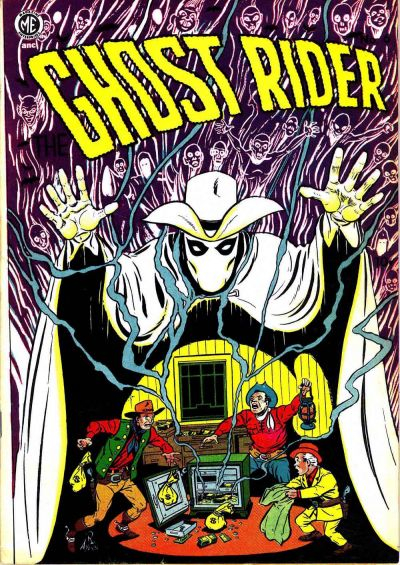
Ghost Rider #6 (1951)

Ghost Rider #6 (Magazine Enterprises, 1951)

Ayers’ full-time comics career spanned from about 1947-48 to the mid-80s, tapering off after that, but he continued to cartoon into the 2000s. From his early work for Magazine Enterprises, for which he co-created the horror-tinged Western character Ghost Rider, to his late-career work for DC, Archie, and Bill Black’s AC, Ayers was a jack-of-all-trades comics artist who put his hand to many different genres and trends. He had a particular yen for Western and war comics.

Avengers #1 (1963)

The Avengers #1 (Marvel, 1963), cover by Kirby, Ayers, and letterer Artie Simek

It is Ayers’ Silver Age work for Marvel that fans are most likely to remember today: he penciled Sgt. Fury and His Howling Commandos (co-created by Kirby) for a heroic ten-year run (1964-1974), and inked Kirby on scads of comics, including Westerns, monster tales, and, most famously, seminal superhero comics such as The Fantastic Four, “The Human Torch” (in Strange Tales), and The Avengers. Whenever I think of Ayers, I see comic books like The Avengers #1 and Fantastic Four Annual #1 (both 1963) in my mind’s eye.

By all accounts, Ayers loved being a comics artist. He was said to be an easygoing and generous man, and took great pride in revisiting his accomplishments and recalling old times (an interview between Ayers and Roy Thomas in Alter Ego #10, from 2001, gives a glimpse into his very early days). In recent years he had been an enthusiastic comics convention-goer as well as commission artist, often recreating iconic covers from his comic book heyday.

My condolences to Mr. Ayers’ family, friends, and fans. I am sorry to know that he is gone.

Links: I recommend my readers visit comics historian Blake Bell’s blog for a touching reminiscence of visiting Ayers at his home back in 2001-2002 (the photo at the bottom of this post comes from there).

Tense Suspense #2 (1959)

Tense Suspense #2 (Fago Magazines, 1959)

Sgt Fury #38 (1967)

Sgt Fury #38 (Marvel, 1967)

Mighty Marvel Western #11 (1970)

Mighty Marvel Western #11 (Marvel, 1970)
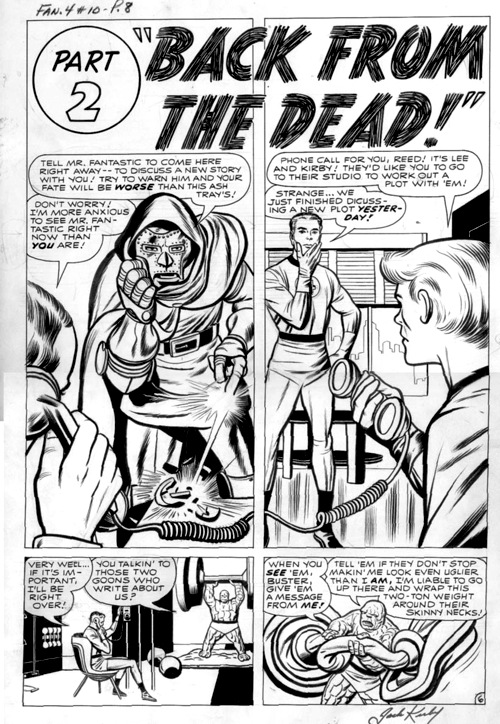
Fantastic Four #10 (1963)

Original page by Kirby, Ayers, and letterer Artie Simek for Fantastic Four #10 (Marvel, 1963)
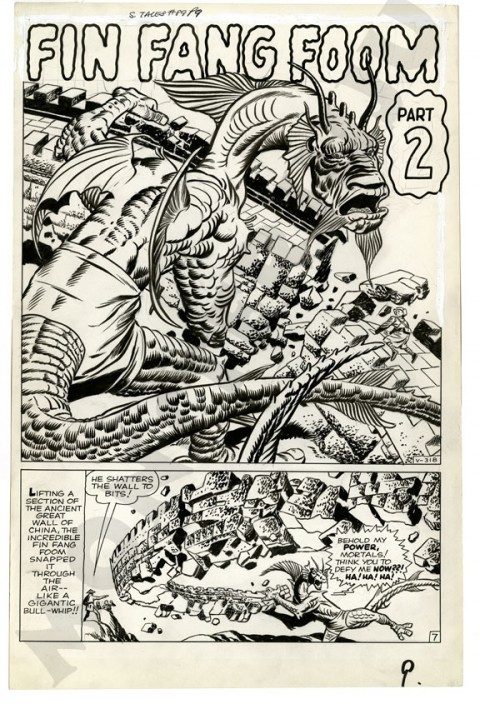
Strange Tales #89 (1961)

Original page by Kirby, Ayers, and letterer Artie Simek [?] for “Fin Fang Foom” (Strange Tales #89, Marvel, 1961)

Fantastic Four Annual #1 (1963)

Splash from Fantastic Four Annual #1 (Marvel, 1963), by Kirby, Ayers, and Simek

Ayers in his studio, by Blake Bell

Dick Ayers at home in his studio, photographed by Blake Bell c. 2001

Kirby Estate Appeals to US Supreme Court

Today brings Kirby news on the legal front—specifically, an important new development in the Marvel v. Kirby case.

The legal news site Law360, the entertainment industry news site Deadline Hollywood, and several comics news sites, such as CBR’s Robot 6 blog and Bleeding Cool, are reporting that on March 21 Jack Kirby’s heirs petitioned the US Supreme Court to review the case.

To be precise, the Kirby estate filed a petition requesting a writ of certiorari—essentially, they have asked the Supreme Court to hear their appeal and reconsider the opinion handed down last August by the Second Circuit Court of Appeals. That opinion reaffirmed the original ruling of the US District Court for the Southern District of New York (July 2011), which had favored Marvel, denying the Kirbys’ case.

The Second Circuit’s decision last August appeared to all but close the door on Marvel v. Kirby. Though the Kirbys petitioned the Second Circuit for a rehearing, their request was denied in October. However, the March 21 petition—which from here on out I’ll refer to as the Cert Petition—may yet reopen the door, at the highest court in the land.

I refer my readers once again to attorney Jeff Trexler’s Comics Journal article from last August, “Taking Back the Kirby Case,” and to the coverage at Deadline Hollywood for a reasonably complete timeline of the case, including legal documents (the original ruling of July 2011; the Second Circuit’s appeal decision, August 2013; the Cert Petition, 21 March 2014). Over the coming week, I will try to embed PDFs of these documents right here at this blog.

I’m at a loss as far as knowing what to say about this case that I have not said before. It’s a complicated and vexing case, certainly. It’s important. Because the case centers on work-for-hire law, it keeps dragging me back to the difference between legality and justice (a point I’ve examined here previously). If the Supreme Court takes up the case—which, as so many commentators have already pointed out, is a big if—it could be a game-changer.

Suffice it to say that I wish the Kirby family success, in the name of justice and a better, more honest history of the American comic book.

History was made at this board, on both coasts

PBS Superheroes Documentary Neglects Kirby

Of all the things that bother me about Michael Kantor et al.’s PBS documentary Superheroes: A Never-Ending Battle, which aired last night, the most disheartening is the show’s one-dimensional take on the rise of Marvel Comics in the 1960s and its almost entire neglect of the crucial role played by Jack Kirby in that rise.

Kirby’s singular contribution to the look and substance of Marvel—the fact that he provided characters, premises, stories, and the overarching visual aesthetic of the company—is never forthrightly addressed. The show simply reinforces the familiar corporate mythology about Stan Lee creating properties and writing stories that were then illustrated by Kirby, Steve Ditko, and other artists—a shallow view that fundamentally misunderstands the role of the cartoonist in the Marvel style of production. The result is all fog and strobe lights, not history.

My full take on the documentary can be found at The Superhero Reader website, here.

A Birthday Bonanza!

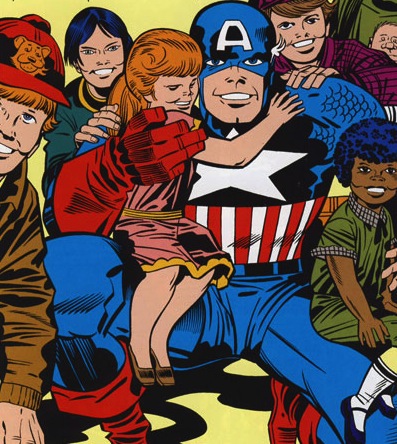
A moment of joy and optimism, from Captain America's Bicentennial Battles (1976)

Today is the 96th birthday of the great Jack Kirby, and it’s wonderful to see the online outpouring of interest, affection, and commentary that this event has inspired!

There’s so much about Kirby on the Web today that knowing where to go could be a right challenge. Me, I recommend:

Or you could just turn off your computer, pick up and read a vintage Kirby comic, and get your mind blown all over again. 🙂

Hail Kirby!!!

Essential Reading: Taking Back the Kirby Case

US Supreme Court Building, photo by Carol M. Highsmith, from the Library of Congress

Attorney Jeff Trexler has written an excellent essay for The Comics Journal titled “Taking Back the Kirby Case” that I emphatically recommend to anyone who cares about comics, the work of Jack Kirby, the implications of copyright law for independent contractors, or just plain fairness.

Trexler not only reviews the decisions in the Marvel v. Kirby lawsuit and considers their ramifications, but also gives a thorough rundown of the legal case histories behind those decisions, in effect explaining the whole complicated story of how case law interprets and affects the work of comics freelancers. He shows, in essence, how court opinions have effected a massive shift of intellectual property from artists to corporations. Along the way, he suggests how and why the U.S. Supreme Court might take an interest in the Kirby case.

Essential reading, for which many thanks to Jeff Trexler! I learned a lot from it.