Kirbyvision in Glorious 3-D!

Kirbyvision: A Tribute to Jack Kirby, an exhibition now showing at the Corey Helford Gallery in Los Angeles, lovingly registers Kirby’s impact on contemporary comics, media, and culture. Curated by the Jack Kirby Museum and Research Center, in collaboration with the Helford, the show offers for sale new or recent works by more than seventy artists inspired by Kirby, alongside a historical exhibition of Kirby originals that outlines his style, techniques, and key creations. Together, the historical exhibit and contemporary tributes reaffirm Kirby’s continuing influence. I urge comics and Kirby fans anywhere within a day’s travel of Los Angeles to pay it a good, long visit (alas, it remains open through just Saturday, August 3—would that it could stay longer!). The show is free and open to the public.

I’ve experienced Kirbyvision twice myself, and hope to again. Having curated the 2015 CSUN show Comic Book Apocalypse: The Graphic World of Jack Kirby (to which the Museum contributed substantially), I have a sense of what it takes to contextualize Kirby’s art for gallery visitors. I greatly admire what the Museum has accomplished here. Of course, I can hardly be objective, since I’m a Kirby diehard (and serve on the Kirby Museum’s Board of Advisors), but I hope that the following description gives the flavor of the show and helps document it for posterity. Do know my bias, going in, but also know that this is a show you should see if you love comic art.
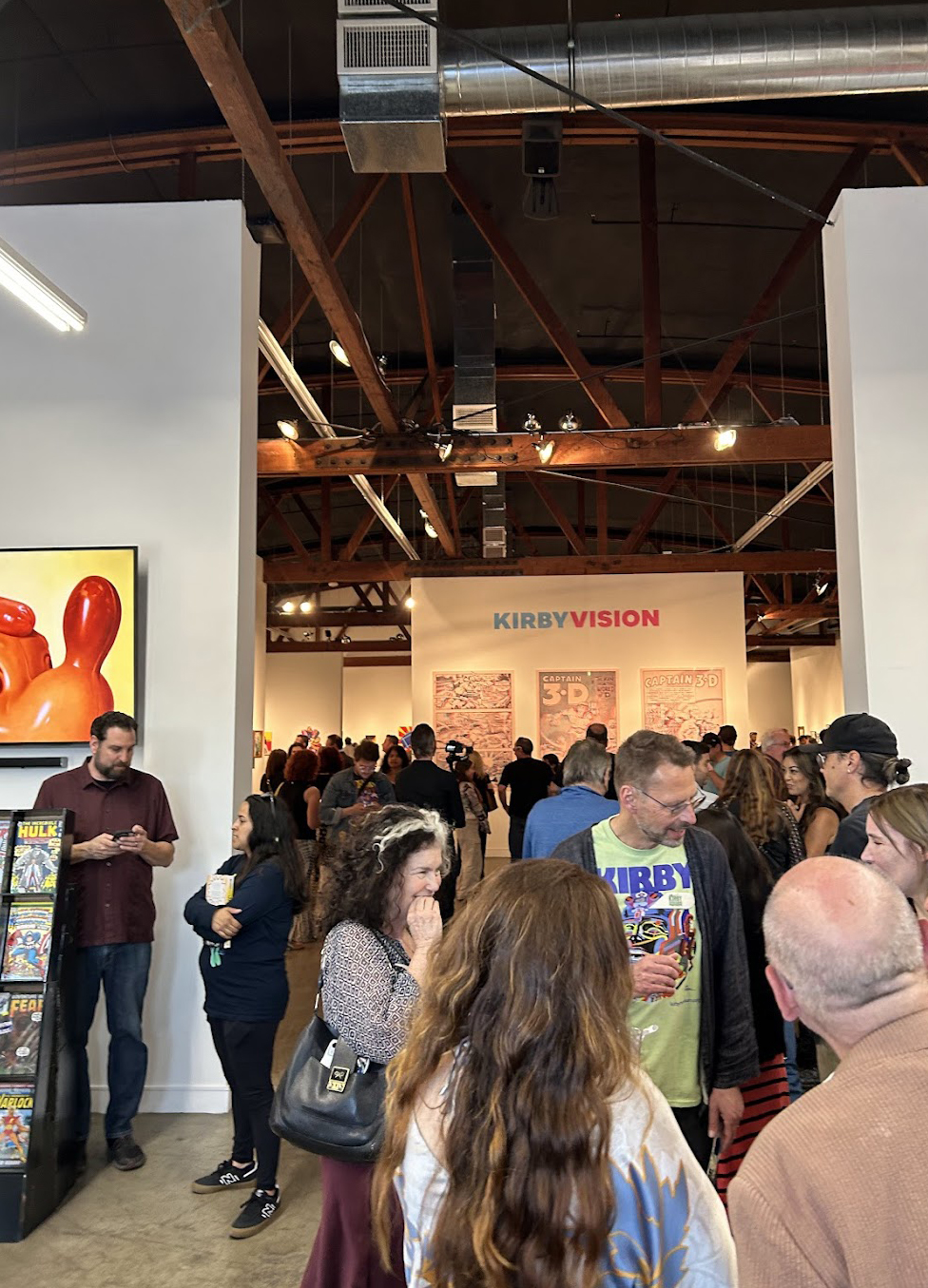
This and most of the photos that follow are by CH.

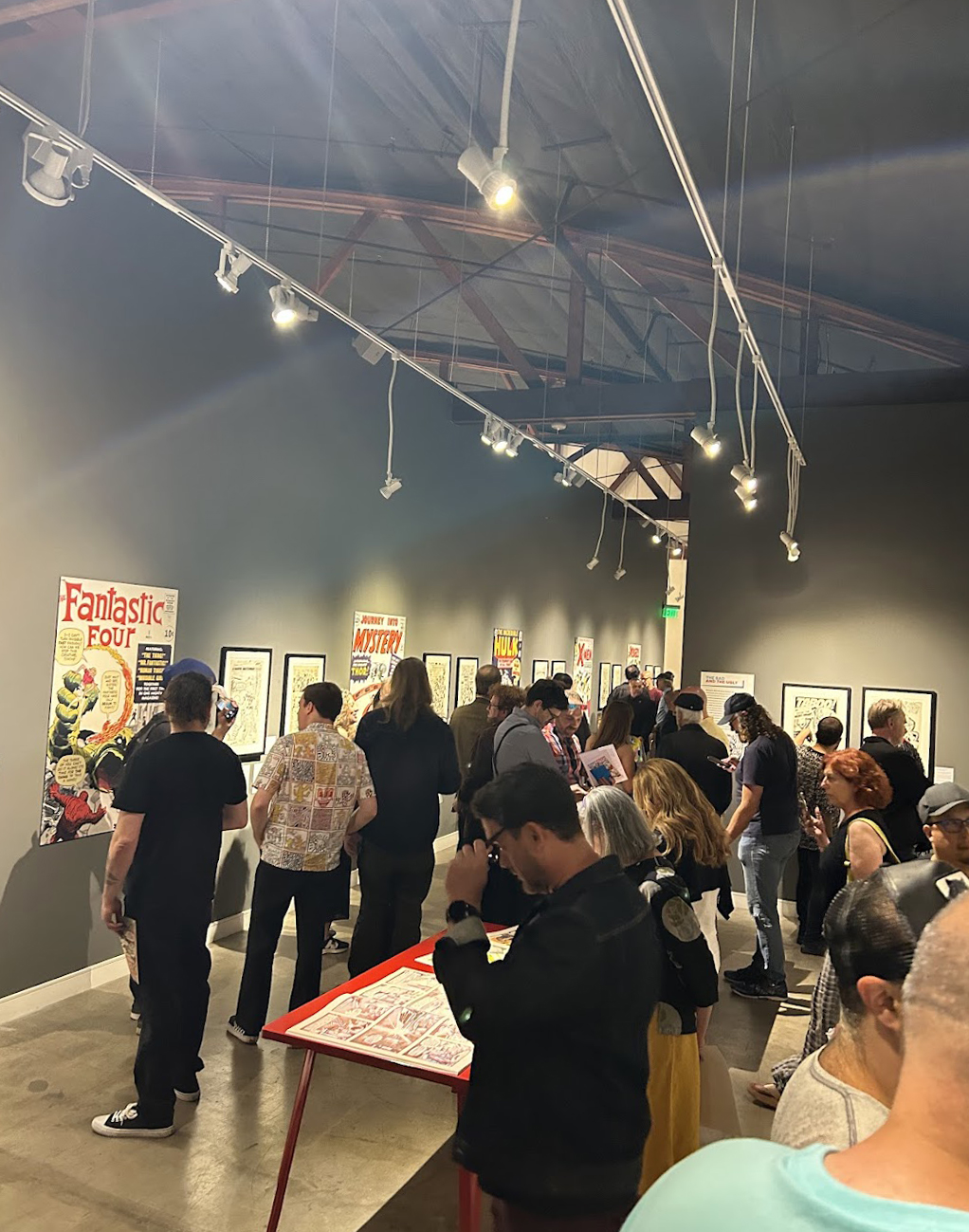
Kirbyvision opened Saturday, June 29, with a bustling reception that brought out diverse artists, collectors, fans, and members of Kirby’s family. The buzz and shared happiness that evening were fairly electrifying. I was glad to be in happy company, and enthralled from the get-go. The show is an eye-popping design experience and a triumph for the Kirby Museum, which has carried the torch since its founding in 2005 and began holding pop-up exhibitions in 2013. For years, the Museum has been seizing opportunities to demonstrate just what it can do—and I think this show, more than any previous event, does that wonderfully. So, here’s my report:
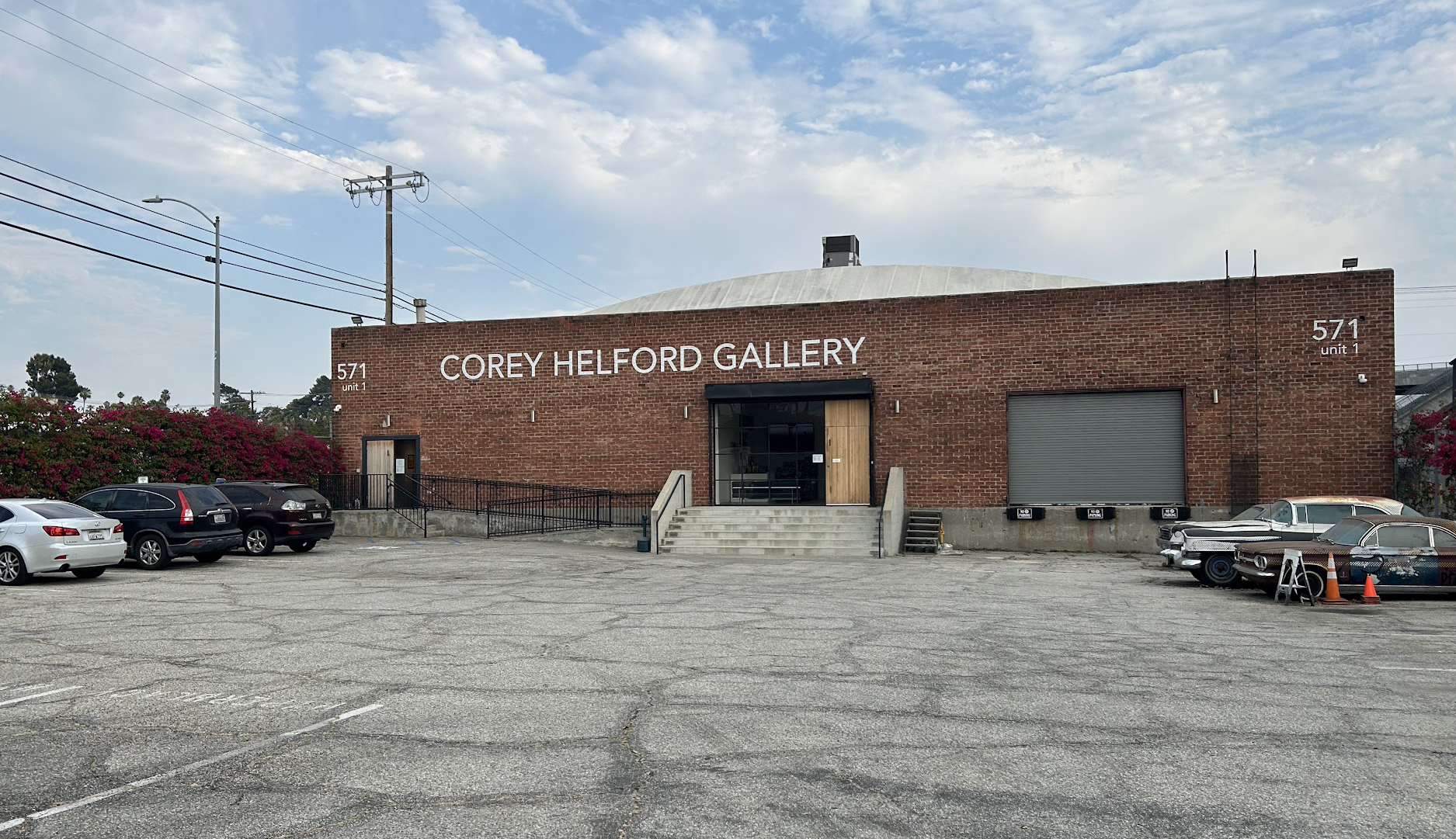
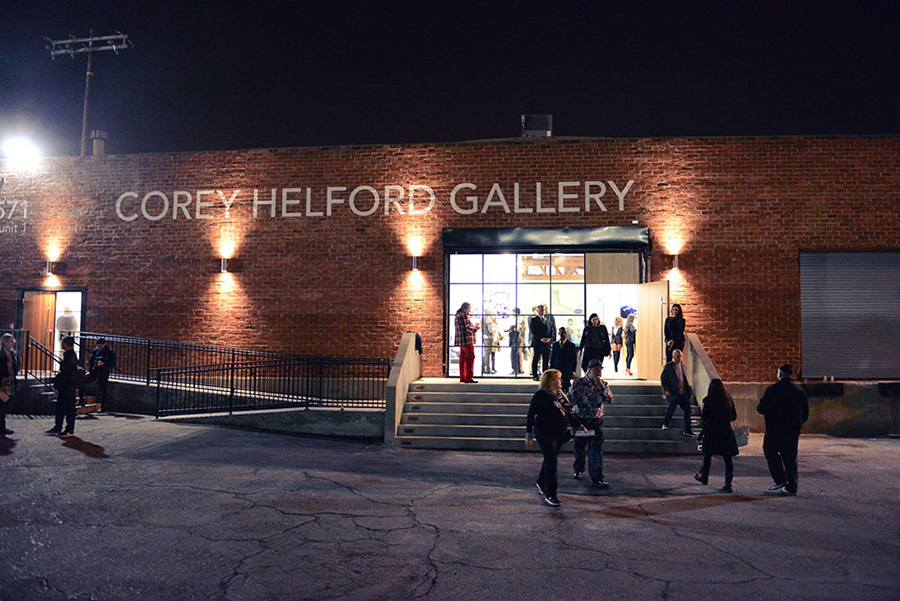
The bottom photo is not actually from Kirbyvision’s opening night, June 29, but perhaps sets the mood? From coreyhelfordgallery.com.

The Corey Helford is in eastside Los Angeles, by the L.A. River, within a district that feels postindustrial. Around it stand imposing buildings festooned with a mix of graffiti and bespoke murals. My wife Mich and I have been visiting L.A. galleries lately, and they tend to be in repurposed settings like this. The Gallery building, a block of brick surrounded by fences, runs to 12,000 square feet. Its main gallery, a vast openness, takes up about 4500 of that, while two other galleries open off to the side. Unsurprisingly, all of these are whitewalled, cement-floored, and adaptable artspaces. Kirbyvision currently occupies most of the building, though one gallery holds an exhibition by painter Bennett Slater (who renders dolls and other commercial icons with Old Master precision).

Slater, an artist frequently shown at the Corey Helford, epitomizes the gallery’s New Contemporary slant. The Helford seems to favor Surreal, Pop-inspired figurative work blending lowbrow references with exacting technique and high gloss. It has a Hi-Fructose and Juxtapoz vibe, with nods to street art and impish personal riffs on commercial design. Kirbyvision mostly fits into that wheelhouse. The bulk of the show consists of eighty-plus homages to Kirby (or genres and brands he is known for). The work on view embraces various media and ranges technically from rowdy handmade-ness to industrial sheen. Paintings and drawings are the main things, though there are also collages, digital prints, and sculptures.
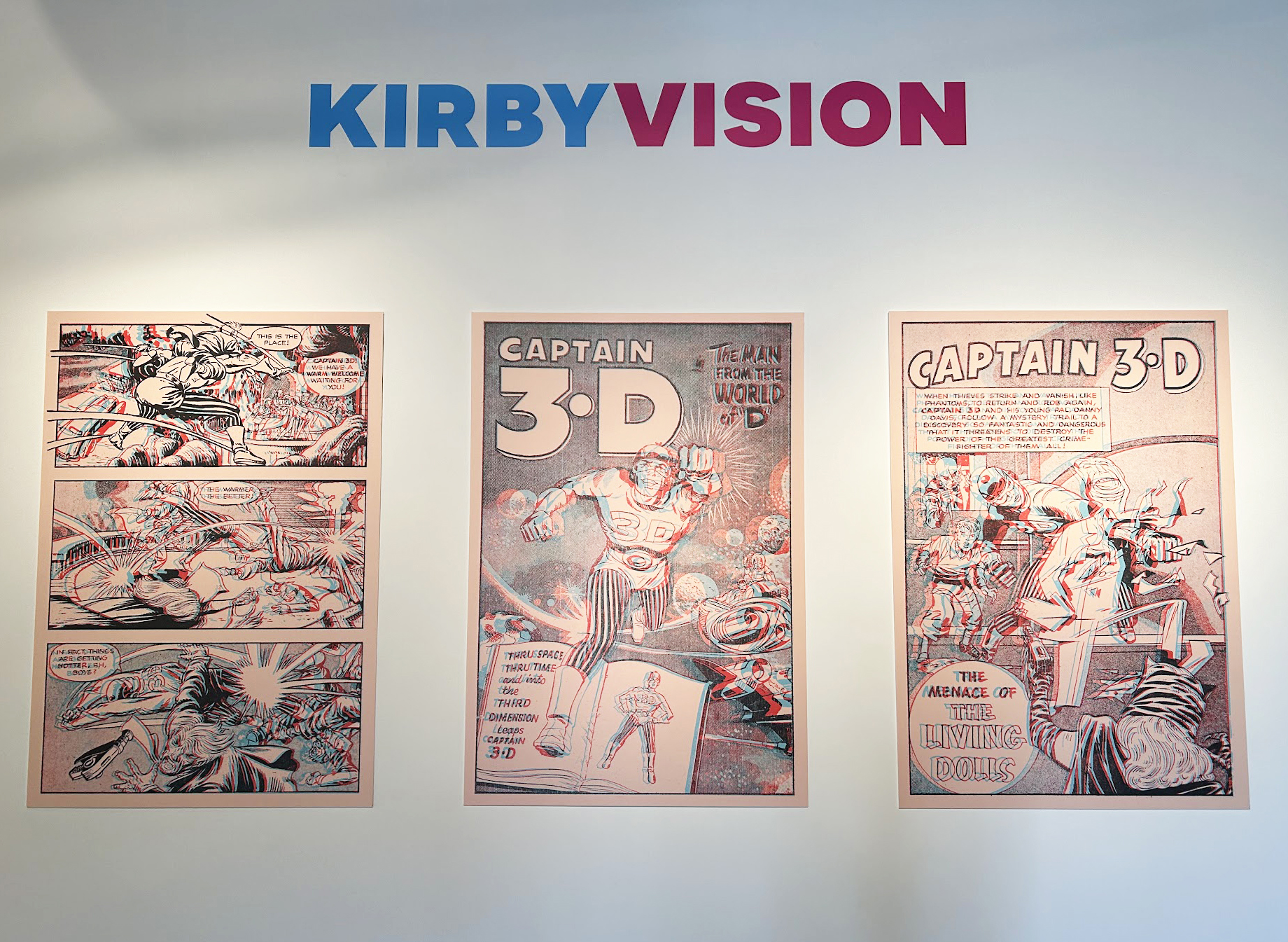
If the works on offer are mixed, the total design of Kirbyvision brings unity. The show’s main design conceit is the idea of 3-D vision, with nods to Kirby and Joe Simon’s single issue of Captain 3-D from 1953 (a then-faddish 3D comic published by Harvey). At the outset, a dividing wall in the main gallery’s entrance (which visitors skirt around to enter the gallery proper) bears a triptych of images from that comic, dramatically scaled up in very effective 3-D separation. Scanning that wall from a few paces back with the anaglyphic (red and blue) 3-D glasses freely provided by the gallery imparts a strong sense of movement. The 3-D elements represent a collaboration with stereoscopy expert Eric Kurland (founder of 3-D Space), whose gift for this kind of work can be felt throughout the show (so keep those glasses with you).
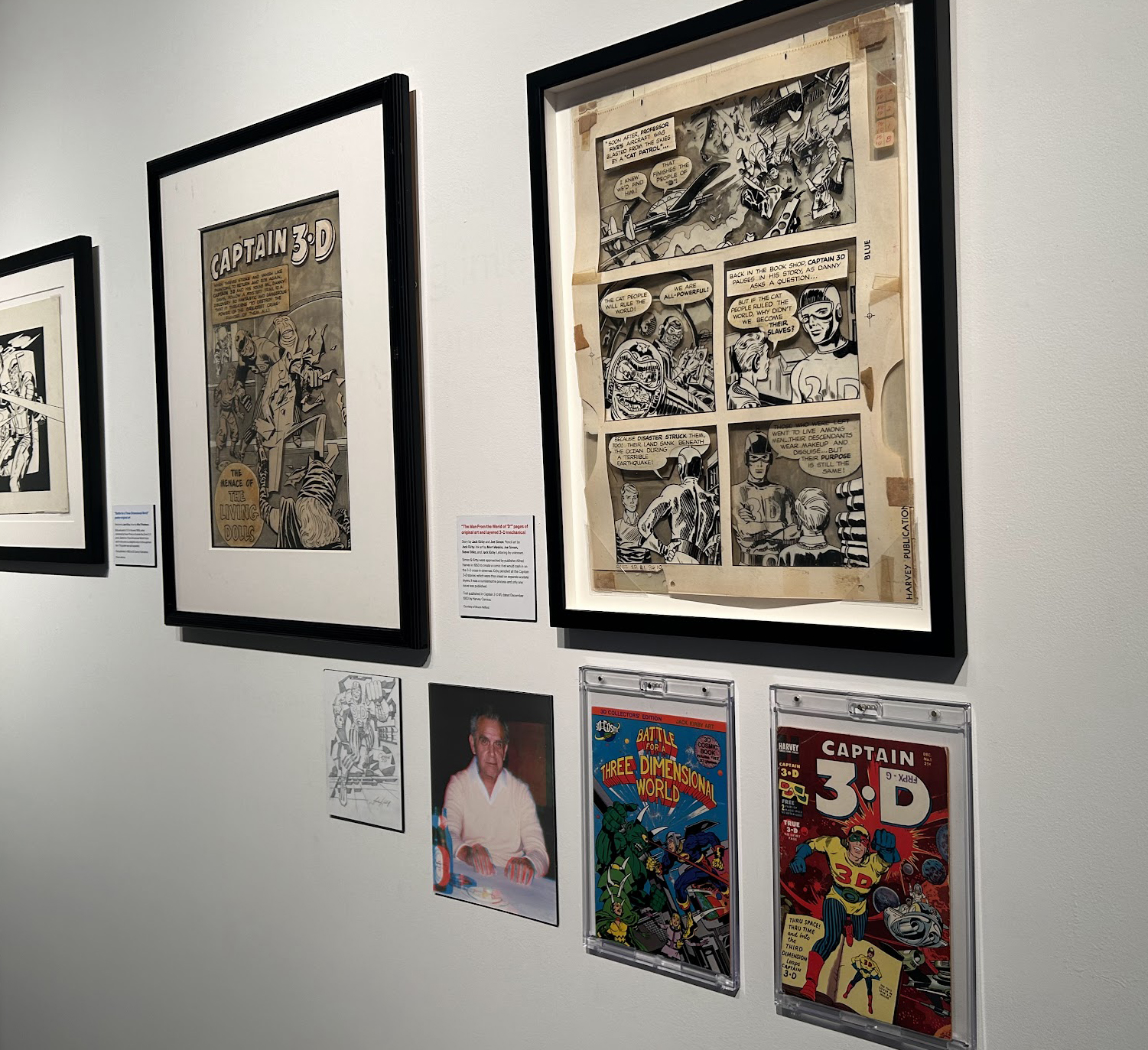
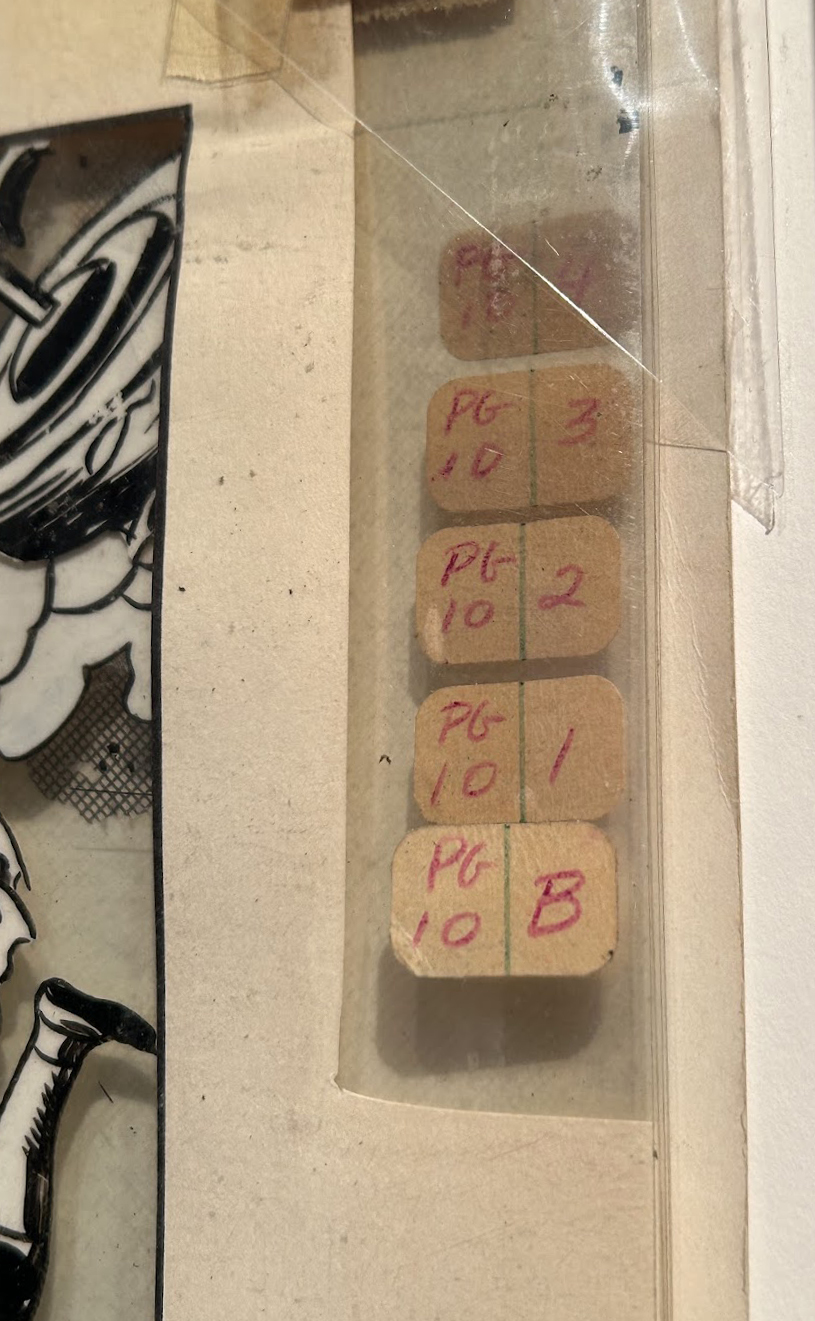
In effect, the 3-D hook gives Kirbyvision a brand identity (while suiting the Helford’s retro Pop sympathies). Displayed near the gallery entrance are two originals from Captain 3-D itself that hint at the laborious processes used to make 3D comics in the early Fifties. Those originals consist of Kirby-drawn elements separated onto layers of acetate, as well as shaded backgrounds on what appears to be Craftint paper. The originals are well preserved, yet their aged patina contrasts with the gorgeous wall-sized reproductions. This is both instructive and cool. Also displayed here are the published Captain 3-D and Kirby’s later 3D collaboration with Ray Zone, Battle for a Three Dimensional World (1982). Further in, attentive visitors will find an oversized reproduction of the entire Captain 3-D comic book (again, hold on to your glasses!).

Other savvy design elements pop up across the show. A library of Kirby books is on sale in the lobby, courtesy of retailer Golden Apple Comics (and Kirby-related videos also play there, sotto voce). Just to the right of the 3-D dividing wall you’ll find a mockup of a period newsstand filled with comic books that, I gather, are free for the taking. On the night of June 29, the comics were vintage Kirby comics; for example, I saw friends leaving with mid-1970s issues of Kamandi (though when I revisited on July 12, the newsstand carried only Archie). Once you come around the dividing wall and into the main gallery space, you’ll find, on the wall’s flipside, a big mural of Kirby’s Galactus painted by the artist Skinner (seemingly based on a splash from Thor #167 by Kirby and Vince Colletta, 1969). Facing that mural, in the gallery’s center, is filmmaker and modelmaker Martin Muenier’s life-sized rendition of Thor’s Mjolnir, magnetically affixed to its anvil-like pedestal, which proved an irresistible interactive element for many visitors (myself included). In short, moving through this space is a lot of fun.

Opening night reception, June 29. I did say it was bustling!

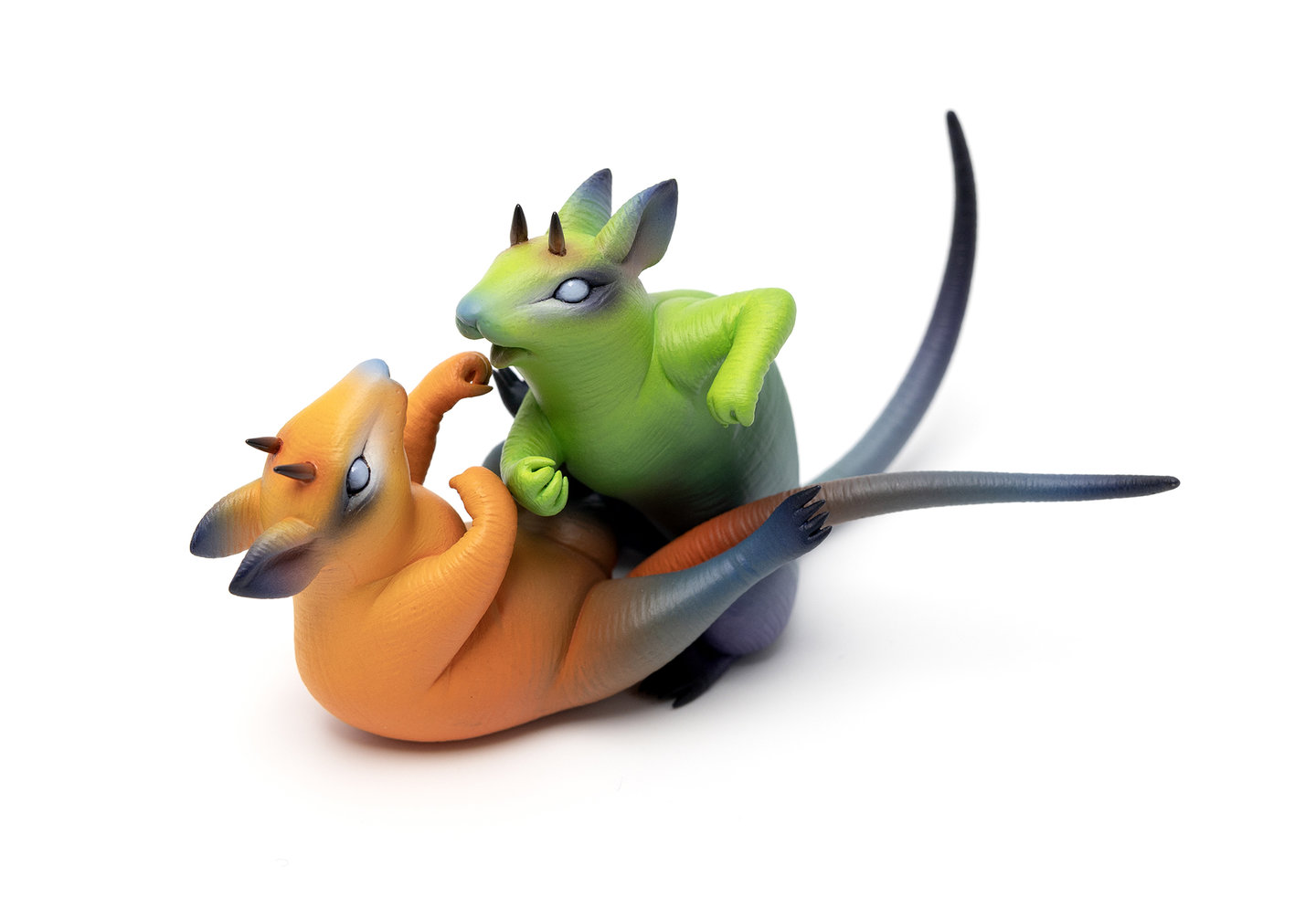
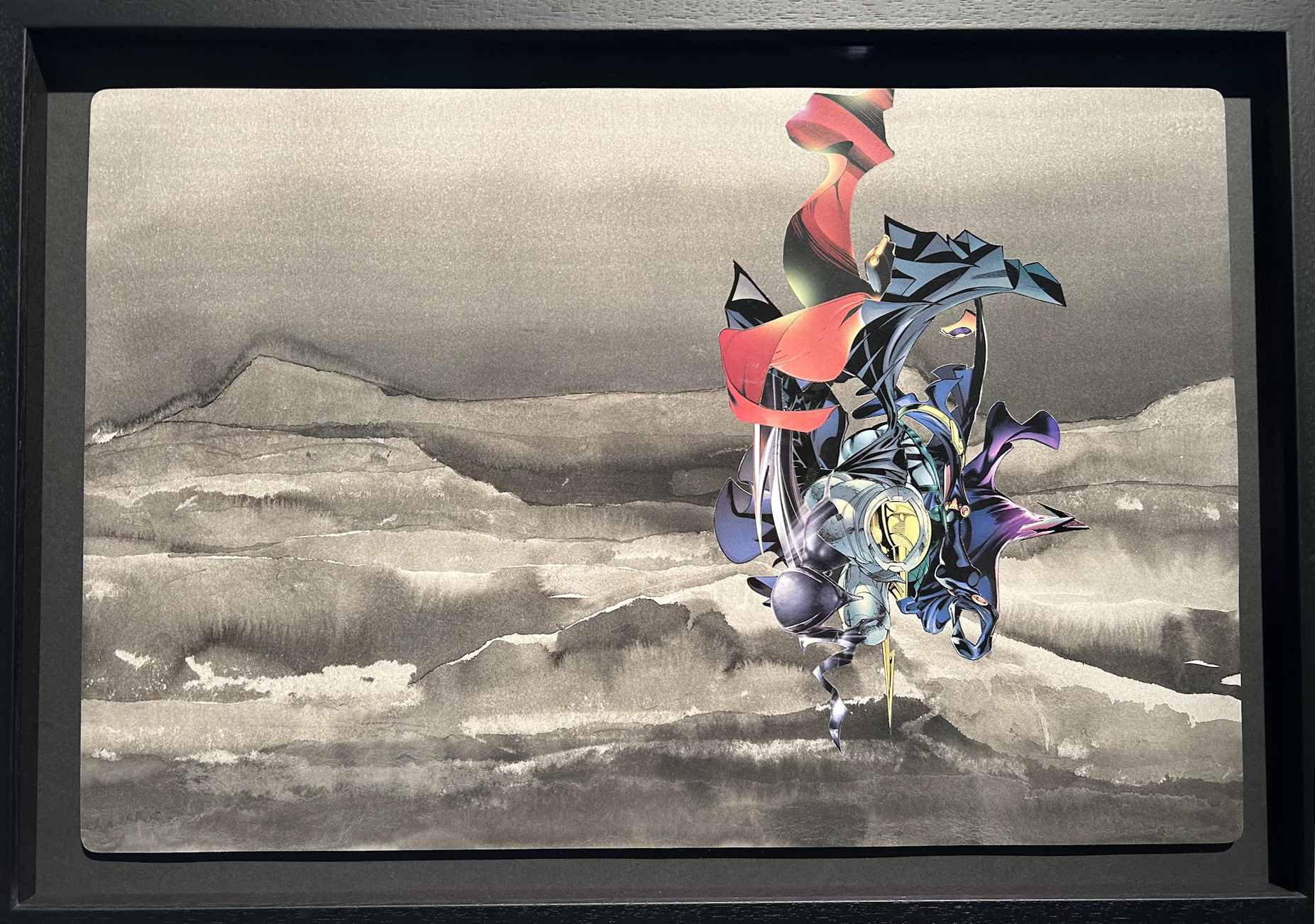
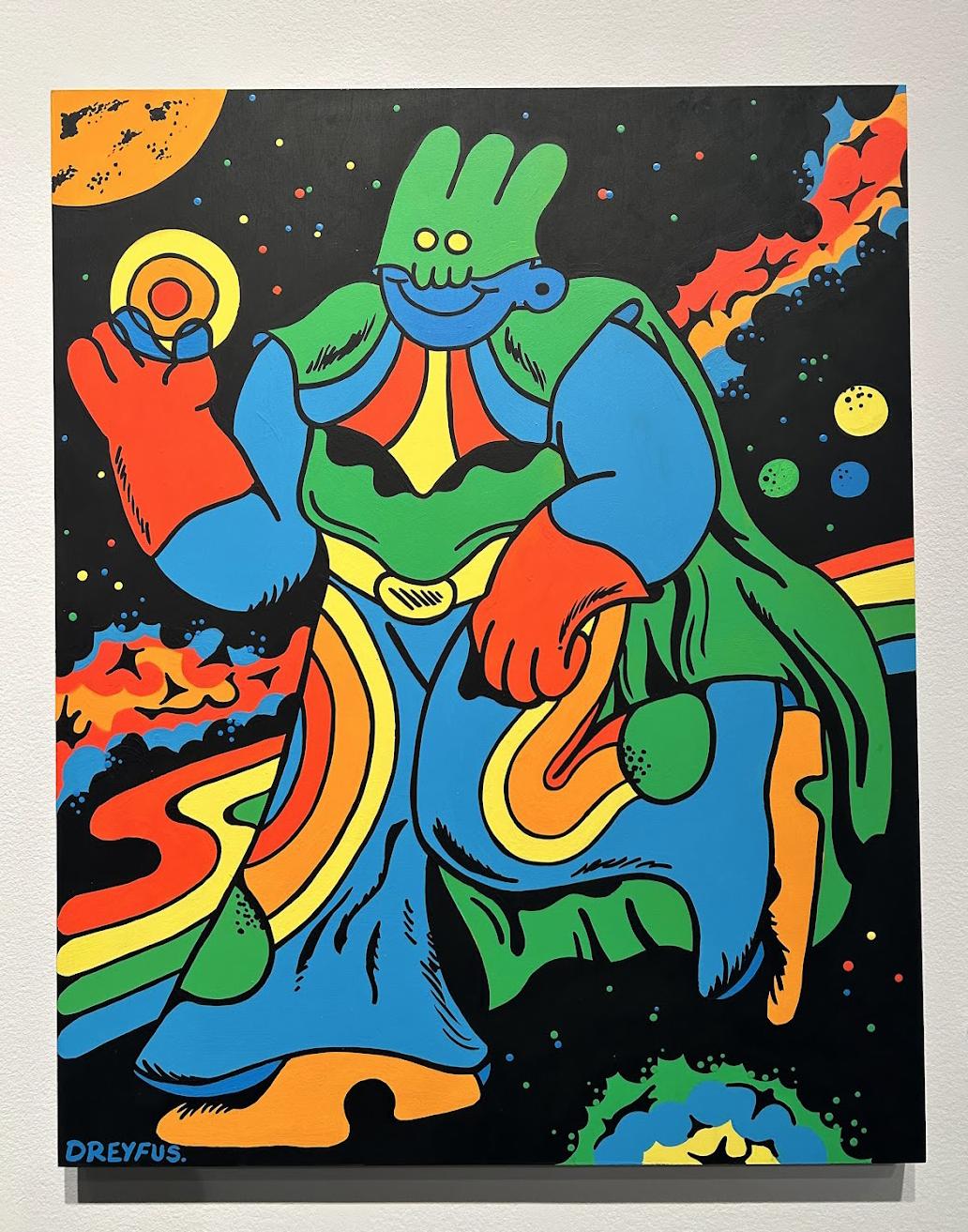
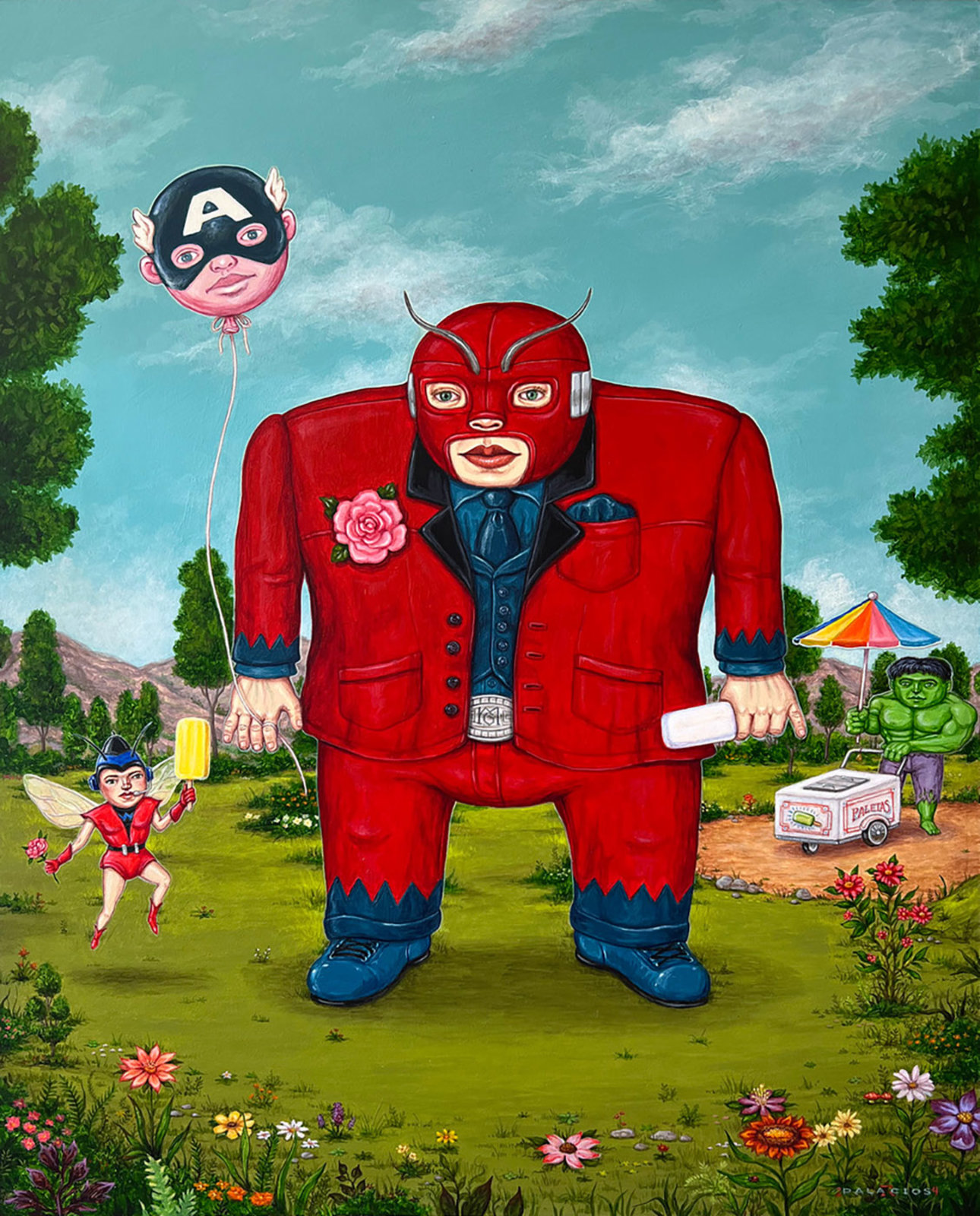
Most of Kirbyvision is presented in traditional white-cube style, with works on the walls proceeding clockwise. Some of the works are homages or détournements of recognizable images by Kirby, such as Patrick McDonnell’s Captain America canvas, The Last Superhero, or Tom Morehouse‘s collage, Kirby Crime, which mashes up images culled from decades of Kirby’s work in crime comics. On the other hand, some works are looser evocations of theme or genre that do not strive to be graphically Kirbyesque, such as Erika Sanada’s miniature ceramic Versus, with its two cute, rabbit-like critters locked in combat, or Aaron Noble’s collage The New Man, which blends swirling, cape-like elements, culled from various drawings of superhero costumes, into a hovering, abstracted shape. Some works cleave to a stylized naturalism familiar from mainstream comic books, while some are more explosively graphic, like Charles Glaubitz’s crackling acrylic and gouache drawing Teach Your Children That We Come from The Stars. Some are sober, but others playful, like Ashley DreyfusAtomic Man, a groovy, bell-bottomed hero, or Robert PalaciosGiant Man’s Day Off, a charming portrait of the Marvel icon as luchador (this and several other pieces reminded me of artists like Mark Ryden or Ivana Flores who traffic in subversive neotenic cuteness, a common enough approach nowadays). Overall, techniques on view range from rubbery cartooning to airbrushed polish, from precisely rendered surfaces (again, Slater) to frenetic painterly smudging.

(Images below of individual artworks are from coreyhelfordgallery.com unless otherwise credited.)
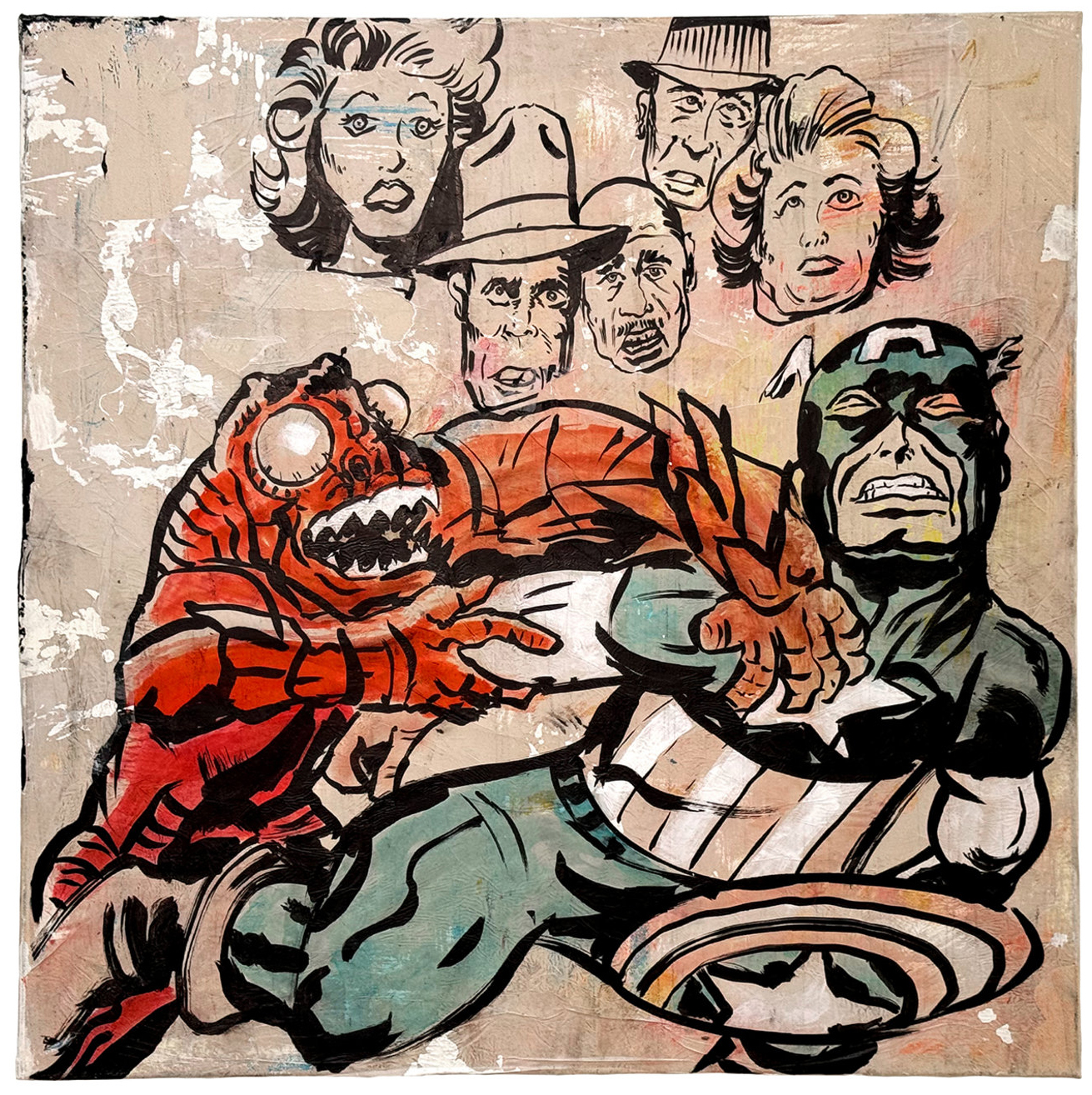
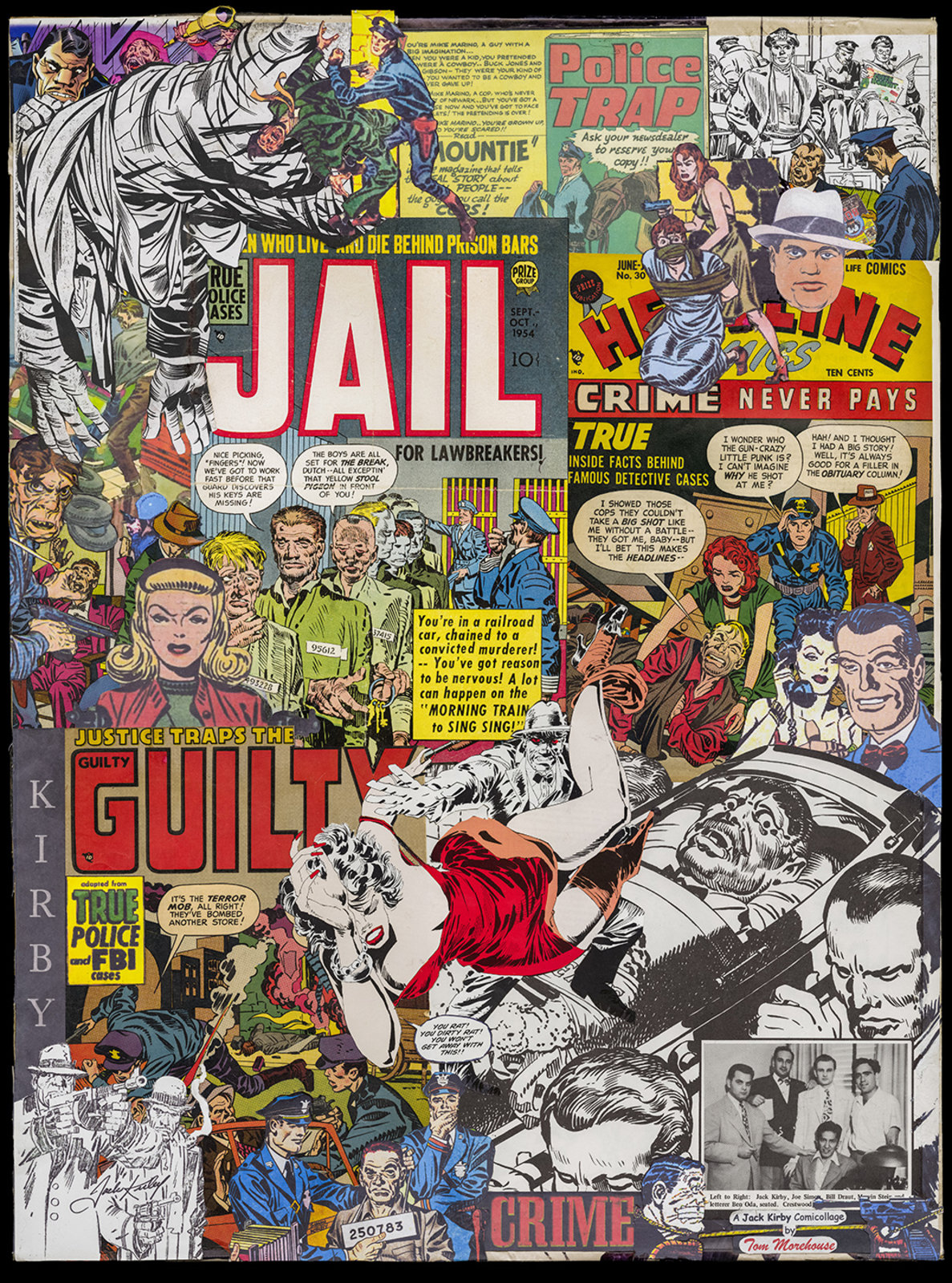
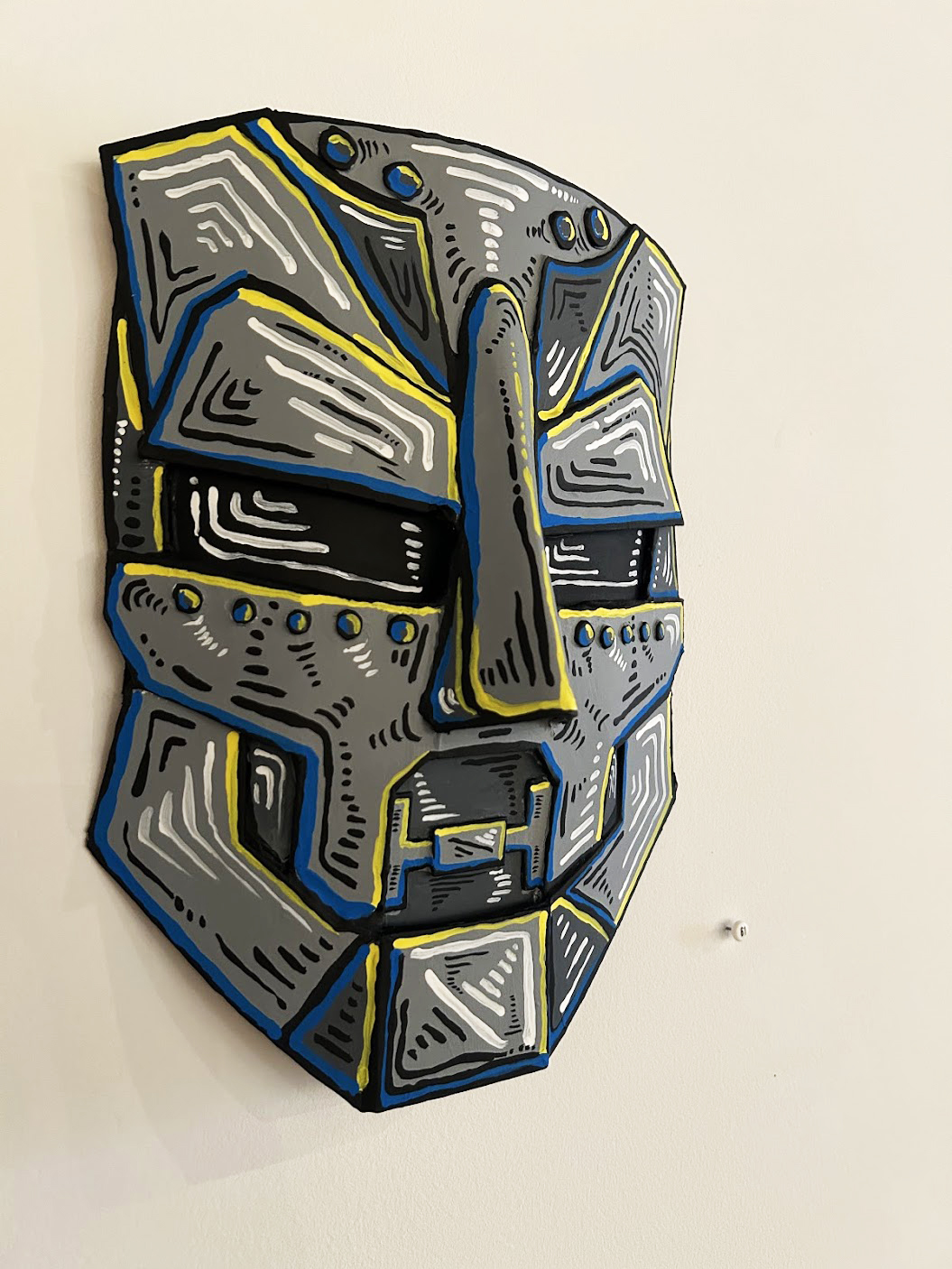
Many of my favorite pieces here depart from the Kirbyesque, or do Kirby style in odd, left-field ways that I find refreshing. These would include the life-size Dr. Doom Mask (acrylic on sculpted cardboard) by artist Nonamey; the canvas Five Cents, by Shaky Kane, which turns Kirby’s Captain America into an outsize bubblegum card; and Mark Frauenfelder’s Flower, Daughter of Googam, which bizarrely combines Flower, Kamandi’s near-nude wild-child love interest, with references to an early-1960s Marvel monster.
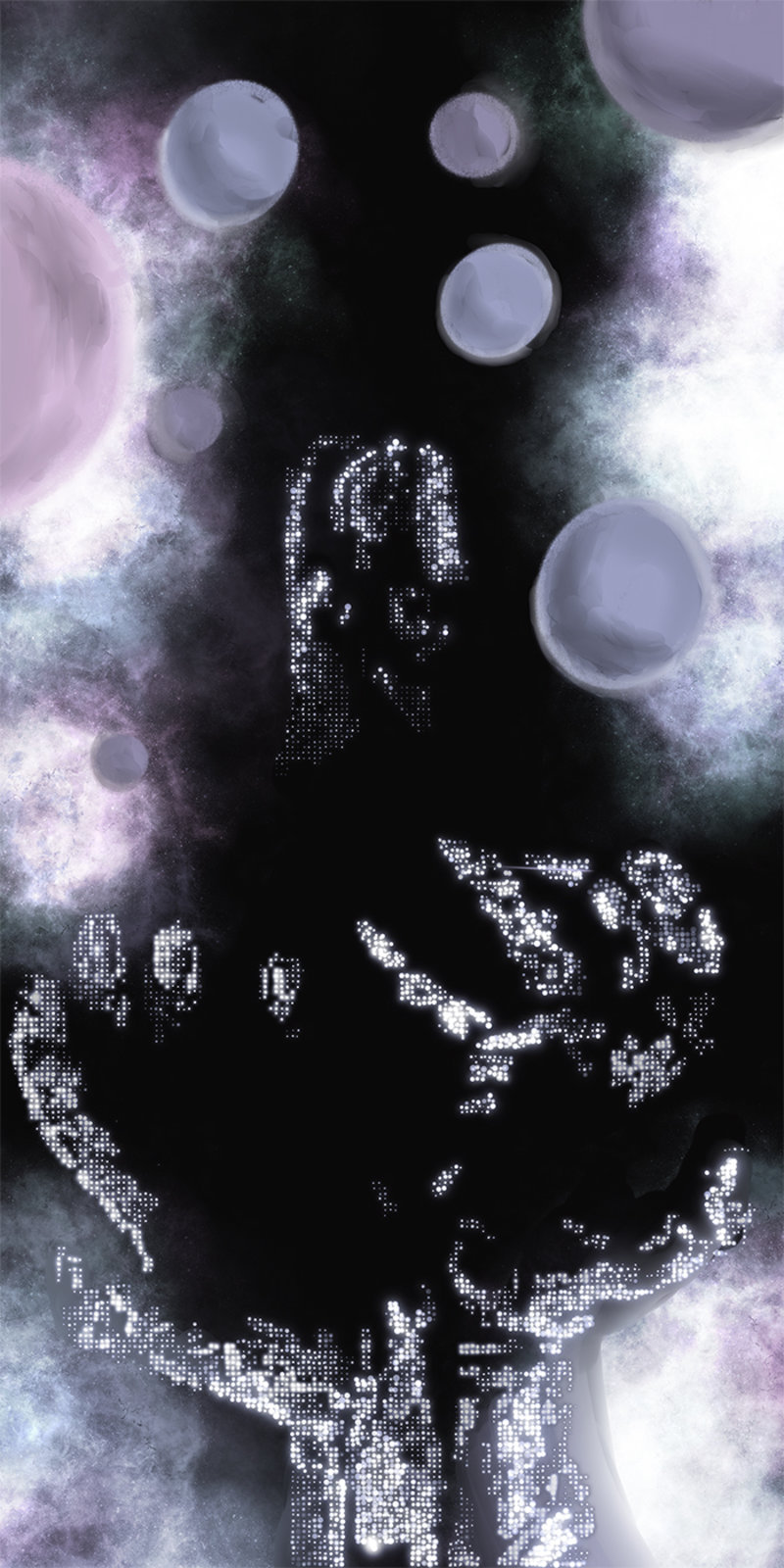
For me, one of the coolest spots in the show juxtaposes Mark Badger’s lively drawing Julius Caesar’s Ghost Appears to Brutus (a spinoff from his Kirby-inspired Caesar comics project?) and Sydney Heifler’s enigmatic digital print Rising, a dark, obscure image in which points of light (like glowing pegs on a pegboard) form a figure rising from two cupped hands, in a seeming homage to the Silver Surfer rising from the hands of Galactus. These are very different works, but their one-two punch delighted me (dig the big hands!). I’d say look out for odd moments of connection or contrast like this throughout.

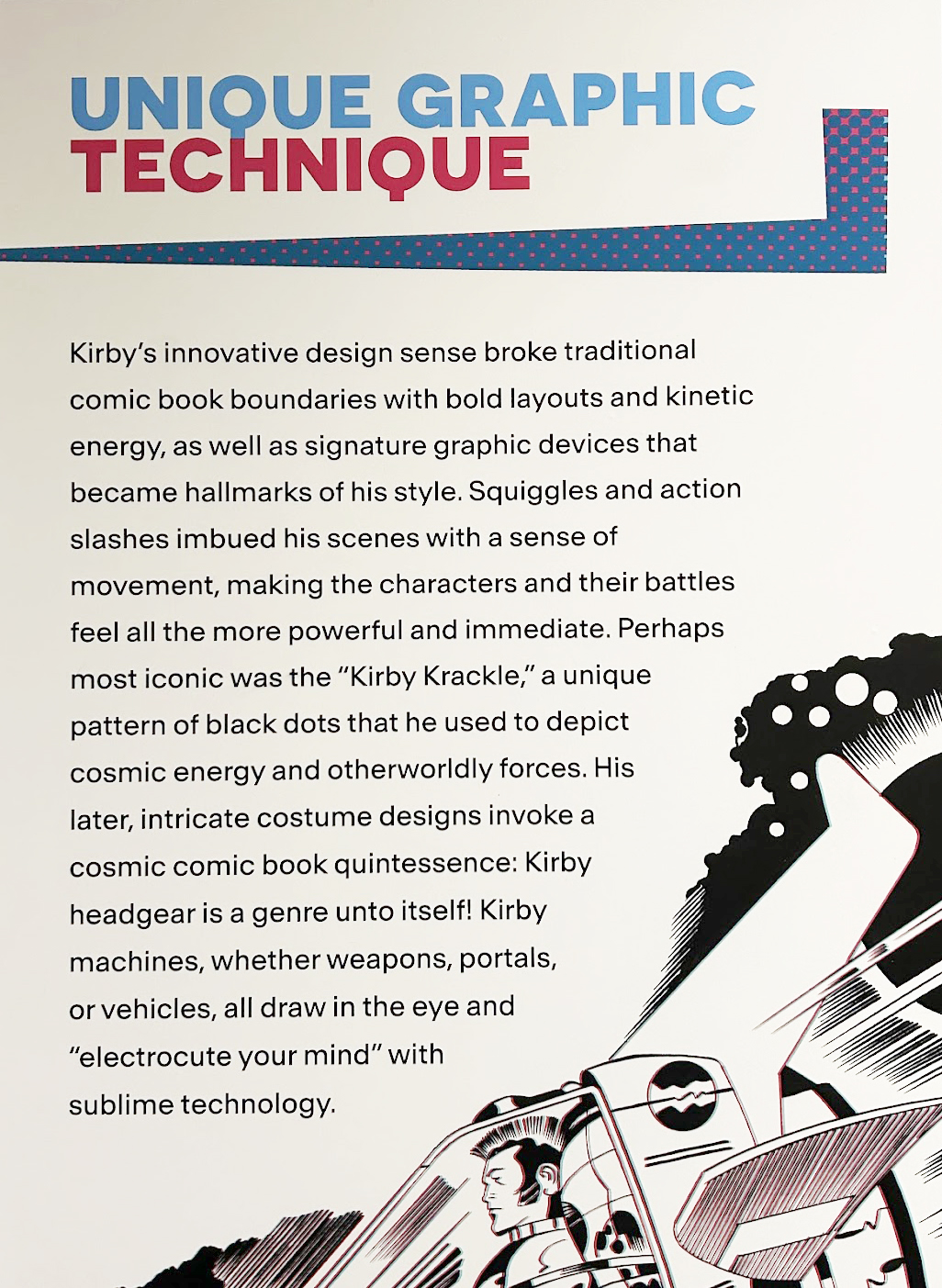
Besides paying tribute to Kirby, Kirbyvision contextualizes Kirby himself via a side gallery of Kirby originals organized by the Kirby Museum (the art on view in this side gallery, note, is not for sale). This is a smaller space, but dense with art and information. It feels distinctly museum-like, in the sense of didactic, yet also welcoming and visually sumptuous, building on the Museum’s track record of accessible pop-up exhibitions. Wall-mounted blurbs, succinct and informative, guide visitors through Kirby’s career thematically rather than chronologically. Newcomers to Kirby can learn a lot here about his graphic style, storytelling habits, range of genres, and famed titles and characters. The emphasis is on Kirby’s handiwork and the outpouring of his sensibility, not on corporate-owned IP (though there is plenty about that too).
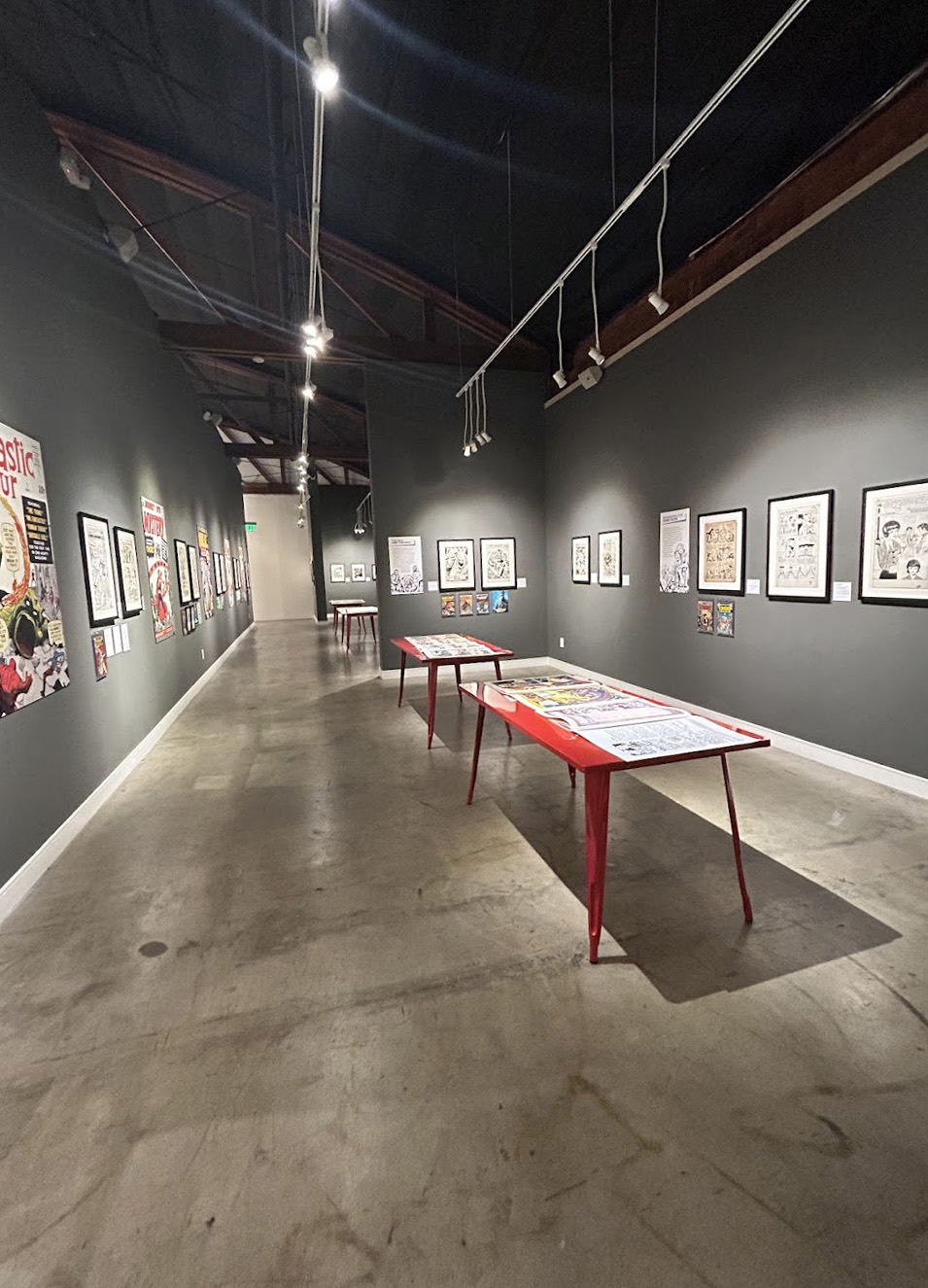
The originals, nearly fifty, are juxtaposed with reproductions of penciling process and, at the same time, images showing Kirby’s influence on screen adaptations (including the Marvel Cinematic Universe). Putting Kirby’s autographic work next to reminders of these adaptations feels like a deliberate strategy. One long wall represents well-known Marvel IP, including Captain America, The Fantastic Four, Thor, The Hulk, The X-Men, and The Avengers, while facing walls and tables lean into Kirby’s personal style and themes. The range of work shown, from 1940s to the 1980s, and from drawings to collages, suggests the arc of Kirby’s career. The genres sampled are many (and sometimes blurred), from superheroes, science fiction, and myth fantasy, to romance, crime, horror, and war. Many facets of Kirby are on display: his futurism, but then again his primitivism; his rapturous psychedelia, but then again his hard-hitting, lived-in urbanism. Various eras and collaborators are represented (among the inkers, I counted at least Dick Ayers, D. Bruce Berry, Vince Colletta, Frank Giacoia, Mike Royer, Joe Sinnott, Chic Stone, Mike Thibodeaux, and Kirby himself). Most importantly, this exhibit suggests something of Kirby’s outlook and spirit.

Along the Marvel wall.

I spent a lot of time in this historical exhibit, digging pages and spreads from, for example, Kirby’s Fourth World, 2001, “The Losers,” Kamandi, and In the Days of the Mob; three of his collages (2001, Spirit World, Captain Victory); contrasting Thors, inked by Ayers and Colletta respectively; a beautiful vintage page from “Just No Good!” (Young Romance #18, 1950), which I took to be mostly inked by Kirby; and on and on.

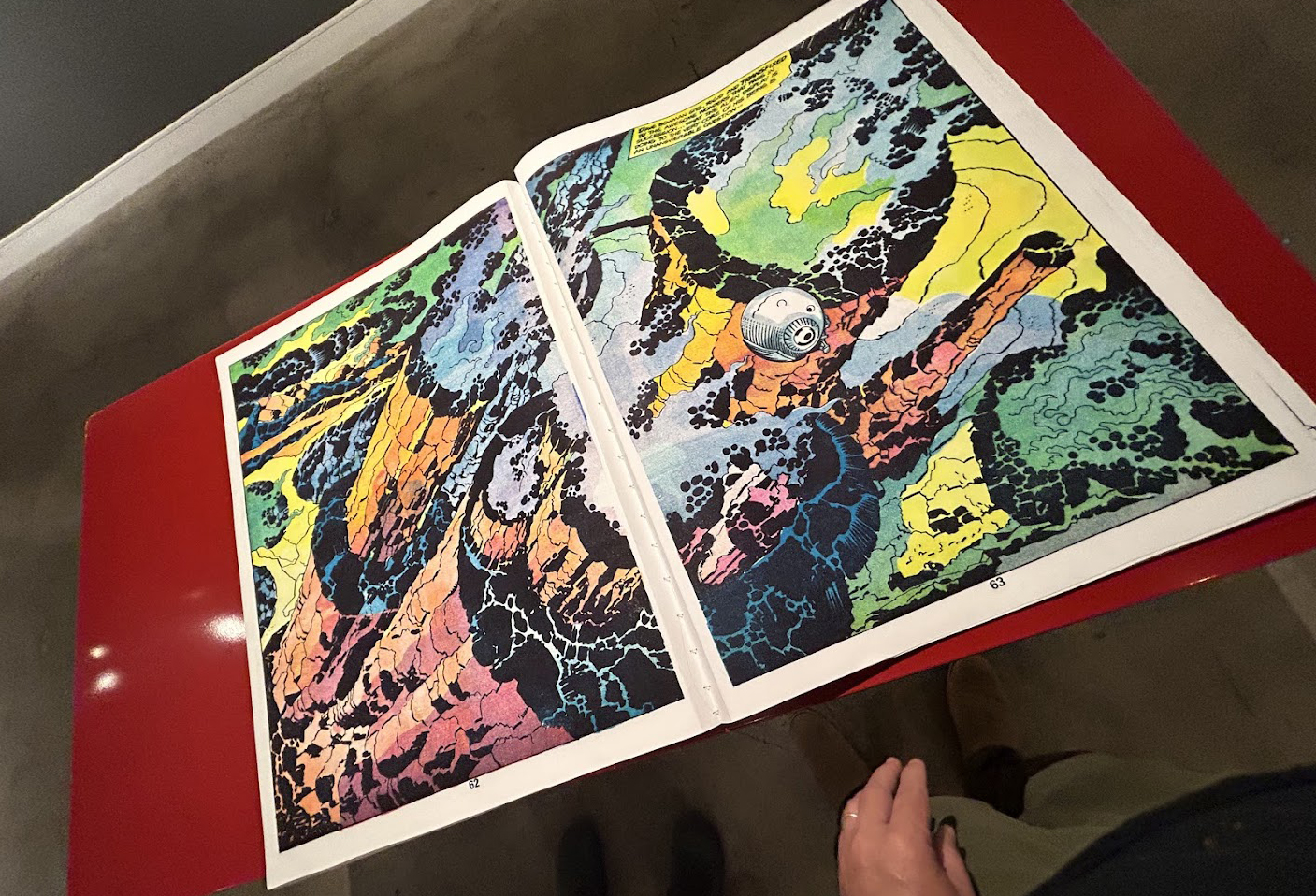
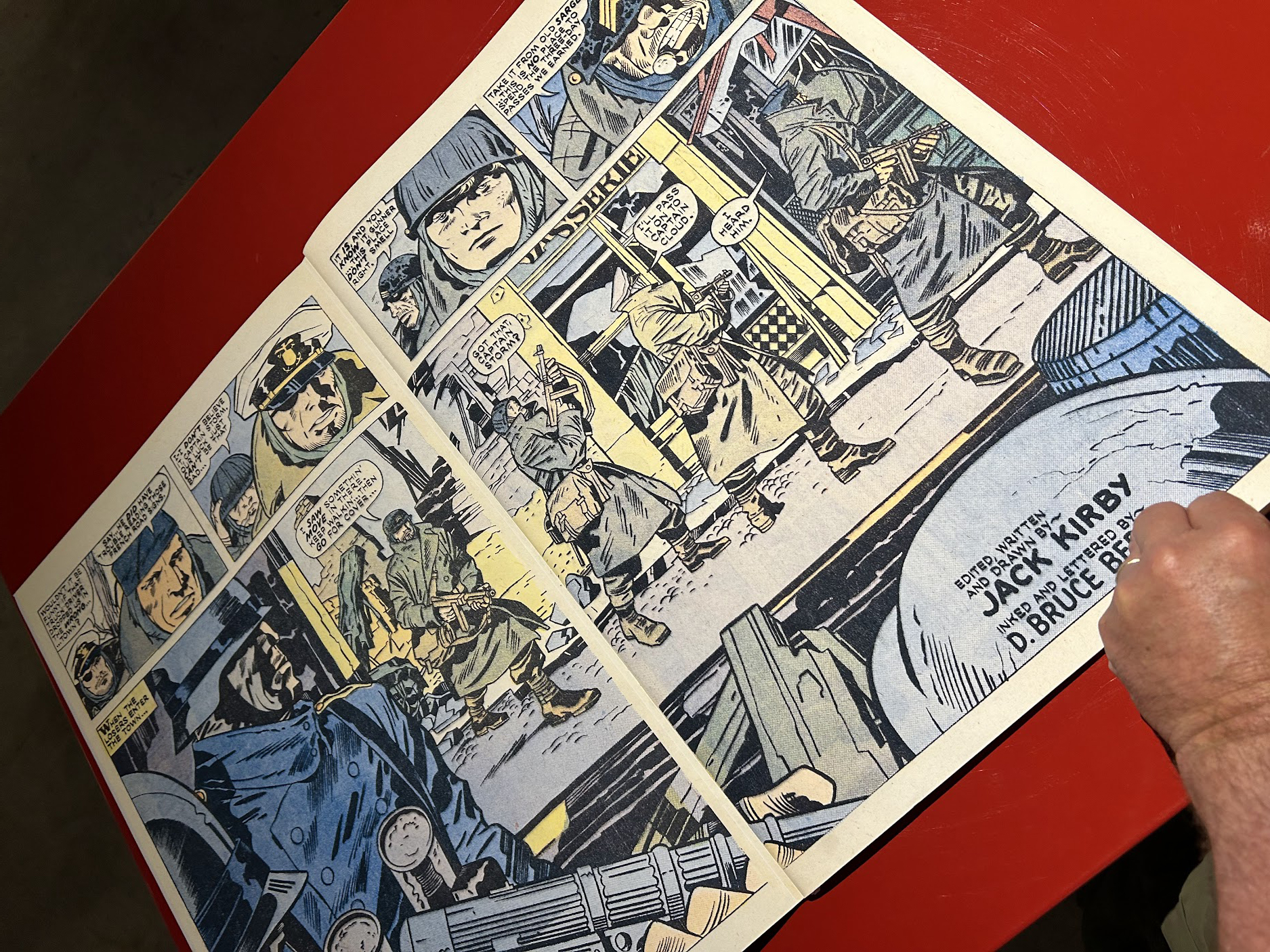
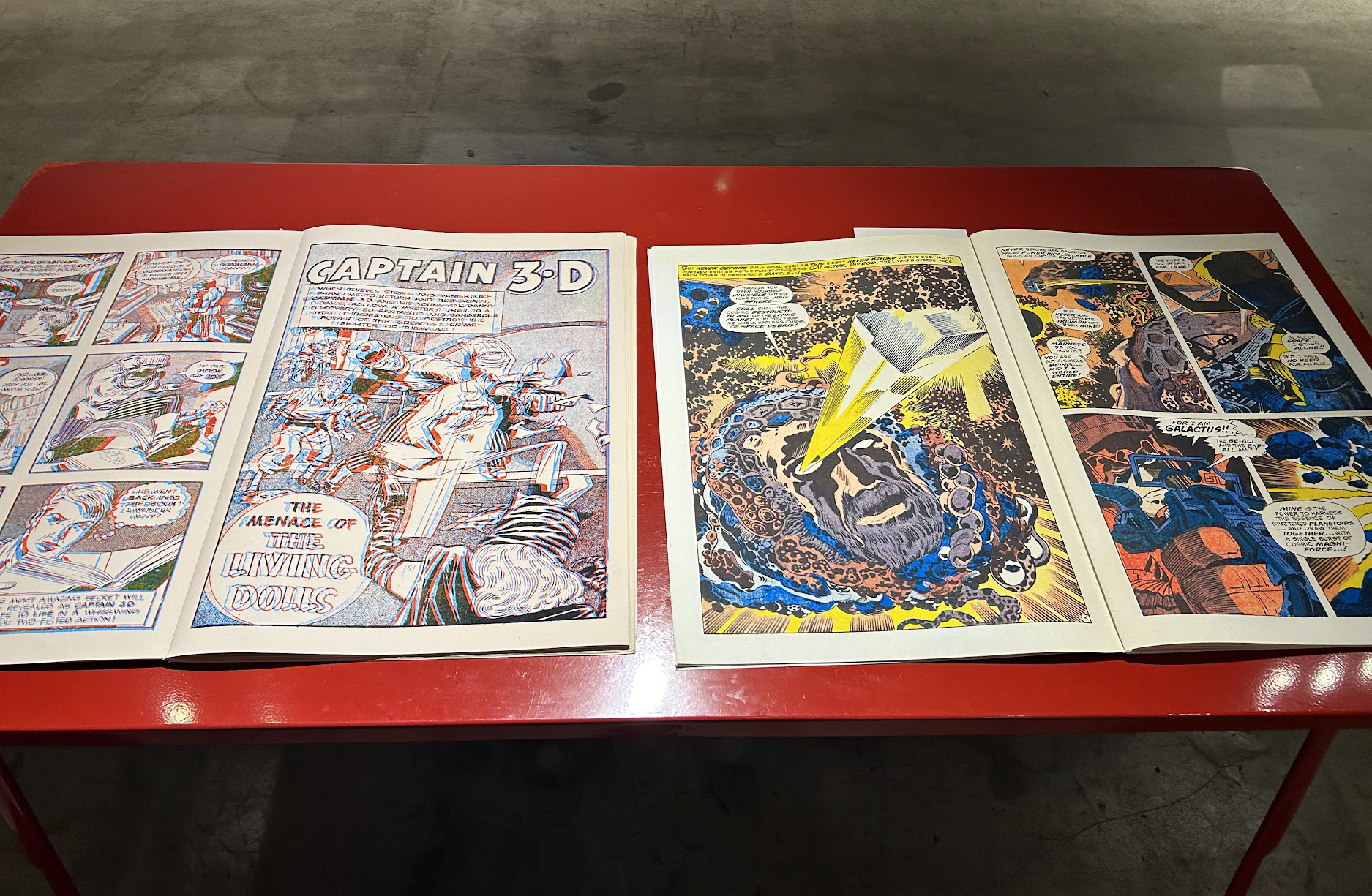
Another highlight of the side gallery is the presence, on four tables, of oversized facsimiles of Kirby comic books, complete with advertising and editorial matter as originally published. Tom Kraft, Kirby Museum President and design wizard, has been producing facsimiles like these since Kirby’s centennial in 2017. Scanning old comics at ultra-high resolution, he and his colleagues then print and bind them as enormous, durable books that visitors are welcome to flip through and read at leisure. These giant books cross the gap between comic art designed for reading and the more spectacular, scaled-up experience we typically expect in museums and galleries. They make it possible to see Kirby’s work up close as if you were a small child just learning to handle physical comics (their scale is both delightful and daunting!). On this occasion, the Museum has provided 17 by 22-inch recreations of Captain 3-D #1, Young Romance #8, Fantastic Four #48, New Gods #7, and Our Fighting Forces #152. I like this mix of famous and more obscure works. In addition, and this is the pièce de resistance, there’s a gigantic, 22 by 30-inch version of Kirby’s adaptation of Kubrick’s 2001: A Space Odyssey. This gets a table unto itself, which is good, because I spent a long time admiring its bombastic pages—some of which Kirby himself colored, in saturated, psychedelic mode. I’ve always liked the idea of exhibiting comic art in poster-sized yet readable form (an unfulfilled dream of mine for Comic Book Apocalypse), as it brings immediacy and accessibility to the gallery experience, and it’s great to see the Kirby Museum pulling this off.
Immediacy and accessibility characterize Kirbyvision as a whole. It’s a hardworking, vivid, extravagant show that captures some of what is wonderful about Kirby, as well as his galvanic influence on comics and culture. Everyone who spends time with it will come away with different observations and favorites. Kudos to the Kirby Museum and thanks to the Corey Helford for making this happen.

Tagged , , , ,

Kirbyvision: A Tribute to Jack Kirby

WHOA. Exciting news for Jack Kirby fans in or near Los Angeles:

The Jack Kirby Museum and Research Center is partnering with the Corey Helford Gallery in Los Angeles to present a large-scale Kirby-themed exhibition that opens next weekend on June 29th:

Kirbyvision: A Tribute to Jack Kirby combines original artwork by Kirby with new works by more than fifty contemporary artists inspired by him. Curated by the Kirby Museum, and presented within the Corey Helford’s 12,000-square-foot space in downtown Los Angeles, Kirbyvision highlights Kirby’s continuing and multifaceted influence on comics, media, and popular culture.

Kirbyvision will be on view from Saturday, June 29, to Saturday, August 3, 2024, and is free and open to the public. A free opening reception will be held on the show’s first day, Saturday, June 29th, from 7:00 to 11:00 pm.

The Corey Helford Gallery, founded in 2006, focuses on New Contemporary art, including figurative, Surreal, and pop culture-inspired work. Here’s where you can find it:

571 S. Anderson St. Los Angeles, CA 90033
Open: Tuesday-Saturday, 12:00 pm – 6:00 pm (admission free)
(310) 287-2340

Speaking personally, I can’t wait! I serve as an advisor to the Kirby Museum and have learned so much from their work, which has included exhibitions, panels, walks and talks, and videocasts and other online projects. They have been carrying the torch for Kirby and Kirby studies heroically, and they provided substantial and crucial design assistance, logistical support, artworks, and files for the 2015 Comic Book Apocalypse show I curated at CSU Northridge. It’s great to have another Kirby show here in town!

Jack Kirby at 105

105 years ago tomorrow — August 28, 1917 — Jacob Kurtzberg was born at 147 Essex Street on NYC’s Lower East Side, the first native-born American in his family. His parents, Rose and Ben, were immigrants from Galicia, in what was then the Austrian-Hungarian Empire.

“Jakie” grew up in the claustrophobic tenements of the Lower East Side, scrabbling for territory and opportunity like so many other kids around him. He ganged up with other kids. He fought with other kids. He read, soaked in movies like a sponge, made up stories in his head, and drew, drew, drew. He eventually drew himself and his family out of the Lower East Side.

As Jack Kirby, he turned the world of American comic books on its head. We continue to reap the harvest of his tameless imagination, furious narrative drawing, and huge, thrilling, absurd ideas. What a force.

Damn. Splash page from Fantastic Four #95 (Feb. 1970) by Kirby and inker Joe Sinnott.

I suspect that Kirby always bore the weight of his upbringing around with him, in his mind, and in his drawing. The above image seems to bear that out.

#JackKirby105 #KirbyDay

The Comics of Jack Kirby: Call for Papers

Announcing a brand-new scholarly book project!

The Comics of Jack Kirby: Critical Perspectives on a Legendary Artist

Edited by Craig Fischer, Charles Hatfield, and Susan Kirtley

Under contract to be published in the University Press of Mississippi’s series Critical Approaches to Comics Artists, edited by David M. Ball

CALL FOR PROPOSALS

More than a quarter-century after his death, Jack Kirby (1917-1994) remains one of the most talked-about creators in the annals of the American comic book. Best known as the archetypal superhero artist and visual architect of the Marvel Universe, Kirby in fact went much further, creating diverse other comic books for many publishers as well as working in animation and comic strips and on sundry projects. An imaginative dynamo, he set a standard for the whole comic book industry. By now, Kirby studies is a thriving fan phenomenon: the source of unending books, articles, and commentary across social media. Despite this, Kirby has received little academic attention. This interdisciplinary collection of essays seeks to change that, and to expand the discussion of Kirby’s work beyond the familiar pathways of biography and homage.

Recent work in comics studies has questioned what gets valued in academia, and why. Inspired by that trend, this project aims to give Kirby’s work the critical study it so richly warrants. We seek to include a diversity of voices and approaches, and to move past the contentious claims to credit or ownership and anxieties about status that have preoccupied Kirby studies to date.

We recognize Kirby as both collaborator and distinctive author: a creator who wrote as well as drew stories throughout his long career. We take it as given that he did not simply illustrate but envisioned, designed, plotted, and often scripted work for Marvel and many other publishers. Kirby’s distinctive style and concerns are manifest across his entire body of work, from his early takes on familiar genres in the 1930s, through his romance, kid gang, superhero, and other comics of the 1940s and early 1950s, to his foundational work as writer, storyteller, designer, and house stylist for Marvel in the 1960s, to the auteurism of his late comics. We invite studies of Kirby as collaborator or sole author, as influence and idea.

We seek argument-driven, historically and theoretically informed work on topics such as, though not limited to: 

  • Kirby and romance (one of the most popular genres in comic book history)
  • Kirby’s other genres: war, westerns, science fiction, crime, humor, superheroes, etc.
  • Gender and/or sexuality in Kirby’s work; Gender Studies and queer theory perspectives on Kirby
  • Race and ethnicity in Kirby’s work; perspectives from ethnic studies and critical race theory
  • Childhood or youth in Kirby’s work
  • Kirby vis-à-vis disability studies
  • Kirby vis-à-vis critical animal studies
  • Teaching Kirby: pedagogical perspectives
  • Other works of art in dialogue with Kirby (adaptation, homage, critique, or challenge)
  • Kirby and Kirbyism on screen
  • Posthumanism, transhumanism, and machine life in Kirby
  • Soldiers, super-soldiers, and militarism in Kirby
  • Religion or spirituality in Kirby
  • Simon & Kirby: the partnership, the shop, the brand
  • Collaborative processes across Kirby’s career
  • Kirby in newspapers: his neglected comic strip and panel-cartoon work
  • Aesthetic and formal dimensions of Kirby’s graphic storytelling
  • Kirby’s way with words, i.e., prose style, narrative voice, dialogue
  • Kirby as collagist
  • Kirby in the art gallery or museum
  • Kirby and/in cosplay or fan art
  • Anti-fans of Kirby: the social, ideological, or aesthetic logics behind aversion to his work
  • Kirby as meme; Kirby as character

We prefer contributions that engage with social and historical contexts and attend to visual and aesthetic as well as narrative and thematic dimensions. Proposals for work in alternate formats (beyond that of the academic essay) are welcomed. Again, we aim to include diverse voices and perspectives.

SUBMISSION GUIDELINES

Interested authors should submit an abstract (500-1000 words) and a biography of no more than 200 words to kirbystudies@gmail.com by February 11, 2022. Please note that submission of an abstract or paper does not guarantee publication. All applicants will be notified by April 8, 2022. Completed chapters of 6,000-8,000 words will be due by October 14, 2022, with the goal of publishing the volume by late 2023. The editors will pursue funding to bring contributors together for a Kirby studies symposium (virtual or in-person).

All of the Marvels: Douglas Wolk’s Marvel Story

You may have heard about Douglas Wolk’s new book, All of the Marvels: A Journey to the Ends of the Biggest Story Ever Told. Frankly, it’s a stunt: what if one reader actually read all of the comic books that make up the Marvel Comics universe, that is, the 27,000-plus comic books published since 1961 that together add up to Marvel’s superhero world? What discoveries or patterns might be gleaned by reading and taking stock of so much stuff? Academics these days might call this approach (after Franco Moretti) distant as opposed to close reading: an overview or sweeping interpretation of a massive set of texts rather than the minutely attentive reading of a small set—essentially, a macroscopic rather than microscopic approach. The thing is, “distant reading” is usually understood to be a matter of machine reading and computational methods (it’s a term much used in the digital humanities). Douglas Wolk is not a machine or array of machines, but one splendidly quirky, human reader. All of the Marvels may sound intimidatingly geeky, but it’s a loving, very personal project—a barnstorming exegetical feat fueled by sheer gushing enthusiasm. Even Marvel’s unloveliest excesses, its long dull stretches and occasionally mortifying missteps, cannot quench that feeling. The stunt turns out to be a delight.

Honestly, when I saw the PR for this book, I got skeptical. Billing Marvel’s piecemeal continuity as “the longest continuous, self-contained work of fiction ever created” begs a lot of questions. To make one story out of Marvel’s corporate patchwork, the stuff of serial comics by an ever-shifting crowd of artists, writers, and editors for hire, spread out over decades, seems either too optimistic or a surrender to hype. Cynically, I can’t help but see Marvel’s “story” as an ever-expanding incoherence, driven by unending opportunism, impersonal editorial mandates, relentless deadlines, and the sort of artistic interchangeability that work for hire demands. My internal argument would go something like this: There is no singular creative intelligence or cohesive collaborative team, nor even a distinct series of deliberate teams, behind the sprawl of Marvel, and the supposed continuity between comics published in the 1960s and comics published now is simply a commercial requirement of the superhero genre, a matter of desperately imposing shape where there is none. Believing in Marvel’s “continuity” amounts to willfully ignoring its publishing history, indulging in a kind of kayfabe that tries to wave away the incoherence even though we all ought to know better. There’s no big story here, I would say, only an accumulation of disparate comics united by branding.

BUT. One of the wise things about Wolk’s book is that he acknowledges all this. He knows that the continuity he can read into the Marvel story “wasn’t molded intentionally, for the most part” (331), that it came about through reckless improvisation prodded by commercial imperatives. He knows that “Marvel” isn’t one thing. Reading Marvel as one story is a creative act, and Wolk does it his way, according to his interests and pleasures. He encourages his readers to do the same, to “stray from the path,” follow their own curiosity, and indulge their tastes (21). Wolk himself, being a great conversationalist, does a fine job of evangelizing for his tastes, but less in terms of what is “important” and more in terms of what’s cool. All of the Marvels is a record of aesthetic delectation. For Wolk, “Marvel” becomes an idiosyncratic reading practice that does not, thank goodness, require a plodding chronological march through sixty years of comics starting in 1961. Marvel is a pond to swim in. Whether to wade in the shallows or plunge into the deep end, or whether to dogpaddle or swim strict laps, is up to you. Acknowledging the discontinuity of Marvel Comics, but still building his own continuity out of it, Wolk remains interesting on his own terms from first to last. He is a remarkably affable and unstrict guide, cheerfully acknowledging Marvel’s shapelessness even as he imposes shape on it. Good for him.

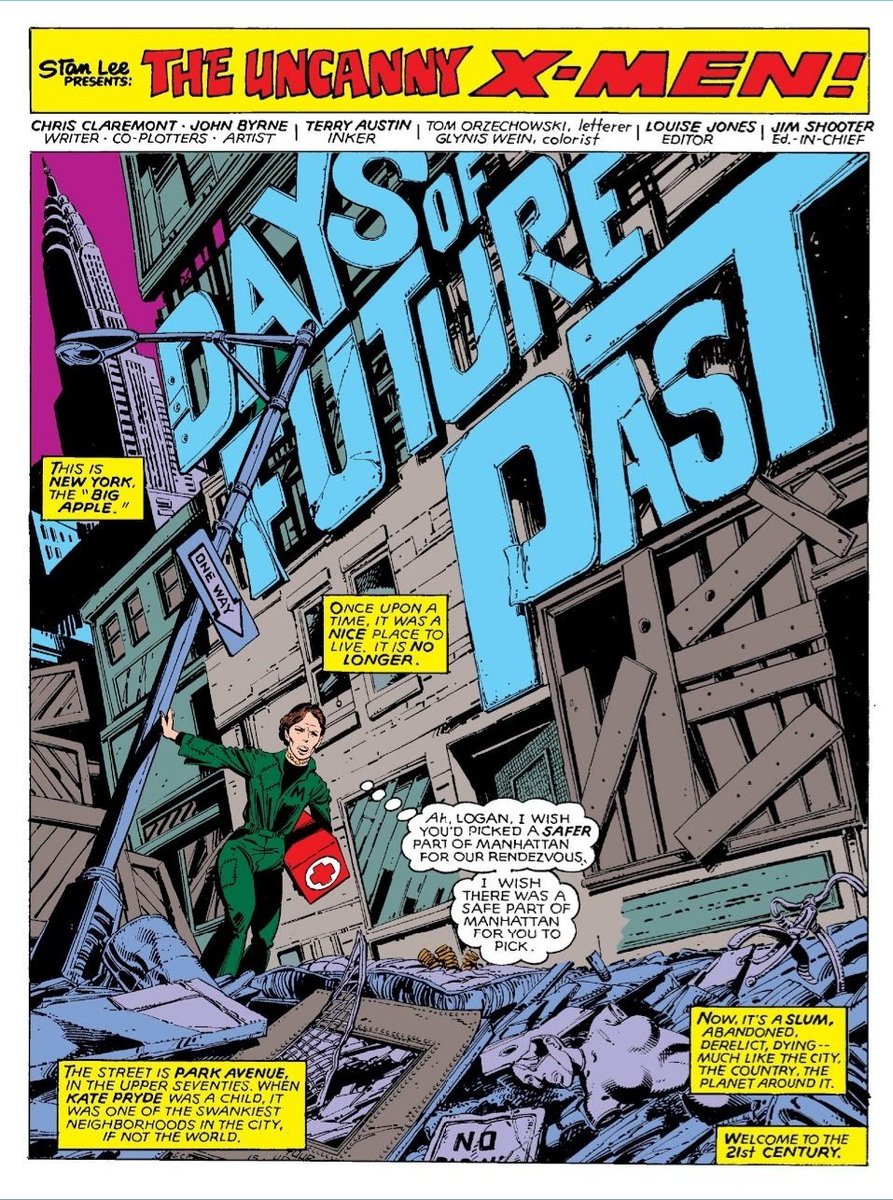
Opening splash to The Uncanny X-Men #141 (Marvel, Jan. 1981), by Chris Claremont, John Byrne, Terry Austin, Tom Orzechowski, and Glynis Wein.

All of the Marvels is refreshingly free of worry about the ever-controversial business of assigning credit for the “creation” of Marvel characters—instead, Wolk assumes creation to be an ongoing, massively collaborative process that can belong to no single person or single team. If that sounds like an ethical dodge, it isn’t—the book generously supplies creator credits, and Wolk delights in the distinctiveness of individual artists and writers. From the outset you can tell that, as he puts it, creators are at least as important as characters (34). All of the Marvels is not a paean to Marvel the company (after all, “a corporation can never love you back,” 328) but a way of remembering thousands of moments of pleasure provided by specific comics created by specific groups of people. In fact, Wolk spends a considerable amount of time on certain scriptwriters—not just Stan Lee, but Chris Claremont and Jonathan Hickman—and cartoonists, chief among them Jack Kirby and Steve Ditko, whom he regularly credits with plotting and character creation or co-creation as well as splendid narrative art. Though the book’s perspective is, obviously, not auteurist, Wolk knows and loves creators, and regards the various Marvel stories as personal work (even as he admits their market-driven and often formulaic nature). Reconciling a creator-focused vision with a sweeping overview of the Marvel Universe is quite a feat—and Wolk pulls it off.

Simply put, All of the Marvels is a wonder. I envy Wolk’s genuinely charming voice and ability to hopscotch around the Marvel Universe so freely. He covers light years in a single bound. There is a lot of bounding around in the book, which makes its clarity and focus all the more impressive. Because Wolk is such a friendly narrator to hang with, and so emphatically underscores the importance of inclusivity and shared fun, he makes the crazy tangles of Marvel feel like diverting mental puzzles and invitations to sociability, rather than migraines. More than anything, I’m thankful for the way he makes this admittedly uptight auteurist and originalist—that’s me, honestly, a reader who has tended to bemoan rather than celebrate the endless rewriting of the Marvel Universe—see the virtues and pleasures of its continual revision.

Granted, there are times when Wolk doesn’t convince me, as when he works hard to find the good in prolonged and gimmicky storylines like Dark Reign or The Superior Spider-Man. His readings tend to be very optimistic: for example, he reads the history of Spider-Man as one of distinct “cycles,” each with a windup and a payoff, whereas I tend to read it merely as a history of repetitive imitation and diminishing returns. I found myself wanting to argue with Wolk at times—but I think that’s part of the pleasure he has to offer. He surely knows that readers, even the most enthusiastic readers, will pick arguments with him. Though All of the Marvels is a determinedly bright and optimistic book, it’s not pollyannish or blind. Wolk starts from the recognition that a great many Marvel comics are bad, and acknowledges that “there is cruelty and unfairness to creative geniuses stamped into every page” (27). He is able to find pleasure in the big patterns and the long haul, yet at the same time invites debate on a thousand points—indeed, the book practically begs for trash-talking, clubby exchanges with fellow fans. Criticism and debate, after all, are inevitable (and pleasurable) aspects of fandom. I don’t think Wolk would have it any other way.

Wolk can occasionally be quite critical. He despises the Punisher (“a wish-fulfillment figure for bloodthirsty creeps”), dislikes the original Secret Wars of 1984 (“superhero comics’ peak intersection of rapacity and artlessness”), and joins the chorus of those lamenting 1990s Marvel for opportunism and crassness (“increasingly incoherent exploits of wasp-waisted babes and muscle-bound men”). Yet he goes for a reparative reading whenever he can. Sometimes he notes troubling tendencies that he doesn’t bother to criticize, as when, for example, he cheerfully acknowledges the “nihilistic” (his word) ethos of Hickman et al.’s Secret Wars of 2015-2016 (I gotta admit, he does make me want to go read all of it). I wish he’d dig in more at moments like that. Also, he does some sleight of hand here and there, brandishing his artistic license, as it were, to keep the book focused: Notably, he personifies the Marvel story as a character with agency and a life of its own, as if it were a person living through interesting times. For example, regarding the nineties, he says, “the story has been looking back on itself—sometimes nostalgically, sometimes critically—and by 2004, it’s trying to shake off its repetitions” (347). This way, Marvel becomes a character that takes its knocks but keeps picking itself up and getting back in the race. This is a good strategy for making every fall a fortunate fall—perhaps that’s a little too convenient?

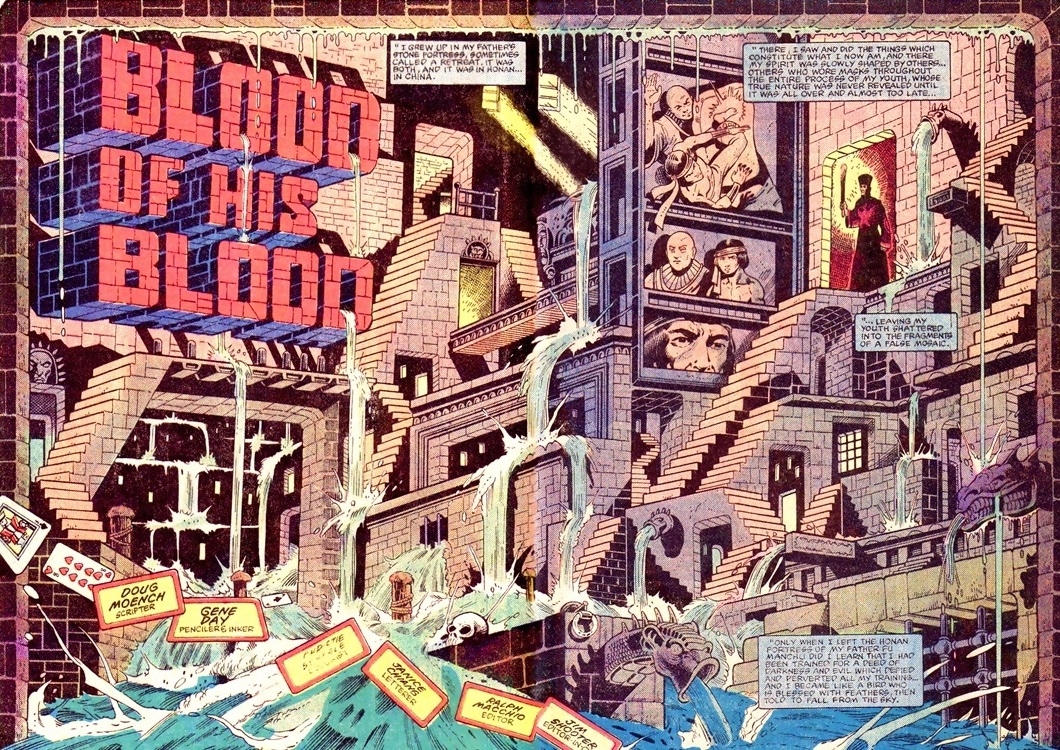
Double-page spread from Master of Kung Fu #116 (Marvel, Sept. 1982), by Doug Moench, Gene Day, Christie Scheele, and Janice Chiang.

But, thanks to Wolk, I can now read or reread Marvel comics with greater enjoyment, even in cases where I think they’re rigged or derivative. That is, I take a new pleasure in the sense of belonging and possibility that All of the Marvels so happily promotes. There are gems scattered throughout the book, from the brief interchapter on pop musicians appearing in Marvel comics, to the ambivalent yet loving chapter on, of all things, Master of Kung Fu, to the beautiful final chapter about passing along his love of Marvel to his young son. A real highlight for me is the interchapter “March 1965,” which is another instance of the kind of up-close cultural history Wolk does so well in his book James Brown’s Live at the Apollo (with its focus on just a few days in October 1962). Every reader will have their own set of highlights, I expect.

No lie—this book is a tonic. Speaking personally, I owe Wolk a lot: This past year, living under lockdown, in the shadow of COVID, and knowing that Wolk’s book would be coming out in late 2021, I did what I had never done before—I got my money’s worth out of the Marvel Unlimited service by reading back and forth between the 1960s and the 21st century. That is, I started on the longest sustained binge-reading of Marvel Comics I’ve ever done (outside of research). This had the effect of naturalizing, for me, digital tablet reading of comic books—a bridge I’d been hoping to cross for years. Armed with the idea that I would get something out of Wolk’s book, and the thought that I might eventually design and teach a new Marvel-themed course, I got over my resistance to screen-reading Marvel comics. As a result, I’ve read some good comics and quite a few lousy comics, plus reread a few old faves, and put them all into new contexts. The arrival of All of the Marvels has made this process, well, not complete (never complete!), but even more enjoyable. Wolk’s tome, this insanely ambitious tour guide, suggests diverse new entryways into, and so many different possibilities for teaching, whatever it is that Marvel has become and keeps on becoming.

So, wow. Do yourself a favor and read this book, if you haven’t already!

PS. I took in part of the book through the audiobook version, read by Wolk himself. It’s a delightful commuting companion. 🙂