Harry Mendryk on Hand of Fire

Harry Mendryk on Hand of Fire

Simon & Kirby expert and blogger extraordinaire Harry Mendryk recently commented on Hand of Fire in encouraging and properly critical terms, noting some of its strengths and fencing with some of its claims. I’m delighted to hear from Mendryk, one of the most expert and dedicated readers of Kirby’s early work and an important source of information about Simon & Kirby in particular. His Simon and Kirby blog is essential reading! (Note that Mendryk performed the art restoration on Titan’s recent and splendid Simon & Kirby Library.)

I’m encouraged to know that Harry finds the book’s discussion of the origins of the Marvel Universe balanced and credible, and that he considers its take on the Fourth World “the best that I have ever read.” I also find his comments about Kirby’s art, which take exception with one of my claims or at least my phrasing, very important. Here’s his conclusion:

[Hand of Fire] is a great book if you want to enter into a discussion about Jack Kirby and his art. You may not agree with everything Hatfield writes, but you will understand why he takes the positions that he does and you may [find] his ideas challenging.

Heartening words indeed! Thanks, Harry, for extending the conversation.

Review and Interview @ Ler BD

LerBD, um blog de Pedro Moura

I’m delighted to see the international interest in Jack Kirby and Hand of Fire. Portuguese comics scholar Pedro Moura has reviewed the book and also interviewed me at his blog Ler BD!

Both the review and the interview are in Portuguese, so, given my unfortunate lack of Portuguese, I’m having to rely on Net-based translation engines—yet I’m able to tell that the review is substantial, wide-ranging, and minutely attentive to the book’s text. Moura has delved deep. Here is the review’s opening, which sets the scene, describing the book’s methodology and range:

O propósito de Hand of Fire não é providenciar nem uma biografia nem uma bibliografia, como Charles Hatfield explica, ambos discursos que existem sobejamente em circulação sobre Jack Kirby. É antes a apresentação de “um ponto crítico de acesso e escrutínio, algo que ajudará quer leitores não iniciados quer fãs de Kirby a apreciar e contextualizar os seus trabalhos mais celebrados” (pg. 14). Este volume deve ser entendido, portanto, como um volume académico no seu sentido mais vincado sobre um dos mais celebrados, conhecidos e importantes autores da banda desenhada moderna norte-americana mainstream, sobretudo no género dos super-heróis, género para o qual Kirby contribuiu de uma forma decisiva em várias das suas fases de desenvolvimento. Como se depreende daquela citação do autor – “os seus trabalhos mais celebrados” -, Hand of Fire não dedica a sua atenção analítica de um modo equilibrado e contínuo a toda a obra de Kirby, mas concentra-se numa meia-dúzia de trabalhos que se podem considerar como os mais significativos, não só na produção do próprio Kirby como também no papel que assumiriam na complexa rede de referências que comporiam, numa primeira instância, os chamados “universos ficcionais” das duas grandes companhias dos super-heróis mainstream, a Marvel e a DC, mas também toda a economia e mecanismos narrativos que estariam associados a esse género. Dessa forma, é possível eleger uns quantos casos de estudo que se tornam palco de manipulação dos vários instrumentos analíticos de que Hatfield dispõem. O académico confessa, no fim, que o seu método é algo “vagabundo” (252), mas esse é o único processo possível quando se analisa uma obra de arte que tanto bebe do visual como do literário/narrativo, como ainda da história e da indústria do livro, da cultura popular, dos seus encontros com matérias de outros quadrantes criativos, da história local, da experiência de uma vida pessoal… Por isso os capítulos de Hand of Fire atravessam os registo histórico, teórico, social, sobre os processos criativos, sobre o género, etc., antes de entrar propriamente em casos de estudo (a saga chamada de “Fourth World” para a DC e o papel de The Eternals na continuidade da Marvel).

Note the link to Moura’s own article on The Eternals!

Throughout his review, Moura engages with key concepts in the book, particularly that of narrative drawing (“desenho narrativo”). Clearly he has read Hand of Fire with particular care—so I look forward to fully translating the results. The few passages I’ve roughly “translated” so far are very impressive, and encouraging!

Look for a link to the downloadable PDF interview at the very end of the review, where the text says:

Como de costume na nossa abordagem a livros desta natureza, temos de agradecer a Charles Hatfield, por ter dedicado parte do seu tempo a responder a um conjunto de perguntas, numa entrevista que podem ler, em português, aqui.

(Clicking on the word aqui—meaning “here”—will take you to the interview.)

Moura and I conducted the interview in English, and then he translated it into Portuguese. I hope the full English version too can eventually be made available!

You can also download the PDF by clicking here.

Thanks to Pedro Moura for spreading the word and enlarging the scope of the conversation!

Essential Reading: Growing up Kirby

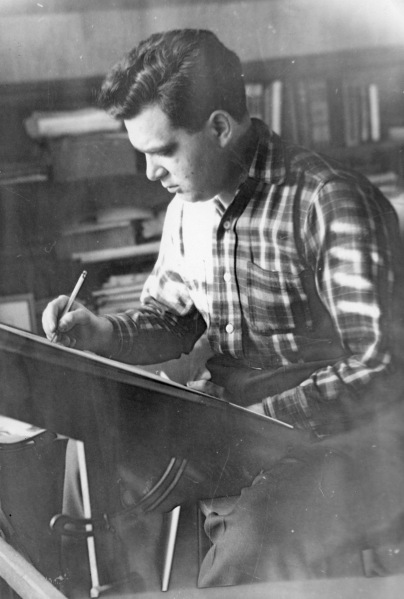
Jack Kirby at work in The Dungeon, East Williston, Long Island, c. 1949

Jack Kirby’s son Neal (b. 1948) shares a wonderfully vivid, detailed remembrance of his father in the article “Growing Up Kirby: The Marvel Memories of Jack Kirby’s Son,” published yesterday, April 9th, on the Los Angeles Times‘ blog Hero Complex.

Besides being heartwarming and emotionally deep—a true, loving family portrait—this essay is a vital piece of Kirbyana, giving an atmospheric account of Kirby’s working habits in the basement studio in the Kirby family’s Nassau County, Long Island home during the 1950s and ’60s, the period when, essentially, Kirby laid the foundations of the Marvel Universe. Absolutely essential reading, for which I can only say a fervent thanks.

Tony Puryear Praises Hand of Fire

Mr. Miracle panel by Tony Puryear

Tony Puryearscreenwriter, designer, comics artist, and author of the graphic SF novel Concrete Park, now being serialized in Dark Horse Presents—has posted a glowing and very encouraging review of Hand of Fire to his blog.

I’m thrilled that Tony has found so much to admire in my book. Here is an excerpt:

… Hatfield takes us deep into the artist’s process and struggle in prose that’s always involving and rich. Hatfield knows his way around the semio-jargon, but makes it accessible to non-academics; you’ll feel smarter for having read this book.

As an artist, one thing I appreciated in particular was Hatfield’s explication of Kirby’s actual drawing…. Hatfield is sensitive to the way an artist’s style is an act of performance, but also the ways in which the marks that make that style create a rhetoric, a vocabulary of signs and references. In this book, Kirby becomes literally the textbook example of an artist whose very strokes, squiggles and yes, dots carry worlds of meaning. Hatfield is alert to the development of Kirby’s style, and his writing on the artists who influenced him, Foster, Caniff, Hogarth, is the best I’ve seen on this little-explored part of the Kirby story.

… When they teach Kirby in the schools, and they will, this book will be a vital part of the curriculum and I recommend it very highly.

I’m glad Hand of Fire has made such a strong impression on such an accomplished artist. Thanks, Tony, for this high praise!

Video from Modern Myths

Thanks again to Modern Myths in Northampton, Massachusetts, for hosting my first talk and signing for Hand of Fire on April 3rd! And thanks to everyone who came. I had a wonderful time discussing Kirby and highlighting the themes and concerns behind my book.

Modern Myths captured the event on video in six parts, and has posted all six on its YouTube channel, here (the link leads to Part 1, but the remaining parts can easily be accessed from there).

http://youtu.be/nsg253Sr_XU

Odd, to see myself online in something like “real” time. But it was a delight to live it!