Apologies to Rick Geary, Jack Kirby, and Joe Sinnott!
This week brings, once again, the happy madness of Comic-Con International in San Diego, an event that in some ways began with Jack Kirby and continues to testify to his influence. I’ll be there this week, for the first time in, what, seven years? (I don’t think I’ve been to CCI since Kirby’s and Will Eisner’s combined centenary in 2017, which is the last time I used the above graphic.)
Honestly, I’m a bit intimated about returning to the hectic swirl that is Comic-Con. Remember, folks: good shoes, plenty of water, energy bars, that sort of thing. And patience! (Maybe don’t plan on attending two back-to-back time-certain events with less than half an hour’s transit or break time in between?)
I’ve been to Comic-Con many times (starting in 1986), but life has changed since we last went. COVID has hit. Politics have seesawed with terrifying unpredictability. My in-laws and my own parents have all passed away. Mom and Dad’s passings were hard. My wife, our daughter, and I have lived in our current house, through the pandemic, long enough to know the place minutely, almost every nook and cranny. My son and his wife have been married seven years, and are parents now, which makes us grandparents (the usual proud and doting kind!). My daughter traverses greater Los Angeles as a librarian and activist. I’ve termed out of my service to the Comics Studies Society and continue to pursue publishing projects. My wife has transitioned out of (she hates the R-word) her years as a teacher and counselor and returned to school to pursue her first love, art. I am eyeing that kind of move (the R-word!) myself in the coming few years. I watched a few Comic-Con@Home videos in 2020 but then lost touch. This blog went on a near two-year hiatus, only recently ended (good grief!). These days, I’m up to my neck in further Kirby studies work. Whew.
I’m looking forward to getting back to CCI in a smaller way than before, with a reduced schedule and, I hope, lots of get-togethers with friends. We’ll be attending the annual Teaching and Learning with Comics workshop (with Peter Carlson, Antero Garcia, and my friend and colleague Susan Kirtley) at the San Diego Central Library on Wednesday afternoon, hopefully the screening of John Kinhart’s documentary film Married to Comics(about Carol Tyler and Justin Green) on Thursday afternoon, the Eisner Hall of Fame ceremony on Friday morning, and of course the panel I’m participating in, which is about Patrick McDonnell’s recent book, The Super Hero’s Journey:
Mutts creator Patrick McDonnell’s The Super Hero’s Journey is a celebration and reinvention of the Marvel Comics drawn by Jack Kirby he loved as a kid. McDonnell will discuss this book and his upcoming Comic-Con Museum exhibit with Kirby experts Glen David Gold (Carter Beats the Devil), Charles Hatfield (Hand of Fire: The Comics Art of Jack Kirby), and publisher Charles Kochman (Abrams ComicArts). Moderated by Kim A. Munson (Comic Art in Museums).
Thanks for Kim Munson for making me a part of this panel!
There are several other Kirby-themed events happening at Comic-Con, and I hope to be able to attend some of them. Look out for:
Jack Kirby’s Mythology (hosted by Rand Hoppe of the Kirby Museum, with Tracy Kirby, Ray Wyman, Jr., Bruce Simon, and Mark Badger), on Thursday at 12:00 noon
TwoMorrows Turns 30 (with John Morrow, publisher and editor of The Jack Kirby Collector among many other things), on Saturday at 4:00pm
and of course Mark Evanier’s Annual Jack Kirby Tribute Panel, on Sunday at 10:00am, this year with Patrick McDonnell, Rick Parker, Tracy Kirby, Dave Schwartz, and Paul Levitz along with Evanier
In addition, there are many panels featuring friends and colleagues of mine that I hope to take in. Also, we’ll be visiting, and on Thursday afternoon after 3pm I’ll be guesting at, the booth of the Jack Kirby Museum and Research Center (booth #1804), which is on my favorite part of the convention floor, in a triangle formed by the IP (independent publishing) Pavilion, the Small Press Pavilion, and the Gold and Silver Pavilion (near Lobby B2). There’s a map below, FYI, or you can find the Museum’s booth by visiting the searchable Comic-Con Exhibitor Portal and typing in “Kirby.”
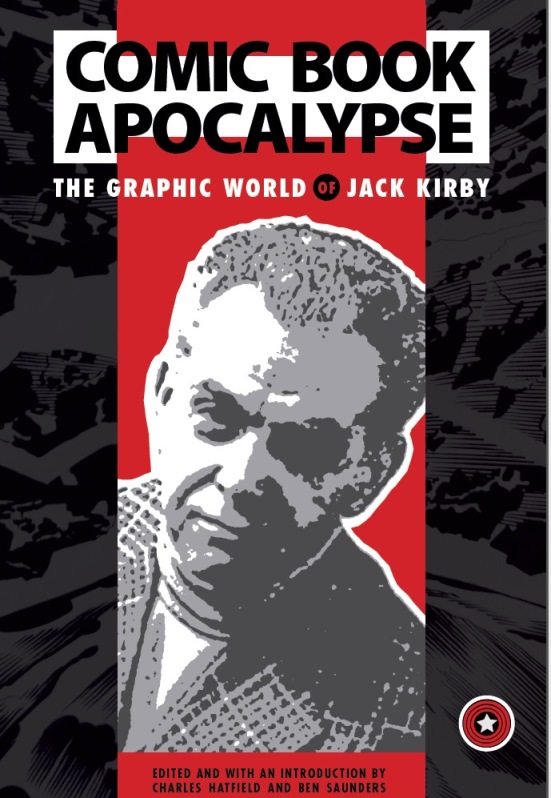
I expect to be at the Museum’s booth on Thursday between 3:30 and 5:30pm, signing and selling copies of my Eisner-winning Hand of Fire: The Comics Art of Jack Kirby (2011) and the exhibition catalog Comic Book Apocalypse: The Graphic World of Jack Kirby (2015). Please drop on by, say hello, and chat with me about Kirby! My books will be discounted a bit, and portion of all sales will go to the Kirby Museum.
Jack and Roz Kirby were practically patron saints of Comic-Con in its early years, and I can think of nothing I’d like to do more at the Con than support the Kirby Museum, who are doing the good work of preserving and extending his legacy. Why not stop by and donate?
If you do get to come to Comic-Con, go easy on yourself and everyone around you, remember to stay watered and fed, walk with patience, and enjoy! It’s like nothing else in this world.
Kirbyvision: A Tribute to Jack Kirby, an exhibition now showing at the Corey Helford Gallery in Los Angeles, lovingly registers Kirby’s impact on contemporary comics, media, and culture. Curated by the Jack Kirby Museum and Research Center, in collaboration with the Helford, the show offers for sale new or recent works by more than seventy artists inspired by Kirby, alongside a historical exhibition of Kirby originals that outlines his style, techniques, and key creations. Together, the historical exhibit and contemporary tributes reaffirm Kirby’s continuing influence. I urge comics and Kirby fans anywhere within a day’s travel of Los Angeles to pay it a good, long visit (alas, it remains open through just Saturday, August 3—would that it could stay longer!). The show is free and open to the public.
I’ve experienced Kirbyvision twice myself, and hope to again. Having curated the 2015 CSUN show Comic Book Apocalypse: The Graphic World of Jack Kirby (to which the Museum contributed substantially), I have a sense of what it takes to contextualize Kirby’s art for gallery visitors. I greatly admire what the Museum has accomplished here. Of course, I can hardly be objective, since I’m a Kirby diehard (and serve on the Kirby Museum’s Board of Advisors), but I hope that the following description gives the flavor of the show and helps document it for posterity. Do know my bias, going in, but also know that this is a show you should see if you love comic art.
This and most of the photos that follow are by CH.
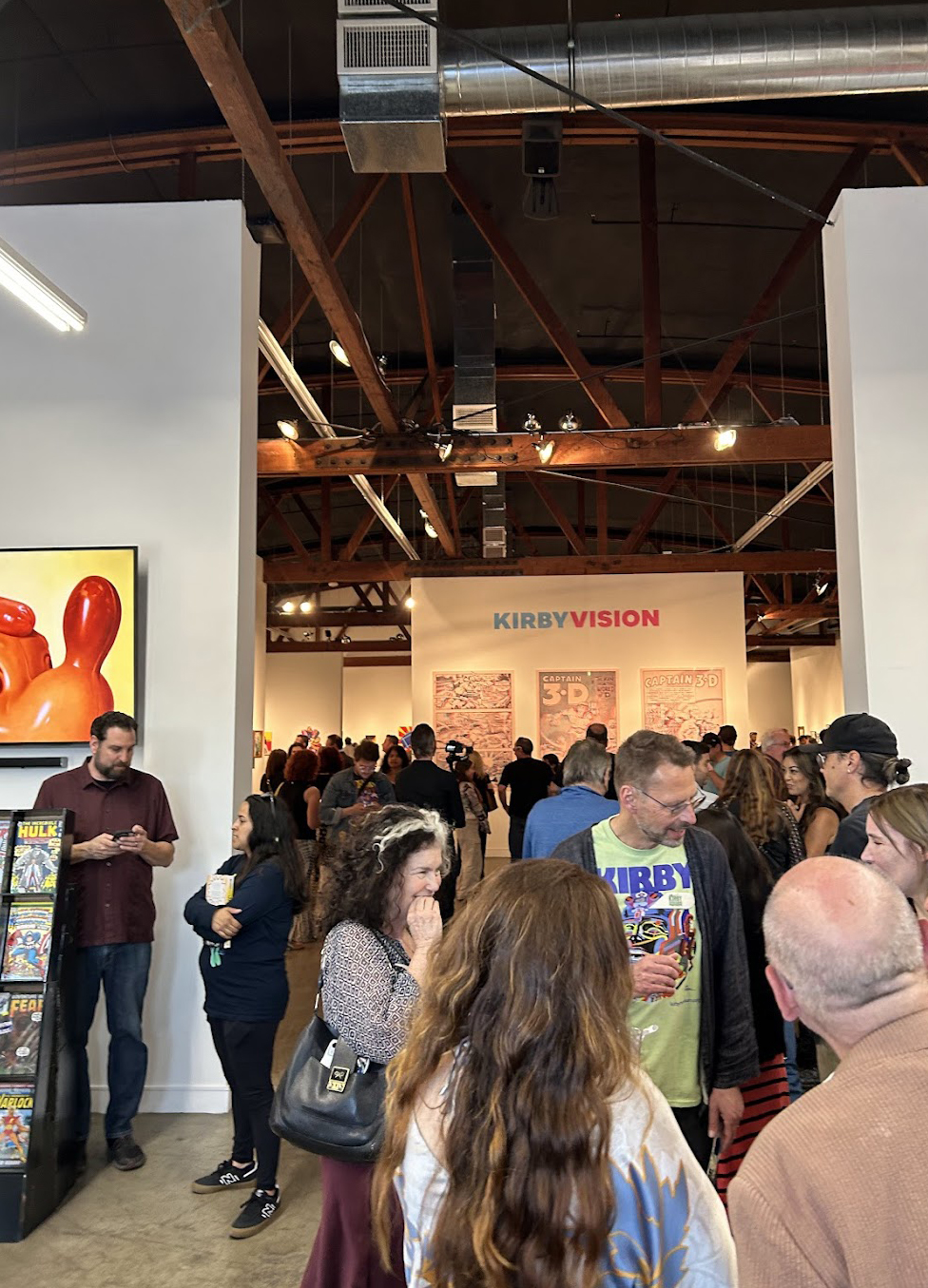
Kirbyvision opened Saturday, June 29, with a bustling reception that brought out diverse artists, collectors, fans, and members of Kirby’s family. The buzz and shared happiness that evening were fairly electrifying. I was glad to be in happy company, and enthralled from the get-go. The show is an eye-popping design experience and a triumph for the Kirby Museum, which has carried the torch since its founding in 2005 and began holding pop-up exhibitions in 2013. For years, the Museum has been seizing opportunities to demonstrate just what it can do—and I think this show, more than any previous event, does that wonderfully. So, here’s my report:
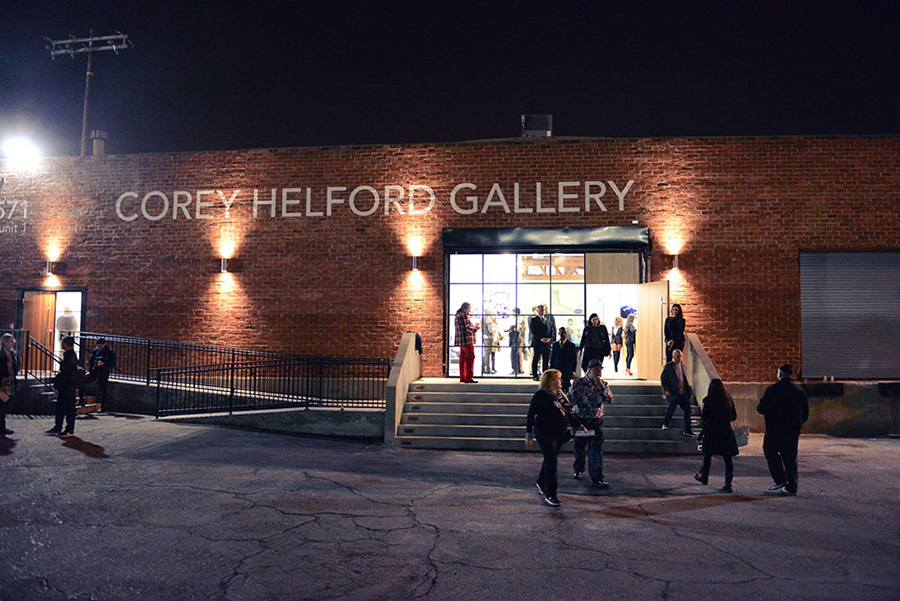
The bottom photo is not actually from Kirbyvision’s opening night, June 29, but perhaps sets the mood? From coreyhelfordgallery.com.
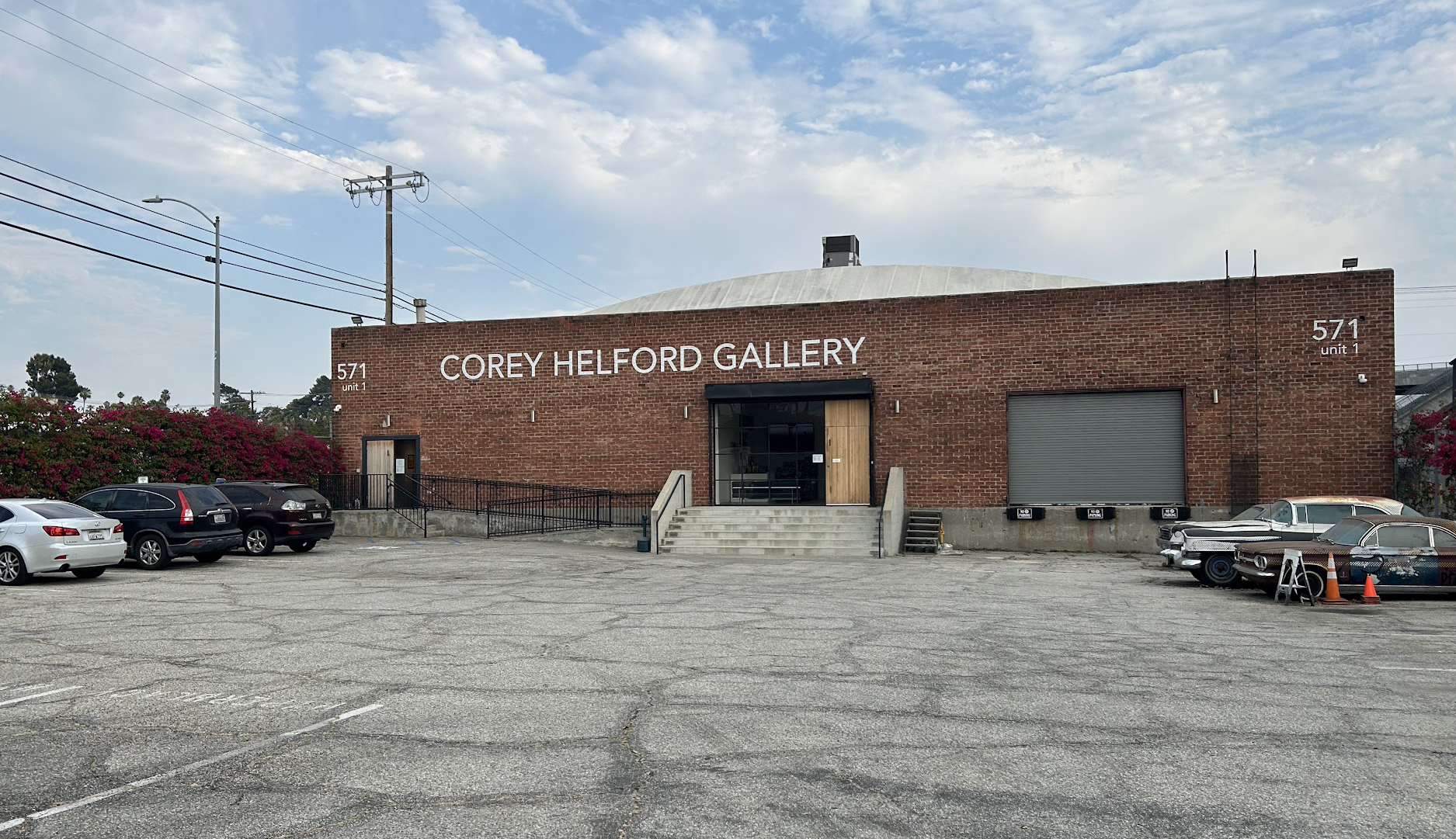
The Corey Helfordis in eastside Los Angeles, by the L.A. River, within a district that feels postindustrial. Around it stand imposing buildings festooned with a mix of graffiti and bespoke murals. My wife Mich and I have been visiting L.A. galleries lately, and they tend to be in repurposed settings like this. The Gallery building, a block of brick surrounded by fences, runs to 12,000 square feet. Its main gallery, a vast openness, takes up about 4500 of that, while two other galleries open off to the side. Unsurprisingly, all of these are whitewalled, cement-floored, and adaptable artspaces. Kirbyvision currently occupies most of the building, though one gallery holds an exhibition by painter Bennett Slater (who renders dolls and other commercial icons with Old Master precision).
Slater, an artist frequently shown at the Corey Helford, epitomizes the gallery’s New Contemporary slant. The Helford seems to favor Surreal, Pop-inspired figurative work blending lowbrow references with exacting technique and high gloss. It has a Hi-Fructose and Juxtapoz vibe, with nods to street art and impish personal riffs on commercial design. Kirbyvision mostly fits into that wheelhouse. The bulk of the show consists of eighty-plus homages to Kirby (or genres and brands he is known for). The work on view embraces various media and ranges technically from rowdy handmade-ness to industrial sheen. Paintings and drawings are the main things, though there are also collages, digital prints, and sculptures.
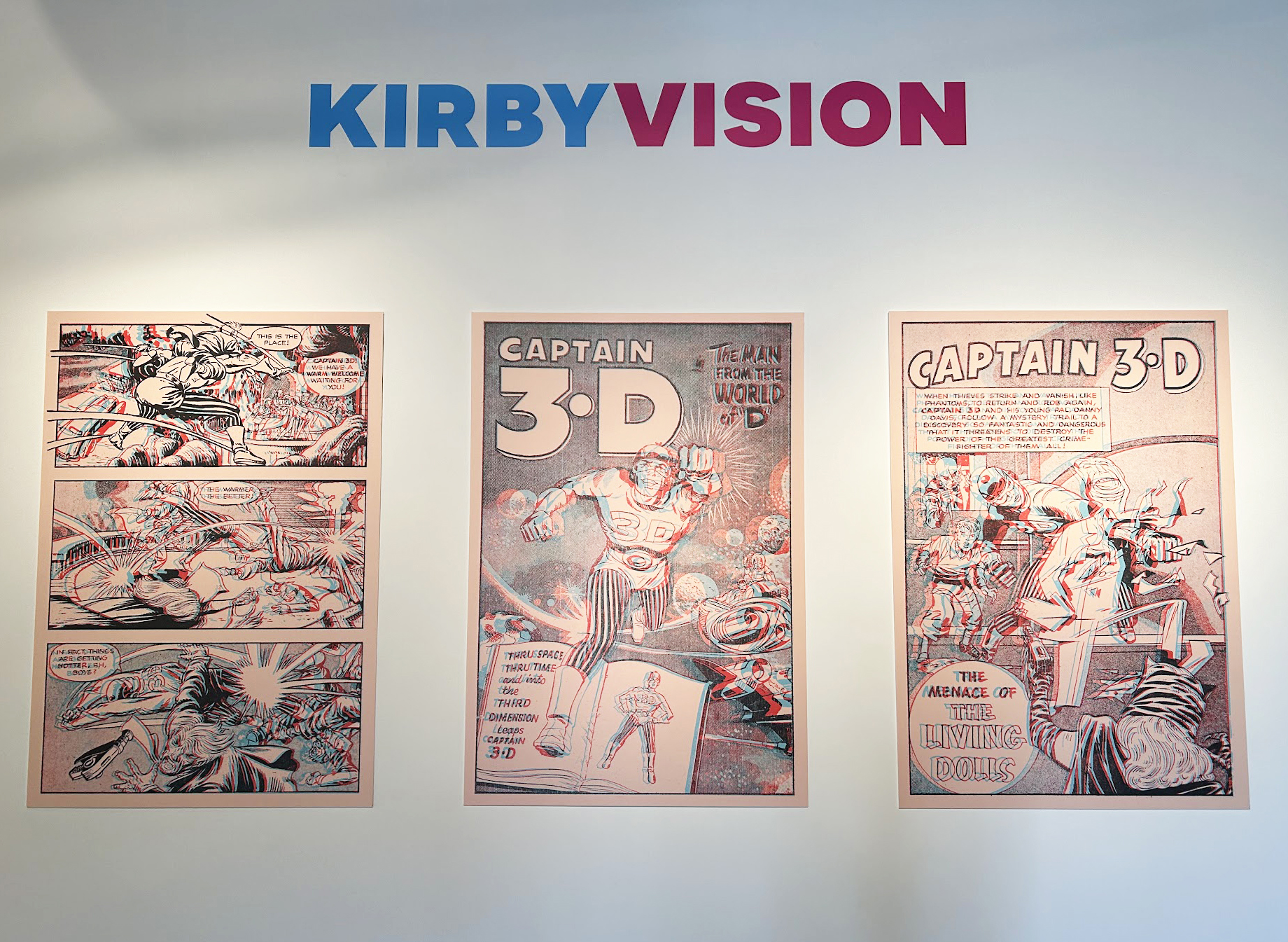
If the works on offer are mixed, the total design of Kirbyvision brings unity. The show’s main design conceit is the idea of3-D vision, with nods to Kirby and Joe Simon’s single issue of Captain 3-D from 1953 (a then-faddish 3D comic published by Harvey). At the outset, a dividing wall in the main gallery’s entrance (which visitors skirt around to enter the gallery proper) bears a triptych of images from that comic, dramatically scaled up in very effective 3-D separation. Scanning that wall from a few paces back with the anaglyphic (red and blue) 3-D glasses freely provided by the gallery imparts a strong sense of movement. The 3-D elements represent a collaboration with stereoscopy expert Eric Kurland (founder of 3-D Space), whose gift for this kind of work can be felt throughout the show (so keep those glasses with you).
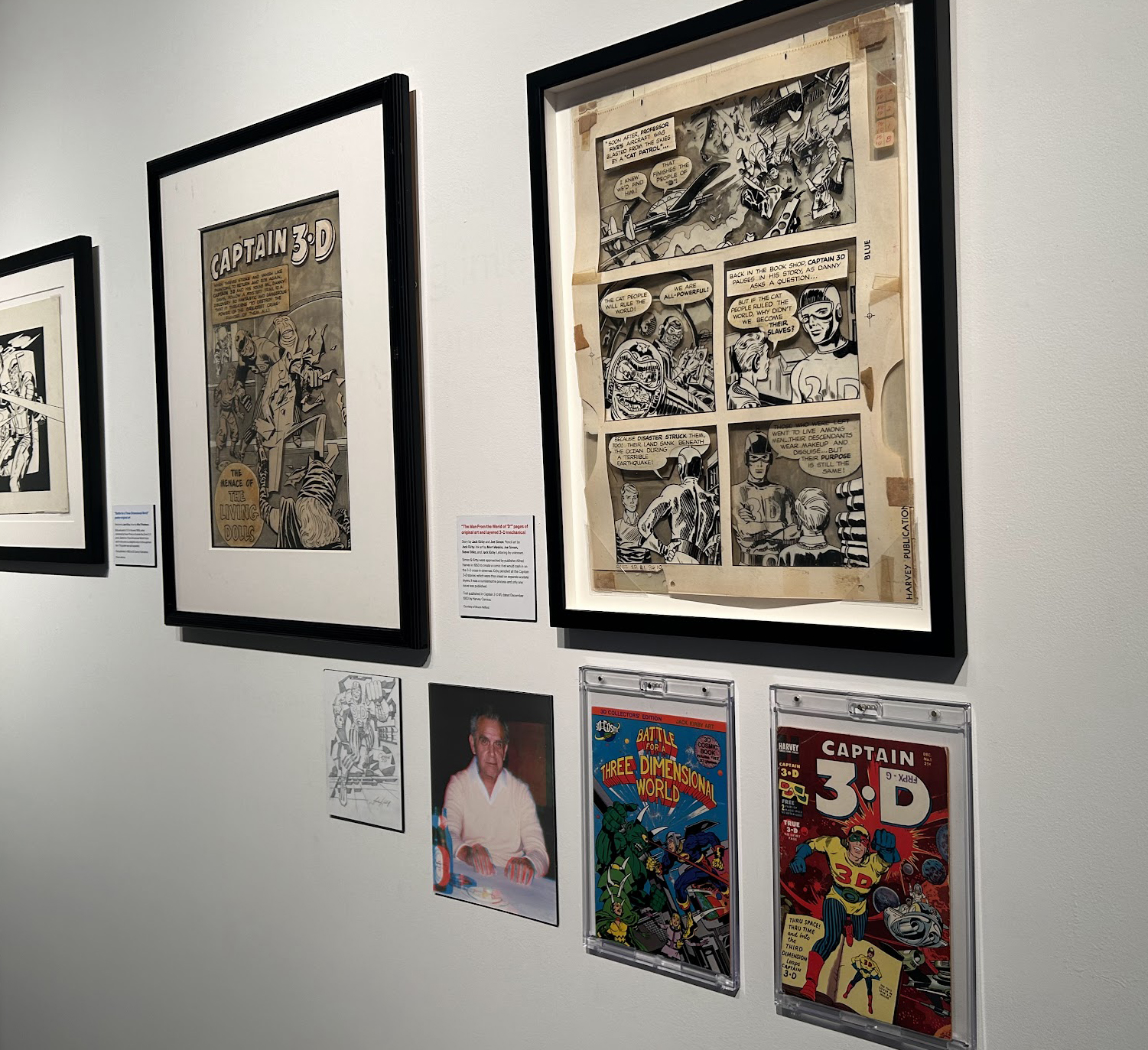
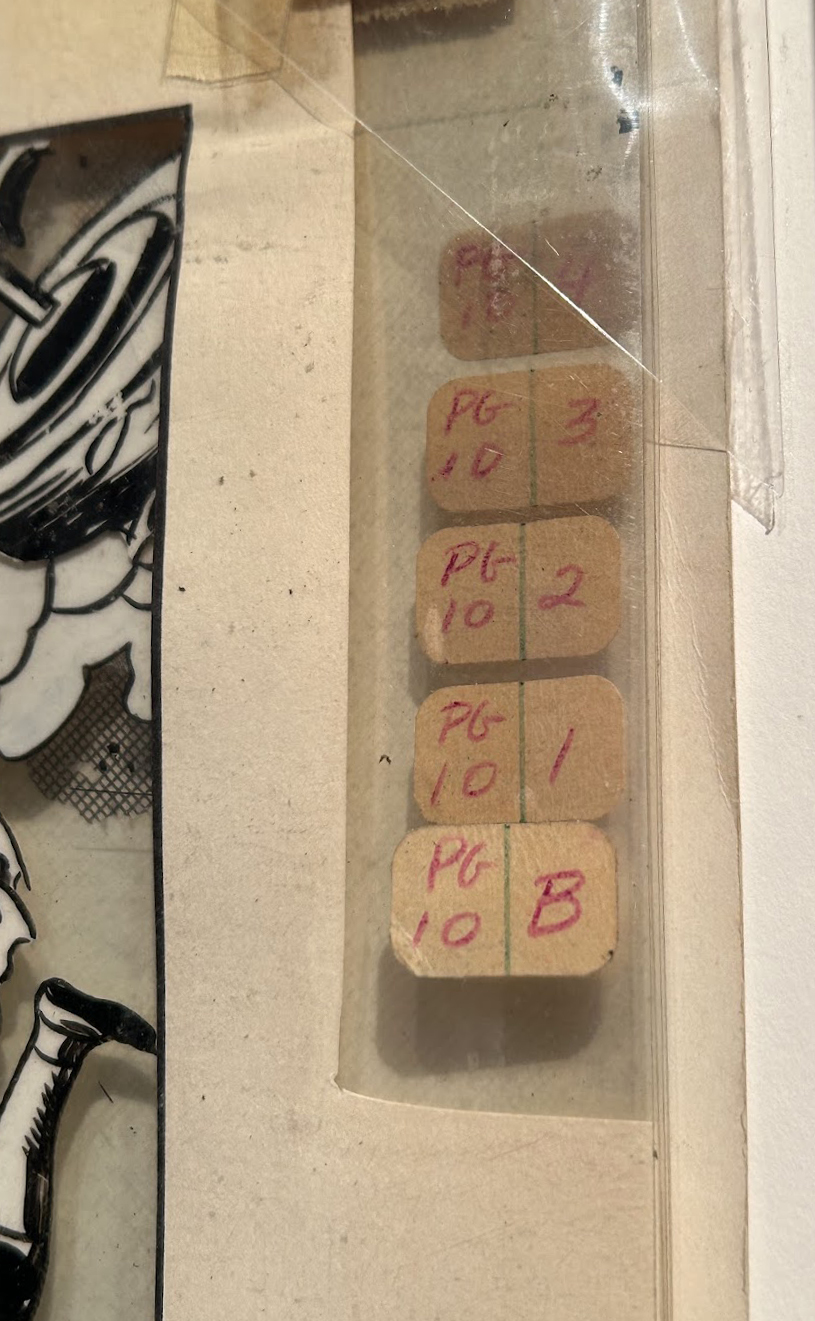
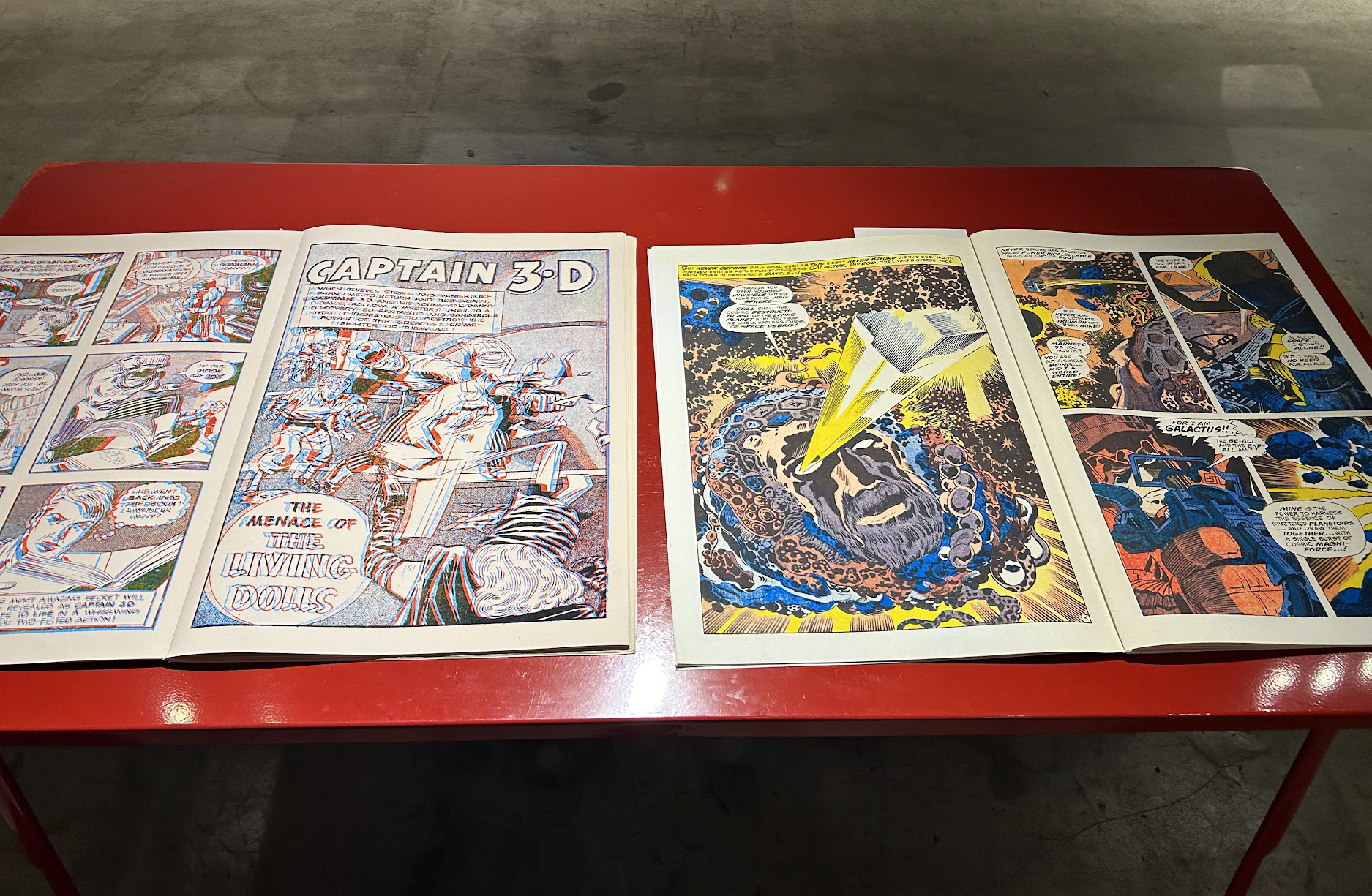
In effect, the 3-D hook gives Kirbyvision a brand identity (while suiting the Helford’s retro Pop sympathies). Displayed near the gallery entrance are two originals from Captain 3-D itself that hint at the laborious processes used to make 3D comics in the early Fifties. Those originals consist of Kirby-drawn elements separated ontolayers of acetate, as well as shaded backgrounds on what appears to be Craftint paper. The originals are well preserved, yet their aged patina contrasts with the gorgeous wall-sized reproductions. This is both instructive and cool. Also displayed here are the published Captain 3-D and Kirby’s later 3D collaboration with Ray Zone,Battle for a Three Dimensional World (1982). Further in, attentive visitors will find an oversized reproduction of the entire Captain 3-D comic book (again, hold on to your glasses!).
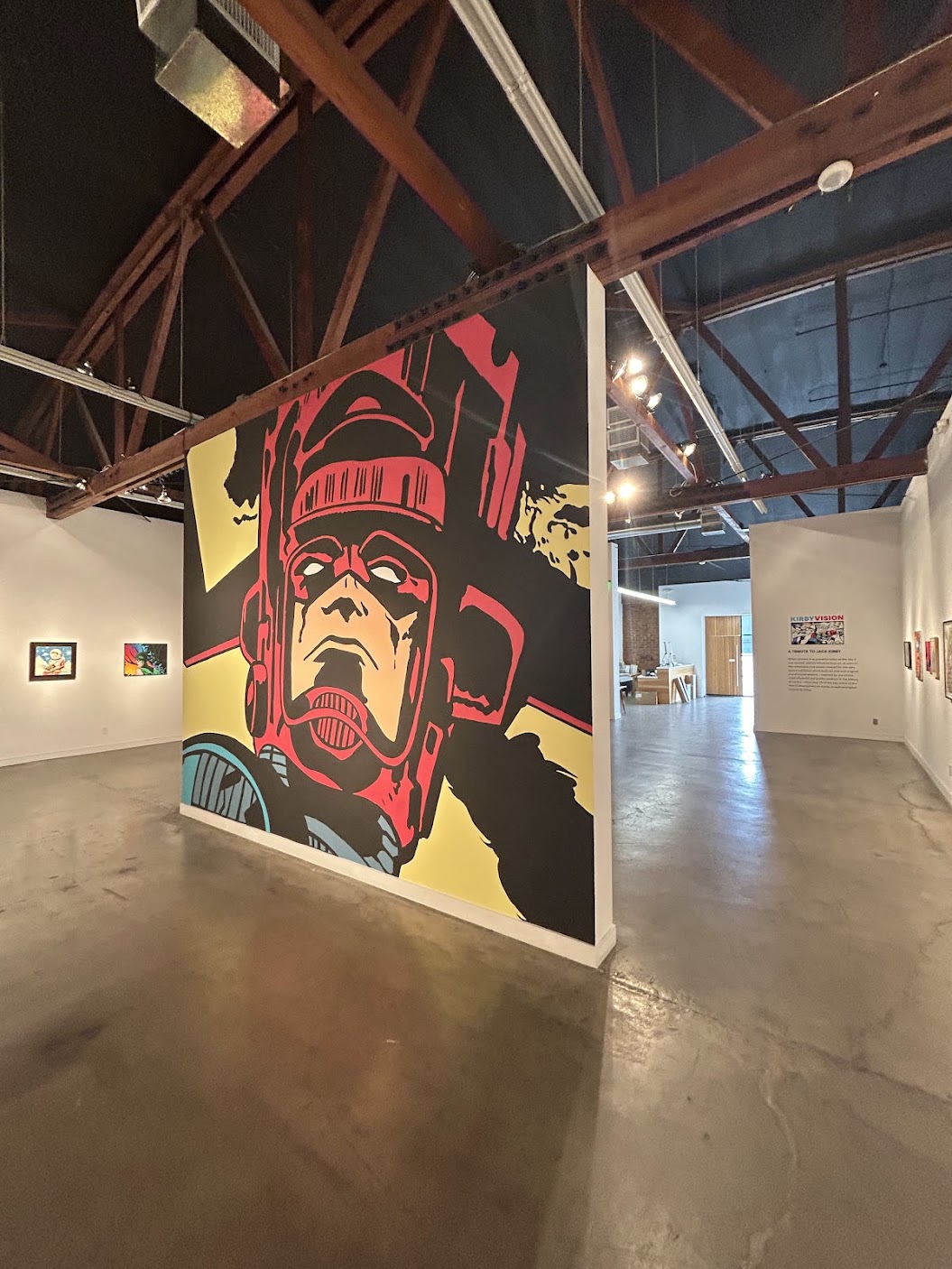
Other savvy design elements pop up across the show. A library of Kirby books is on sale in the lobby, courtesy of retailer Golden Apple Comics (and Kirby-related videos also play there, sotto voce). Just to the right of the 3-D dividing wall you’ll find a mockup of a period newsstandfilled with comic books that, I gather, are free for the taking. On the night of June 29, the comics were vintage Kirby comics; for example, I saw friends leaving with mid-1970s issues of Kamandi (though when I revisited on July 12, the newsstand carried only Archie). Once you come around the dividing wall and into the main gallery space, you’ll find, on the wall’s flipside, abig mural of Kirby’s Galactus painted by the artist Skinner (seemingly based on a splash from Thor #167 by Kirby and Vince Colletta, 1969). Facing that mural, in the gallery’s center, is filmmaker and modelmaker Martin Muenier’s life-sized rendition of Thor’s Mjolnir, magnetically affixed to its anvil-like pedestal, which proved an irresistible interactive element for many visitors (myself included). In short, moving through this space is a lot of fun.
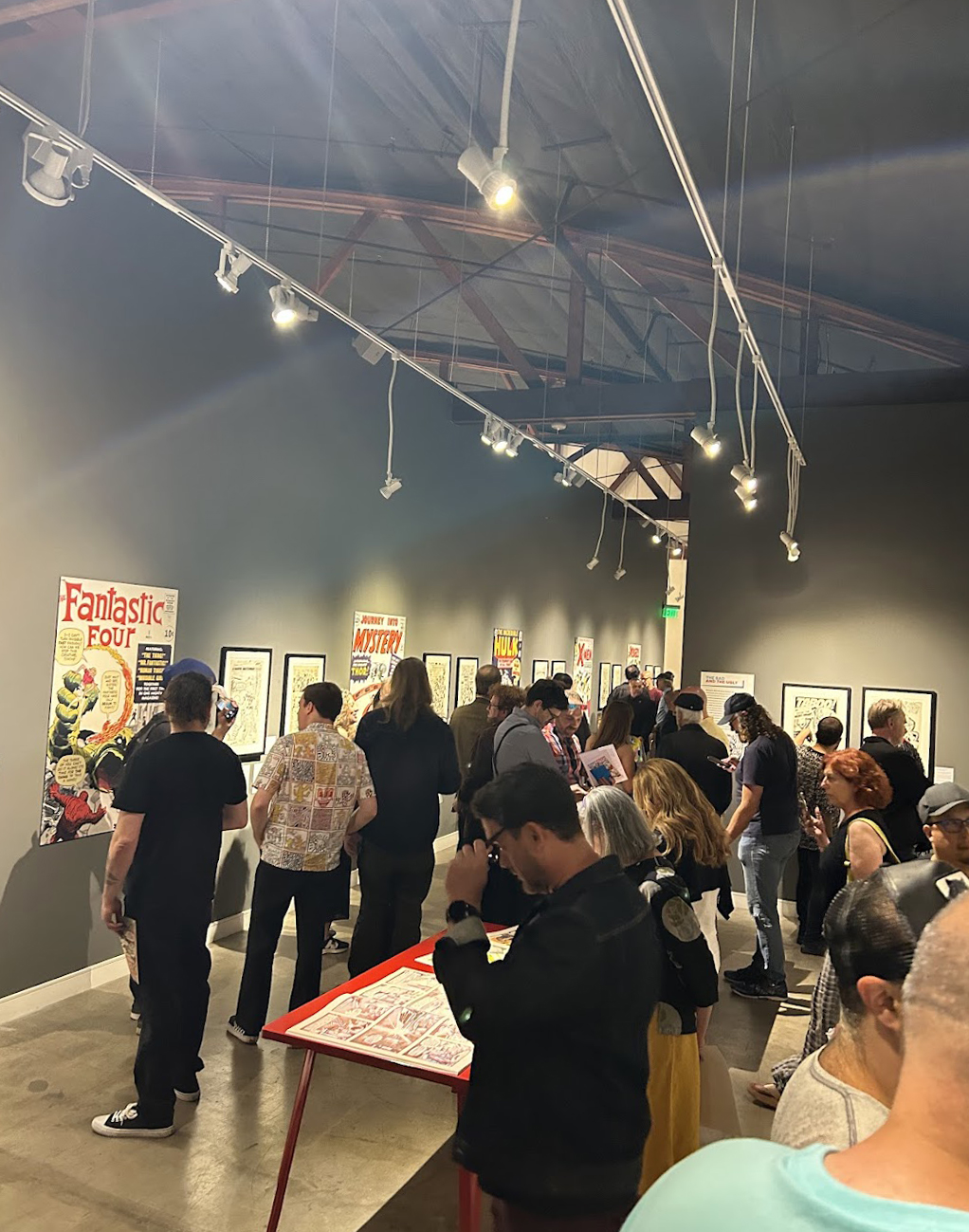
Opening night reception, June 29. I did say it was bustling!
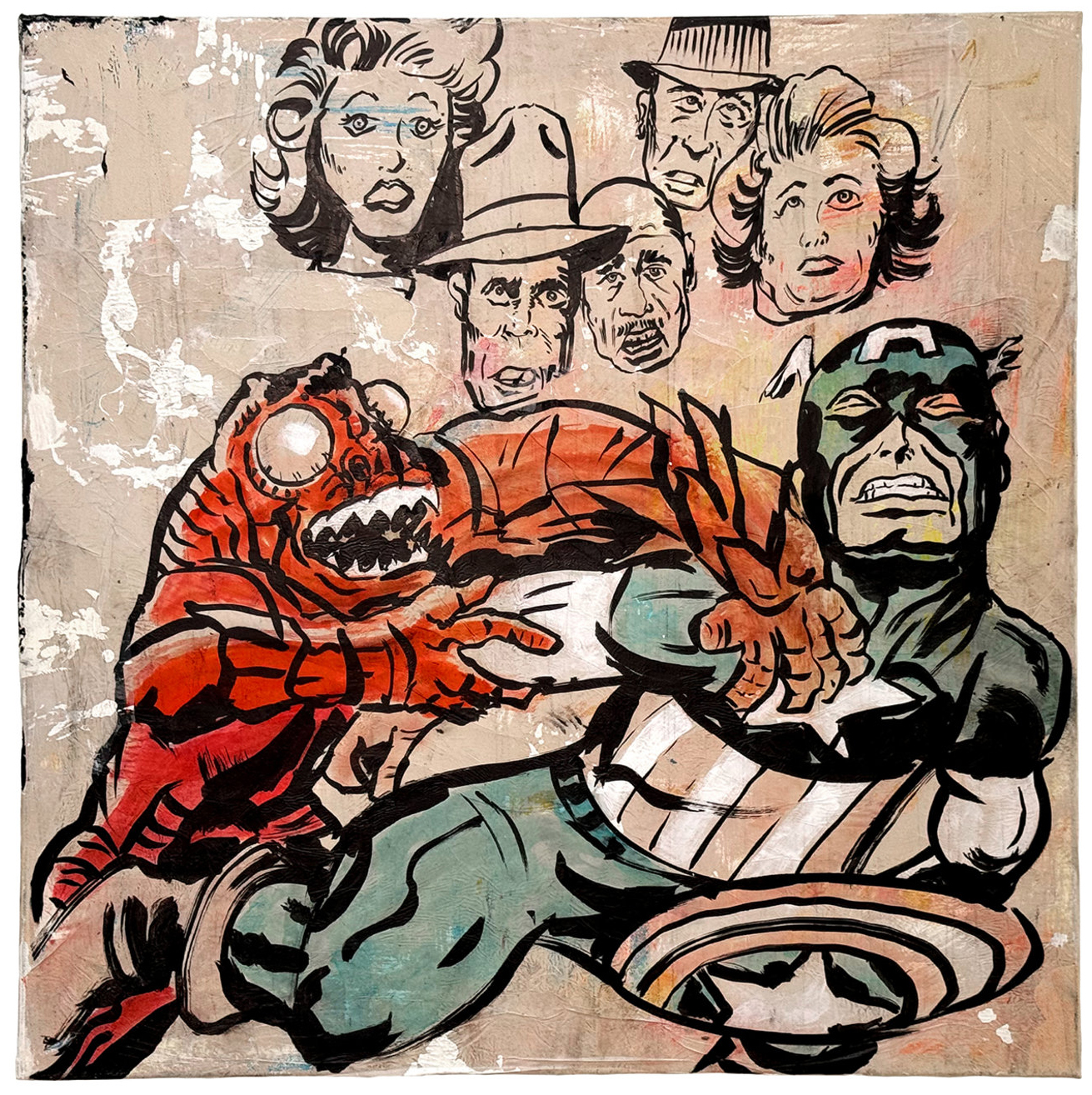
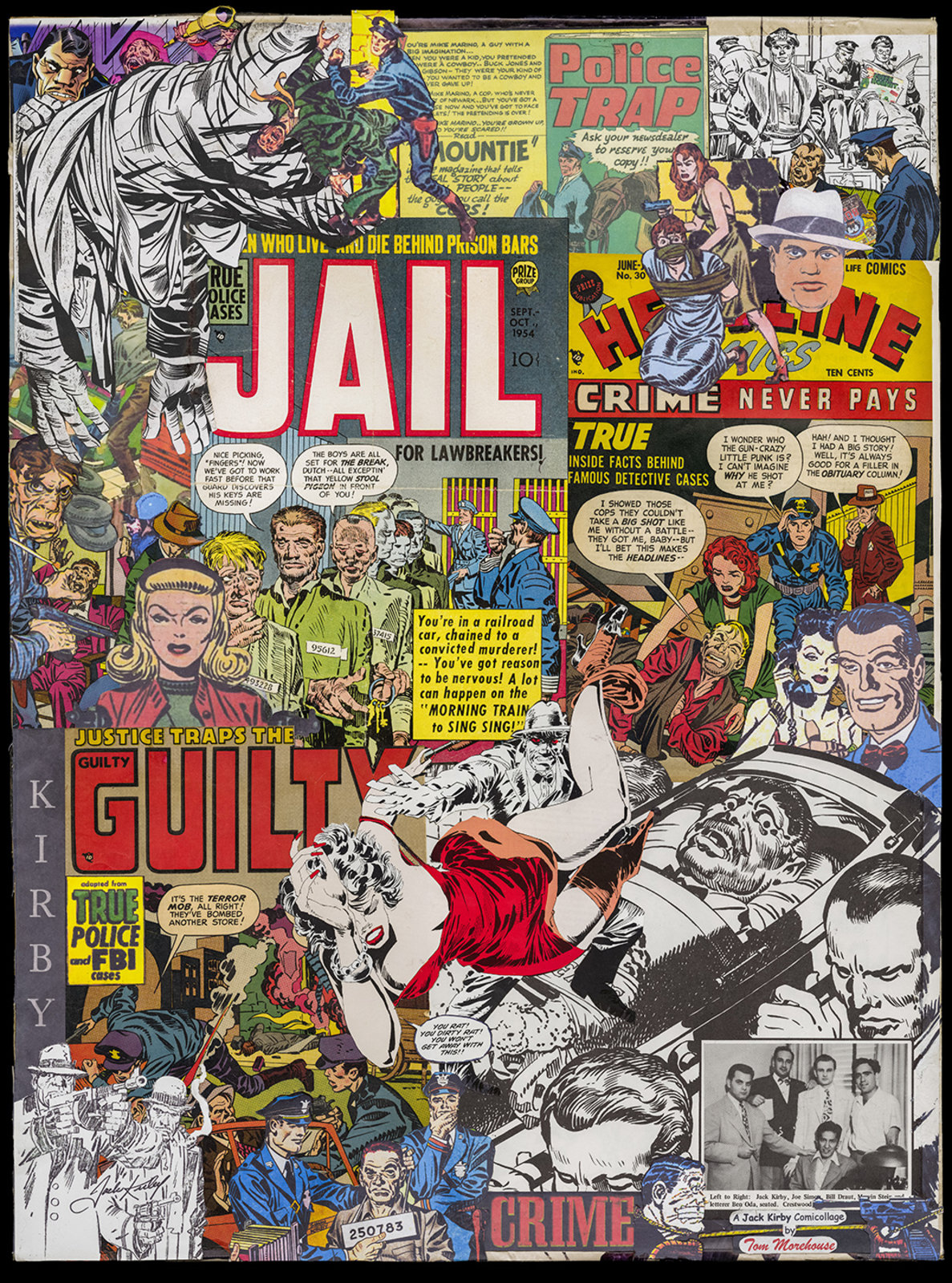
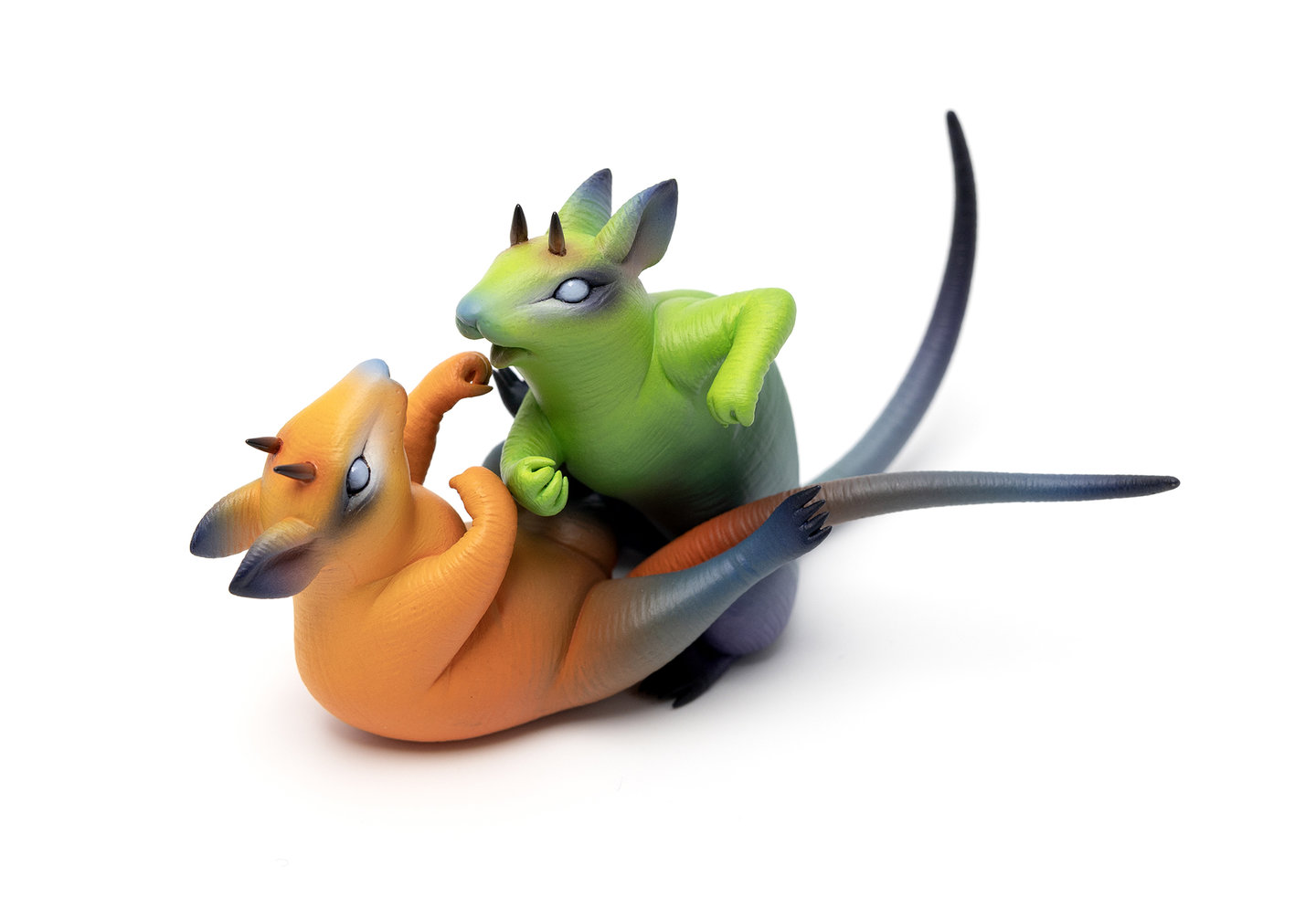
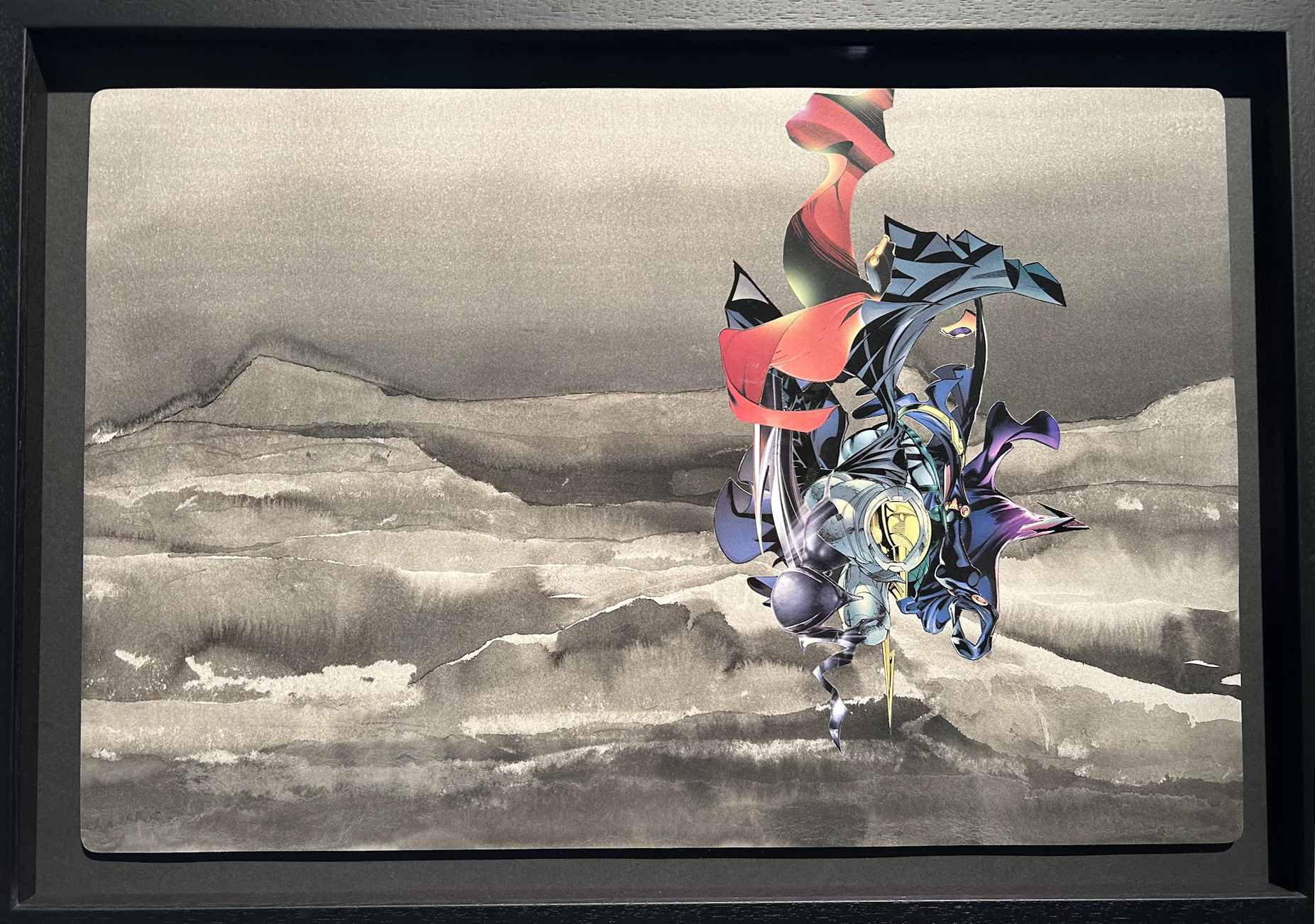
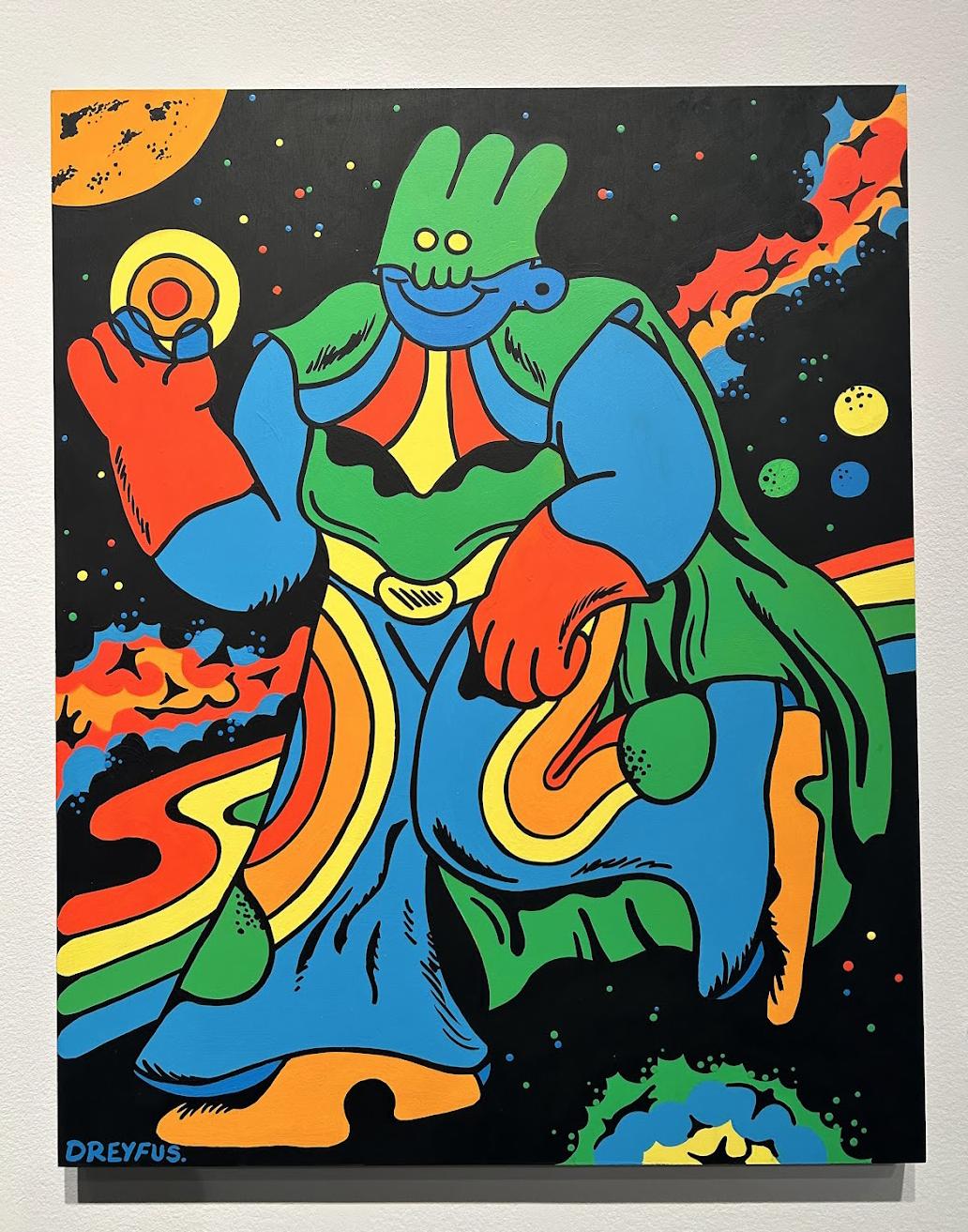
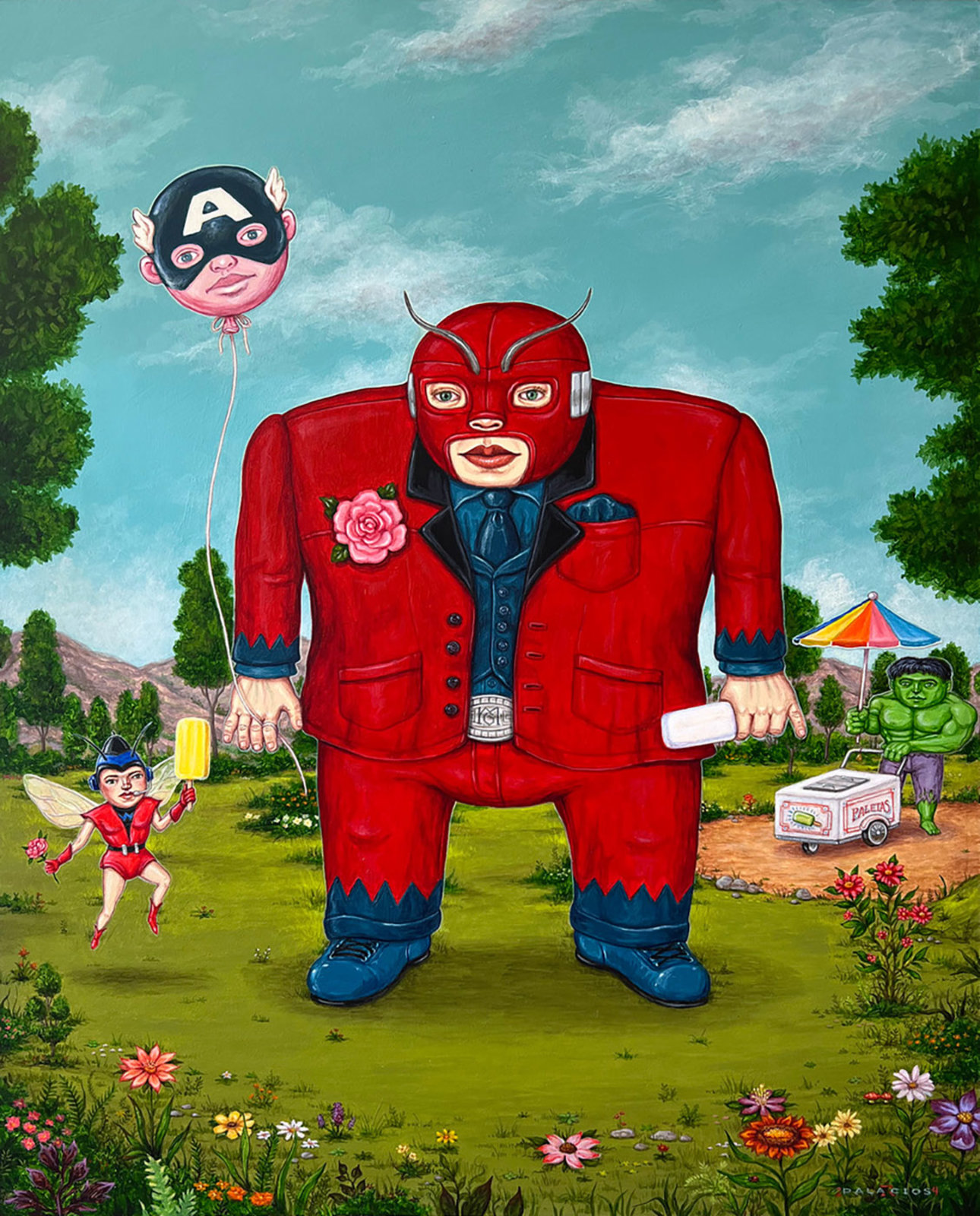
Most of Kirbyvision is presented in traditional white-cube style, with works on the walls proceeding clockwise. Some of the works are homages or détournements of recognizable images by Kirby, such as Patrick McDonnell’s Captain America canvas, The Last Superhero, or Tom Morehouse‘s collage, Kirby Crime, which mashes up images culled from decades of Kirby’s work in crime comics. On the other hand, some works are looser evocations of theme or genre that do not strive to be graphically Kirbyesque, such as Erika Sanada’s miniature ceramic Versus, with its two cute, rabbit-like critters locked in combat, or Aaron Noble’s collage The New Man, which blends swirling, cape-like elements, culled from various drawings of superhero costumes, into a hovering, abstracted shape. Some works cleave to a stylized naturalism familiar from mainstream comic books, while some are more explosively graphic, like Charles Glaubitz’s crackling acrylic and gouache drawing Teach Your Children That We Come from The Stars. Some are sober, but others playful, like Ashley Dreyfus’ Atomic Man, a groovy, bell-bottomed hero, or Robert Palacios’ Giant Man’s Day Off, a charming portrait of the Marvel icon as luchador (this and several other pieces reminded me of artists like Mark Ryden or Ivana Flores who traffic in subversive neotenic cuteness, a common enough approach nowadays). Overall, techniques on view range from rubbery cartooning to airbrushed polish, from precisely rendered surfaces (again, Slater) to frenetic painterly smudging.
(Images below of individual artworks are from coreyhelfordgallery.com unless otherwise credited.)
Patrick McDonnellTom MorehouseErika SanadaAaron Noble (photo by CH)Charles GlaubitzAshley Dreyfus (photo by CH)Robert Palacios
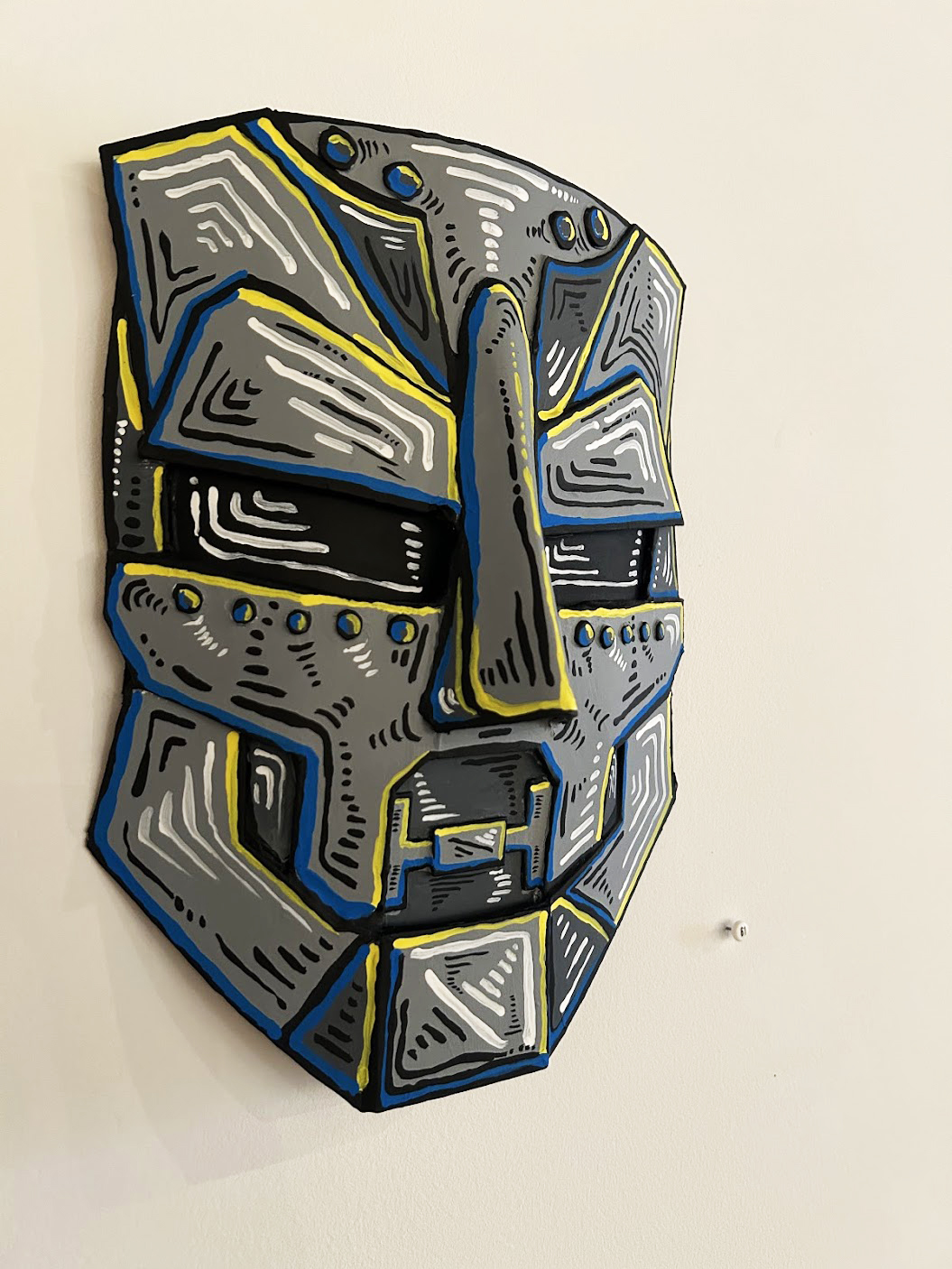
Many of my favorite pieces here depart from the Kirbyesque, or do Kirby style in odd, left-field ways that I find refreshing. These would include the life-size Dr. Doom Mask (acrylic on sculpted cardboard) by artist Nonamey; the canvas Five Cents, by Shaky Kane, which turns Kirby’s Captain America into an outsize bubblegum card; and Mark Frauenfelder’s Flower, Daughter of Googam, which bizarrely combines Flower, Kamandi’s near-nude wild-child love interest, with references to an early-1960s Marvel monster.
NonameyShaky KaneMark Frauenfelder
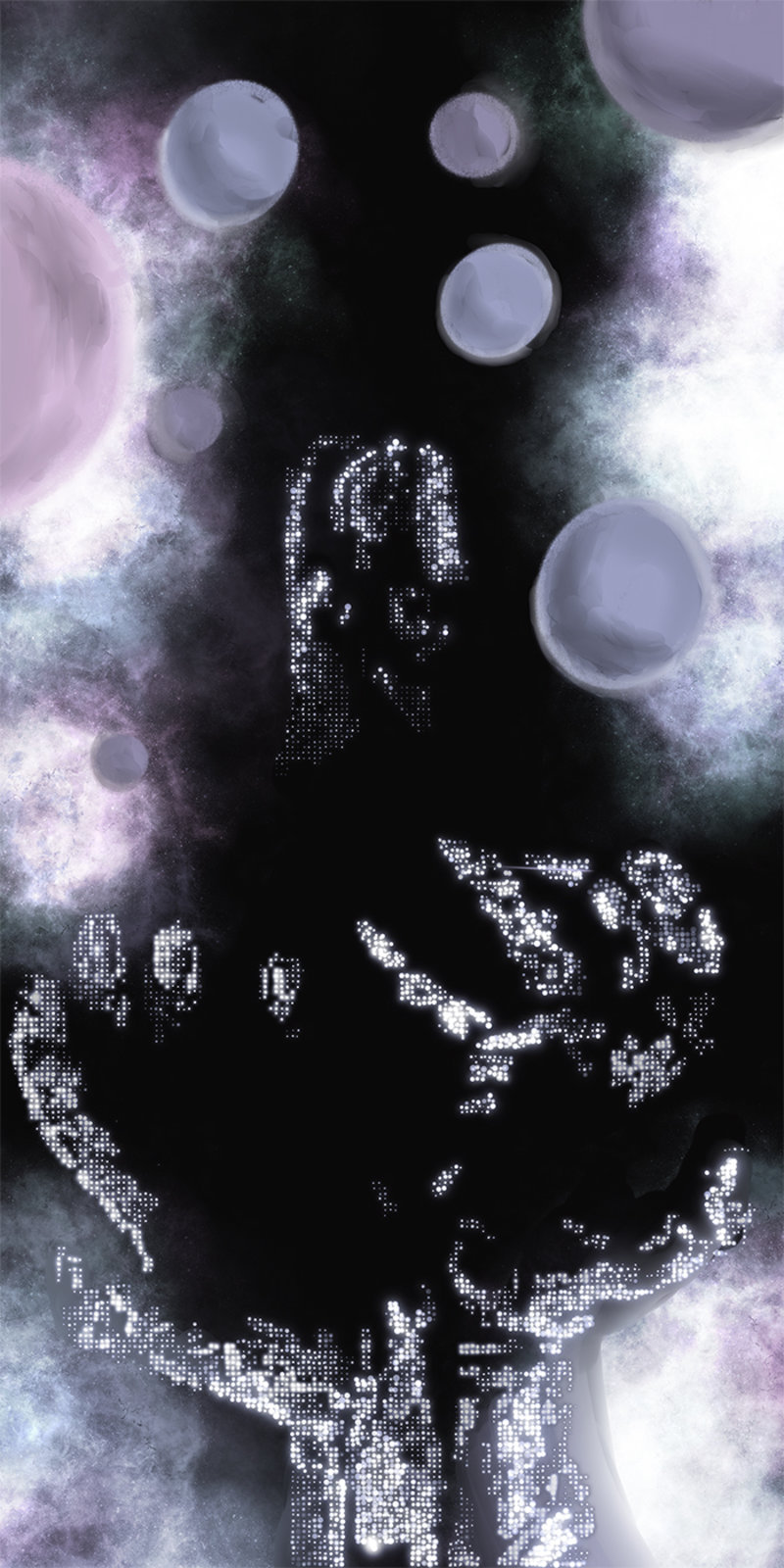
For me, one of the coolest spots in the show juxtaposes Mark Badger’s lively drawing Julius Caesar’s Ghost Appears to Brutus (a spinoff from his Kirby-inspired Caesar comics project?) and Sydney Heifler’s enigmatic digital print Rising, a dark, obscure image in which points of light (like glowing pegs on a pegboard) form a figure rising from two cupped hands, in a seeming homage to the Silver Surfer rising from the hands of Galactus. These are very different works, but their one-two punch delighted me (dig the big hands!). I’d say look out for odd moments of connection or contrast like this throughout.
Mark BadgerSydney Heifler
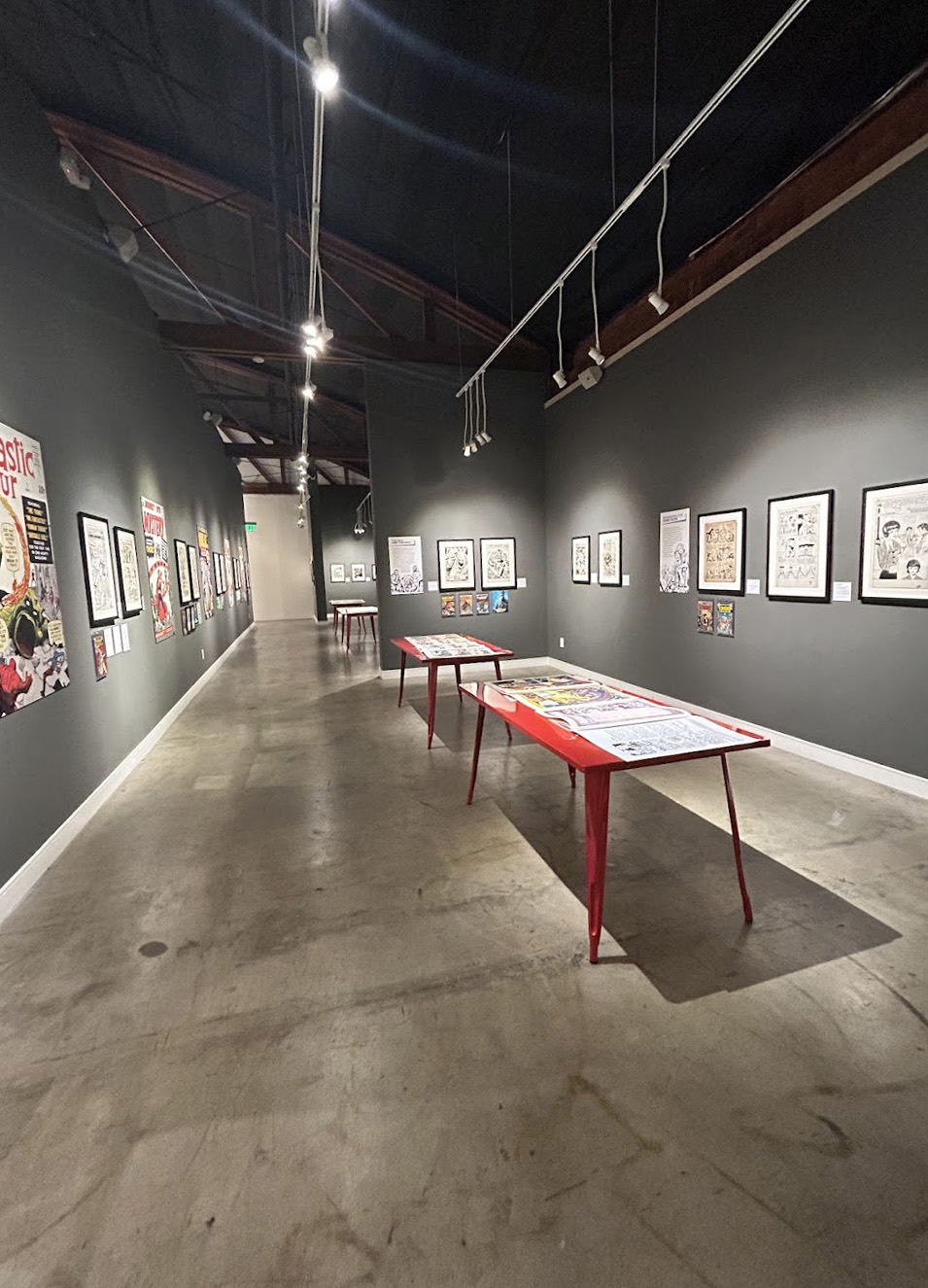
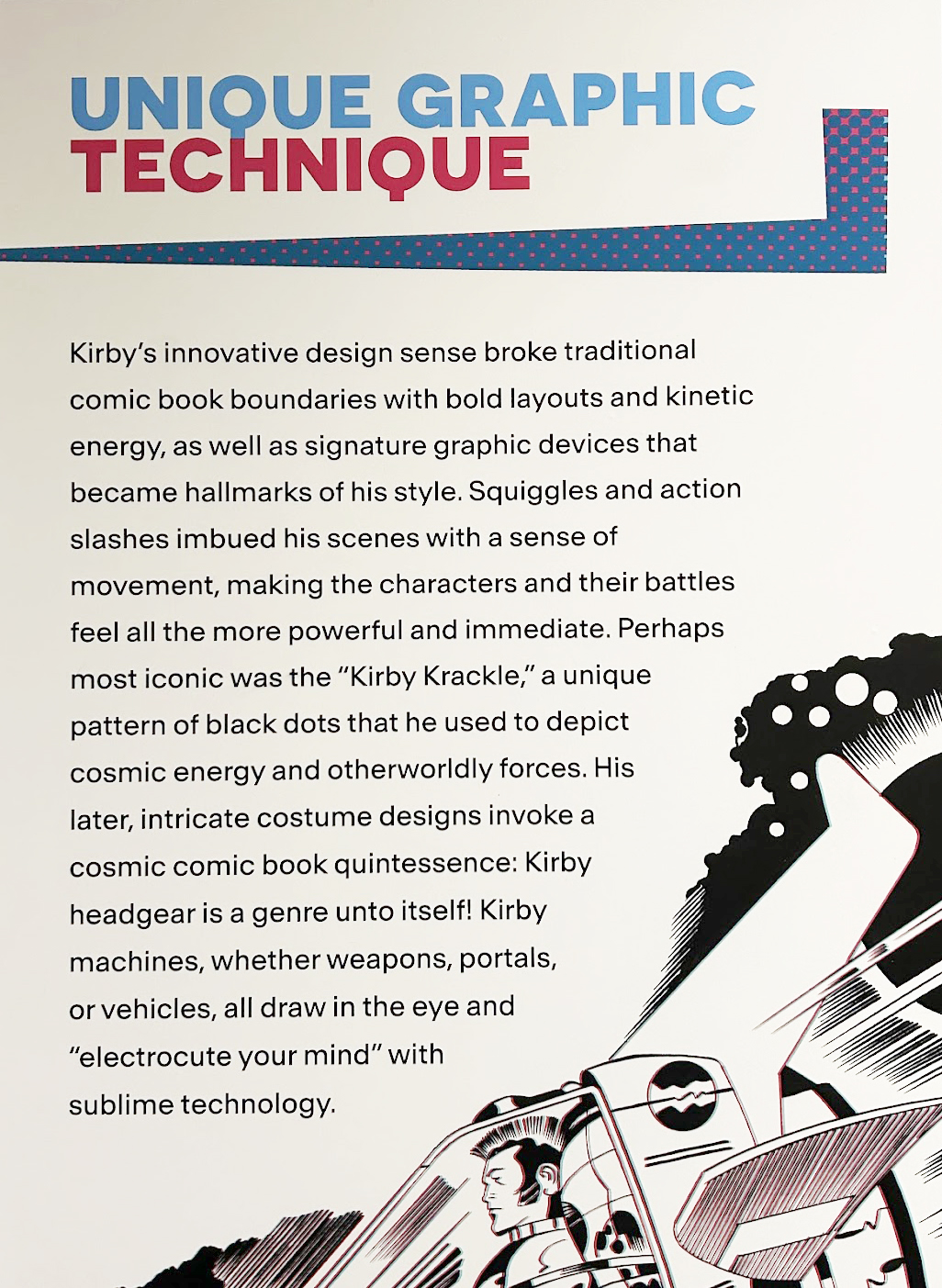
Besides paying tribute to Kirby, Kirbyvision contextualizes Kirby himself via a side gallery of Kirby originals organized by the Kirby Museum (the art on view in this side gallery, note, is not for sale). This is a smaller space, but dense with art and information. It feels distinctly museum-like, in the sense of didactic, yet also welcoming and visually sumptuous, building on the Museum’s track record of accessible pop-up exhibitions. Wall-mounted blurbs, succinct and informative, guide visitors through Kirby’s career thematically rather than chronologically. Newcomers to Kirby can learn a lot here about his graphic style, storytelling habits, range of genres, and famed titles and characters. The emphasis is on Kirby’s handiwork and the outpouring of his sensibility, not on corporate-owned IP (though there is plenty about that too).
On opening night, of course.On a quieter occasion.Sample wall didactics
The originals, nearly fifty, are juxtaposed with reproductions of penciling process and, at the same time, images showing Kirby’s influence on screen adaptations (including the Marvel Cinematic Universe). Putting Kirby’s autographic work next to reminders of these adaptations feels like a deliberate strategy. One long wall represents well-known Marvel IP, including Captain America, The Fantastic Four, Thor, The Hulk, The X-Men, and The Avengers, while facing walls and tables lean into Kirby’s personal style and themes. The range of work shown, from 1940s to the 1980s, and from drawings to collages, suggests the arc of Kirby’s career. The genres sampled are many (and sometimes blurred), from superheroes, science fiction, and myth fantasy, to romance, crime, horror, and war. Many facets of Kirby are on display: his futurism, but then again his primitivism; his rapturous psychedelia, but then again his hard-hitting, lived-in urbanism. Various eras and collaborators are represented (among the inkers, I counted at least Dick Ayers, D. Bruce Berry, Vince Colletta, Frank Giacoia, Mike Royer, Joe Sinnott, Chic Stone, Mike Thibodeaux, and Kirby himself). Most importantly, this exhibit suggests something of Kirby’s outlook and spirit.
Along the Marvel wall.
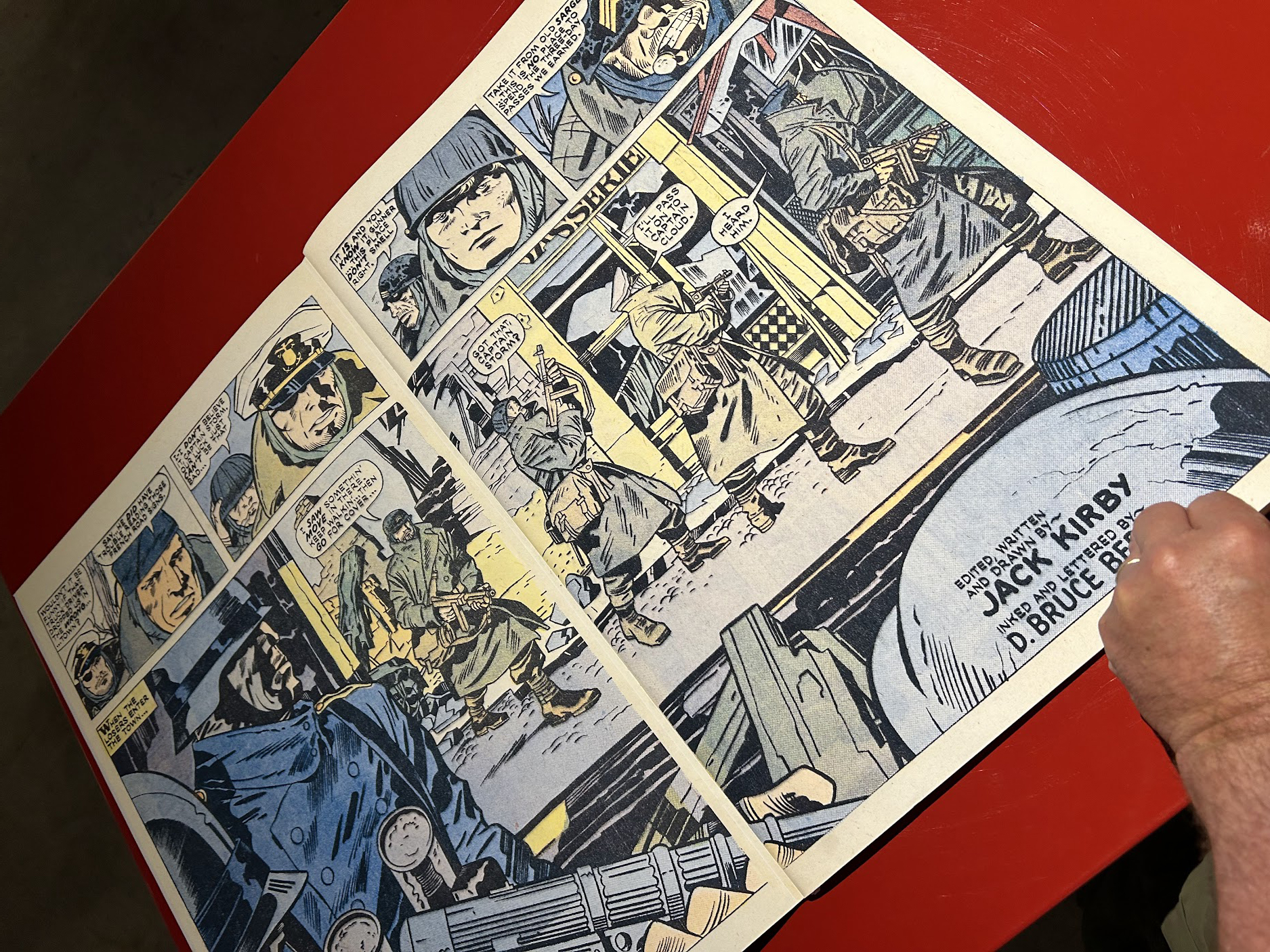
I spent a lot of time in this historical exhibit, digging pages and spreads from, for example, Kirby’s Fourth World, 2001, “The Losers,” Kamandi, and In the Days of the Mob; three of his collages (2001, Spirit World, Captain Victory); contrasting Thors, inked by Ayers and Colletta respectively; a beautiful vintage page from “Just No Good!” (Young Romance #18, 1950), which I took to be mostly inked by Kirby; and on and on.
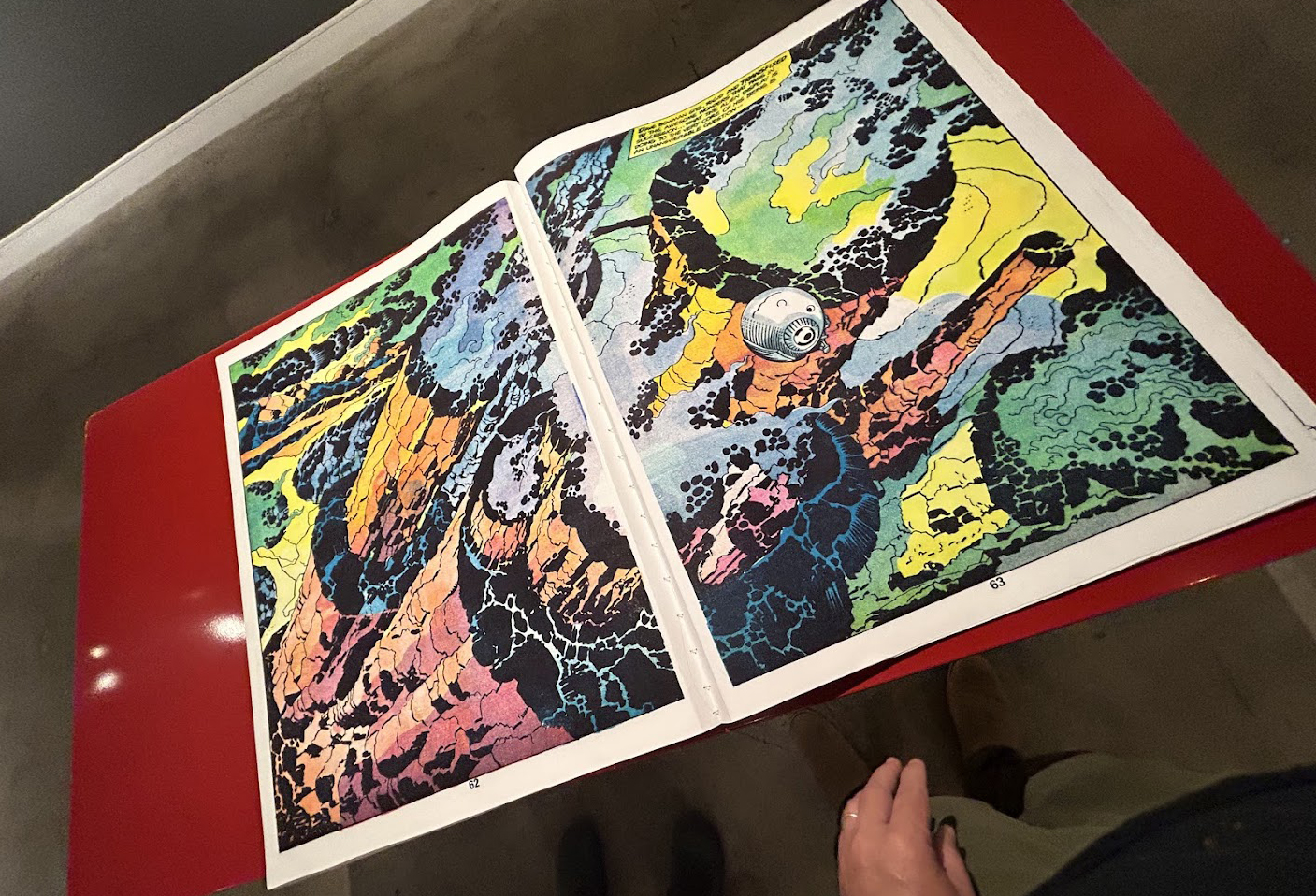
Another highlight of the side gallery is the presence, on four tables, of oversized facsimiles of Kirby comic books, complete with advertising and editorial matter as originally published. Tom Kraft, Kirby Museum President and design wizard, has been producing facsimiles like these since Kirby’s centennial in 2017. Scanning old comics at ultra-high resolution, he and his colleagues then print and bind them as enormous, durable books that visitors are welcome to flip through and read at leisure. These giant books cross the gap between comic art designed for reading and the more spectacular, scaled-up experience we typically expect in museums and galleries. They make it possible to see Kirby’s work up close as if you were a small child just learning to handle physical comics (their scale is both delightful and daunting!). On this occasion, the Museum has provided 17 by 22-inch recreations of Captain 3-D #1, Young Romance #8, Fantastic Four #48, New Gods #7, and Our Fighting Forces #152. I like this mix of famous and more obscure works. In addition, and this is the pièce de resistance, there’s a gigantic, 22 by 30-inch version of Kirby’s adaptation of Kubrick’s 2001: A Space Odyssey. This gets a table unto itself, which is good, because I spent a long time admiring its bombastic pages—some of which Kirby himself colored, in saturated, psychedelic mode. I’ve always liked the idea of exhibiting comic art in poster-sized yet readable form (an unfulfilled dream of mine for Comic Book Apocalypse), as it brings immediacy and accessibility to the gallery experience, and it’s great to see the Kirby Museum pulling this off.
Immediacy and accessibility characterize Kirbyvision as a whole. It’s a hardworking, vivid, extravagant show that captures some of what is wonderful about Kirby, as well as his galvanic influence on comics and culture. Everyone who spends time with it will come away with different observations and favorites. Kudos to the Kirby Museum and thanks to the Corey Helford for making this happen.
Kirbyvision: A Tribute to Jack Kirbycombines original artwork by Kirby with new works by more than fifty contemporary artists inspired by him. Curated by the Kirby Museum, and presented within the Corey Helford’s 12,000-square-foot space in downtown Los Angeles, Kirbyvision highlights Kirby’s continuing and multifaceted influence on comics, media, and popular culture.
Kirbyvision will be on view from Saturday, June 29, to Saturday, August 3, 2024, and is free and open to the public. A free opening reception will be held on the show’s first day, Saturday, June 29th, from 7:00 to 11:00 pm.
The Corey Helford Gallery, founded in 2006, focuses on New Contemporary art, including figurative, Surreal, and pop culture-inspired work. Here’s where you can find it:
Speaking personally, I can’t wait! I serve as an advisor to the Kirby Museum and have learned so much from their work, which has included exhibitions, panels, walks and talks, and videocasts and other online projects. They have been carrying the torch for Kirby and Kirby studies heroically, and they provided substantial and crucial design assistance, logistical support, artworks, and files for the 2015 Comic Book Apocalypse show I curated at CSU Northridge. It’s great to have another Kirby show here in town!
Tomorrow, Friday, August 28, 2020, would have been the 103rd birthday of Jack Kirby. To honor the occasion, the Jack Museum and Research Center is holding 3 Days for 103, a three-day online event series to be streamed live to Facebook, YouTube, and Twitter. Running Friday the 29th through Sunday the 30th, from 11:00 a.m. into the evening each day, 3 Days for 103 boasts a terrifically diverse roster of guests from comics, art, film, and other fields, including colleagues, family, biographers, fans, and fellow artists. (I’m proud to be in that company: I’ll be interviewed on Saturday, Aug. 29, from 4:00 to 5:00 p.m. Eastern time.)
3 Days for 103, according to the Museum, will stream to Facebook and YouTube, and those who follow the museum on those platforms can elect to receive notifications for each event. In addition, the 3 Days for 103 events will stream to Twitter (via Periscope), but in that case, says the Museum, “there are no individual links to share”; simply follow @JackKirbyMuseum throughout the days.
The events will be promoted using the hashtag #Kirby103 — please spread the news! The Kirby Museum has the details, and full program, here: https://kirbymuseum.org/3for103/
Thanks, as ever, to the Kirby Museum for its tireless and inspired efforts!
Fittingly, it was fifty years ago this past Tuesday, Aug. 25, that DC Comics published Kirby’s first teaser for The Fourth World: the epochal, idea-crammed, and fearlessly strange Superman’s Pal, Jimmy Olsen #133. Just to read that comic is to experience a sort of Kirby contact high: so amazing. It’s hard to believe it’s been half a century since The Fourth World premiered — a real milestone!
PS. Also, taking us back closer to Kirby’s roots, this week blogger Alex Jay shared more from his research into Kirby’s life — namely, images of Kirby’s World War II draft registration card. These images are revealing glimpses into Kirby’s (and New York City’s, and the USA’s) life in mid-October 1940. A lovely thing to see, especially during this special week.
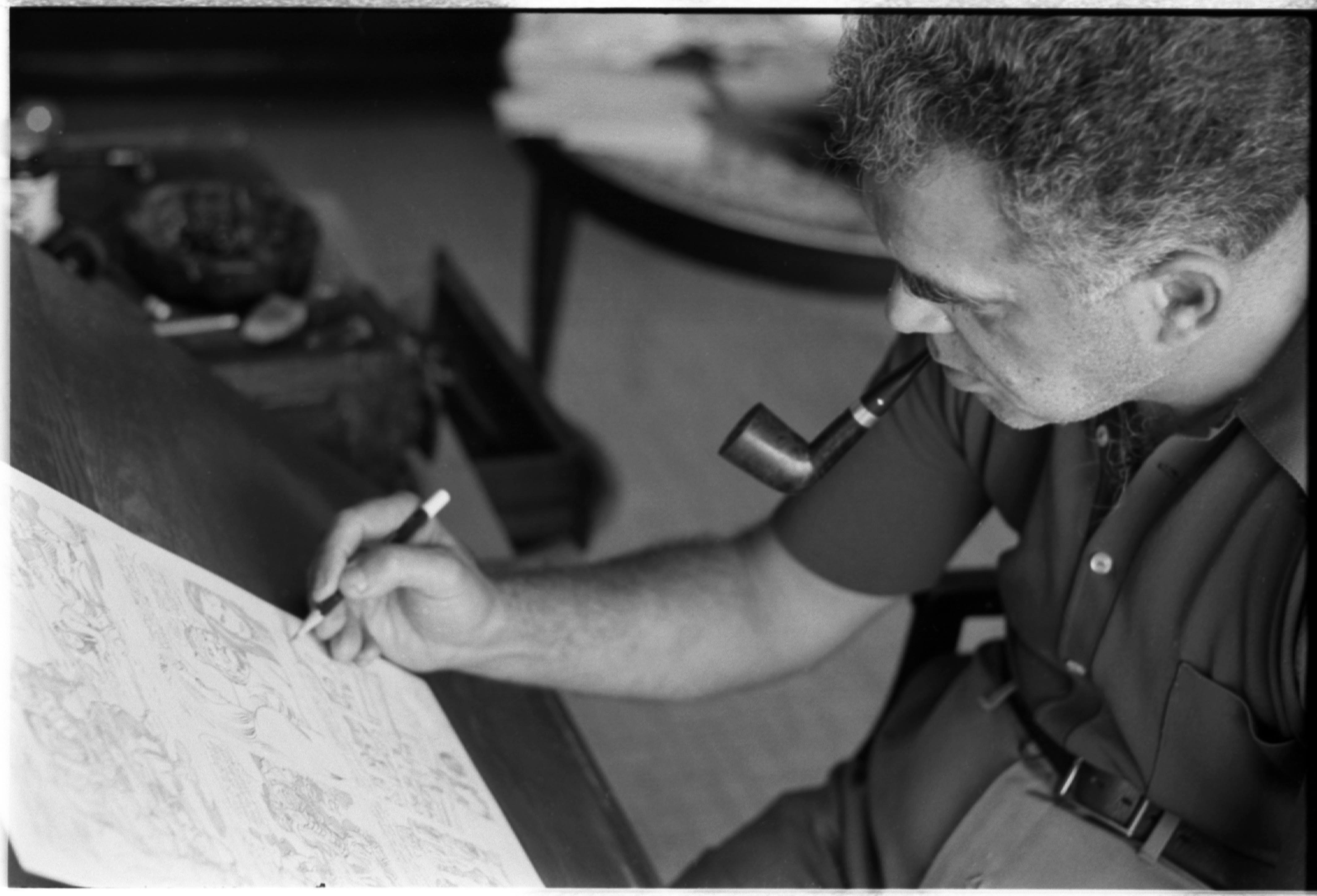
Kirby at work, Thousand Oaks, CA, Sept. 1972. Photo by and (c) David Folkman.
Today, August 28, I call Kirby Day. This would have been the 102nd birthday of Jack Kirby (b. Jacob Kurtzberg, 1917-1994), as inventive and influential a comics creator as the field has ever seen, and one of the under-appreciated architects of what is now 21st century popular culture, both in the US and around the world. On this day, this unofficial holiday, why not donate to The Hero Initiative in support of veteran comics creators in need? Giving back on Kirby’s birthday is a grand tradition that deserves continuing.
And, if you’re in or near New York City — not, like me, on the wrong coast — then why not join the Jack Kirby Museum & Research Center this evening on the Lower East Side, Kirby’s point of origin, for their celebratory walking tour and mixer? That sounds wonderful. It’s a free, non-ticketed event (the precise starting point and other info can be found on the Museum’s site at the above link). Kirby belongs to the world, but his roots in NYC deserve to be recognized and retraced. (How about a commemorative plaque at Kirby’s Essex Street birthplace, hmm?)
KIRBY, HYPE & HISTORY
Kirby’s name has now been coopted and rebranded as a “Disney legend,” and is at last gaining traction in entertainment media coverage, with film adaptations of his late-period auteurist works The New Gods and The Eternals looming (from Warner/DC and Marvel Studios respectively). However, his larger career story, beyond what can be harnessed to hype new adaptations, still seems unknown even to many fans of the Marvel Universe — a pop-culture franchise impossible to imagine without Kirby’s foundational work. Happily, the now-touring exhibition Marvel: Universe of Super Heroes (reviewed here on 23 April 2018) casts Kirby as, essentially, cofounder of that universe, and conversations around films like Thor: Ragnarok and the upcoming Eternals have made Kirby and his designs a frequent talking point. I have to admit, I had never expected to see this.
But to me the heart of the story remains (of course) Kirby’s own art and storytelling, and his own improbable record of unstinting creativity against long odds, in an industry that often treated creators like dirt. Thrilling to the latest news of pending screen adaptations ought to be balanced, I think, by a critical awareness that comics, as comics, do not necessarily gain from these things, and that a history of comics that is hostage to the current exploitation of corporate IP is not really history, but hype. Anyone who has published scholarship on comics creators like Kirby is probably familiar with the odd sensation of seeing scholarly opportunities open up precisely because of that hype — but I believe we should be wary of pop-culture presentism that repackages, but also occludes, the very history of the things we are researching. Sure, bring on the adaptations, the marketing campaigns, the DVD/Blu-ray extras and all that (I’ll be paying attention to the Eternals and New Gods films), but it’s the conversation around Kirby’s comic art as such that most interests me.
Kirby does not equal Marvel, or DC, and even his work for DC and Marvel ought to be framed in terms other than those of corporate mythology!
KIRBY STUDIES NEWS:
Man, I wish I had been able to go to France this summer. It’s been a feast of comic art exhibitions in France these last few months, and not one but two shows about Kirby have taken place in the Normandy region, coinciding with the 75th anniversary of the Allied invasion of Normandy and subsequent liberation of France. In France, Kirby’s name seems indelibly linked with his part in the liberation as well as his Marvel work, so this seems to have been perfect timing. One of these exhibitions closed just this past weekend, and the other (sigh) closes on September 29. I so wanted to give my passport another workout this summer, but, alas, could not.
I owe most of what I know about these exhibitions to social media posts and, especially, a review essay by comics scholar Jean-Paul Gabilliet (Of Comics and Men) for the International Journal of Comic Art. This thoughtful and detailed essay, by one of the leading historians of the American comic book, is happily available online, pending its publication in a future issue of IJOCA; I recommend it highly:
One of the exhibitions, co-curated by French Kirby biographer Jean Depelley, focused squarely on Kirby’s wartime experience. Titled La guerre de Jack Kirby, l’inventeur des super-héros modernes [The war of Jack Kirby, the inventor of modern superheroes], it reportedly consisted of reproductions of comic book art and photographs, with emphasis on Kirby’s time as a combat infantryman in Nazi-occupied France. This fairly small exhibition ran from June 4 through August 24 at Les 7 lieux, a media library and cultural center in the city of Bayeux (famed in not only military history but also, of course, the history of sequential art).
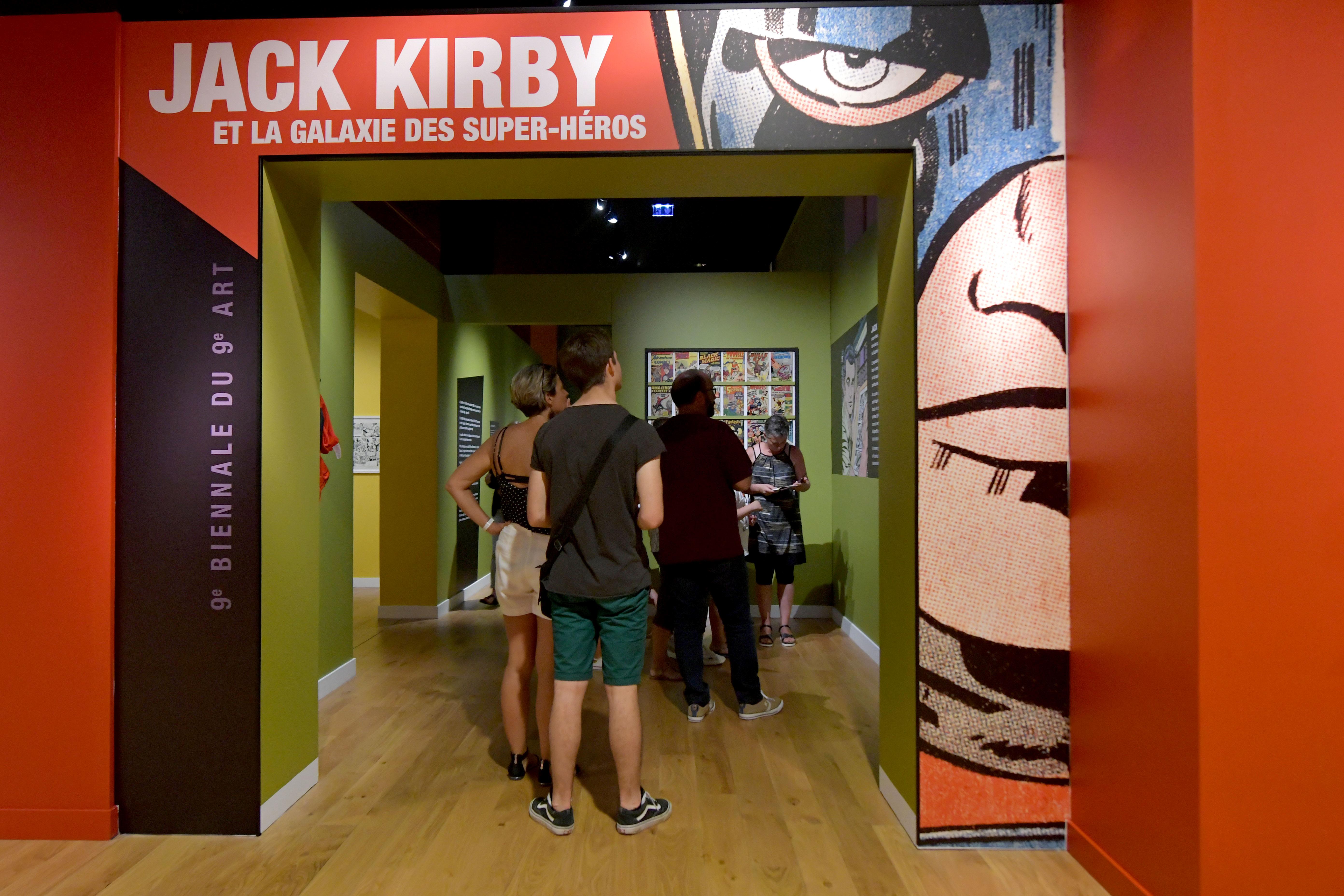
At the same time, roughly 60 miles away, a very large exhibition titled Jack Kirby: la galaxie des super-héros ran (and is still running, through Sept. 29, having been extended) at Le Musée Thomas Henry, a fine-arts museum in Cherbourg, the famed Normandy port city. Co-curated by Musée curator Louise Hallet and comic art dealer Bernard Mahé, this exhibition is part of the Biennale du 9e art, a biennial event that centers on a big exhibition focused on a major creator. La galaxie reportedly includes more than 200 pieces of original comic art, about three-fourths of which are by Kirby, the other one-fourth being works by, as Gabilliet says, Kirby’s precursors (e.g. Hal Foster; Alex Raymond) and followers (e.g. Steranko; John Buscema). This sounds frankly like an overwhelming feast for the eye and the mind. Dig a couple of borrowed photos:
Jack Kirby: la galaxie des super héros at Le Musée Thomas Henry. Photo: actua.fr, 28 July 2019.
Curator Louise Hallet and Darkseid, Le Musée Thomas Henry. Photo: Ouest-France, 22 May 2019.
La galaxie appears to have been one of the very largest Kirby exhibitions ever, comparable in scope to The House that Jack Built (co-curated by Paul Gravett and Dan Nadel for Lucerne’s Fumetto festival in 2010). Gabilliet writes thoughtfully of the exhibition’s pleasures and limitations, in terms that reminded me of the challenges I faced when curating Comic Book Apocalypse for the CSUN Art Galleries (2015). But, ah, just to see the complete “Even Gods Must Die” (New Gods, 1984 series, #6), on view at La galaxie — man, what I wouldn’t have done for that experience. I dearly regret missing these shows, just as I regret missing Mostri, uomini, dei [Monsters, Men, Gods], the Kirby exhibition at Bologna’s BilBOLBul comics festival last fall.
Right now, Gabilliet’s conclusion is ringing in my head:
[C]omic art exhibiting seems increasingly open to a plurality of conceptual and aesthetic possibilities that by far transcend the arguably increasingly humdrum pattern of “career retrospectives,” notwithstanding the genuine satisfaction one is perfectly free to experience while beholding wall-to-wall displays of original comic art drawn by a given creator. While many museums and galleries still regard comic art as “easily accessible” art that will likely attract paying visitors—a legitimate expectation by all means, unfortunately—the full museographic potential of comic art is yet to be tapped. The more imaginative curators will prove, the more alive we will all become to the versatility of our favorite art form.
Yet to be tapped. Absolutely. But things are happening. This puts me in mind of, one, Kim Munson’s forthcoming academic anthology, Comic Art in Museums (UP of Mississippi, 2020), in which I believe I will have a couple of pieces; two, the pending Comic-Con Museum in San Diego; and three, the pending Lucas Museum of Narrative Art in Los Angeles (currently advertising for a comic art curator). It would be reasonable to expect major Kirby-themed exhibitions from either or both of those places.
TWO OTHER NEWS ITEMS:
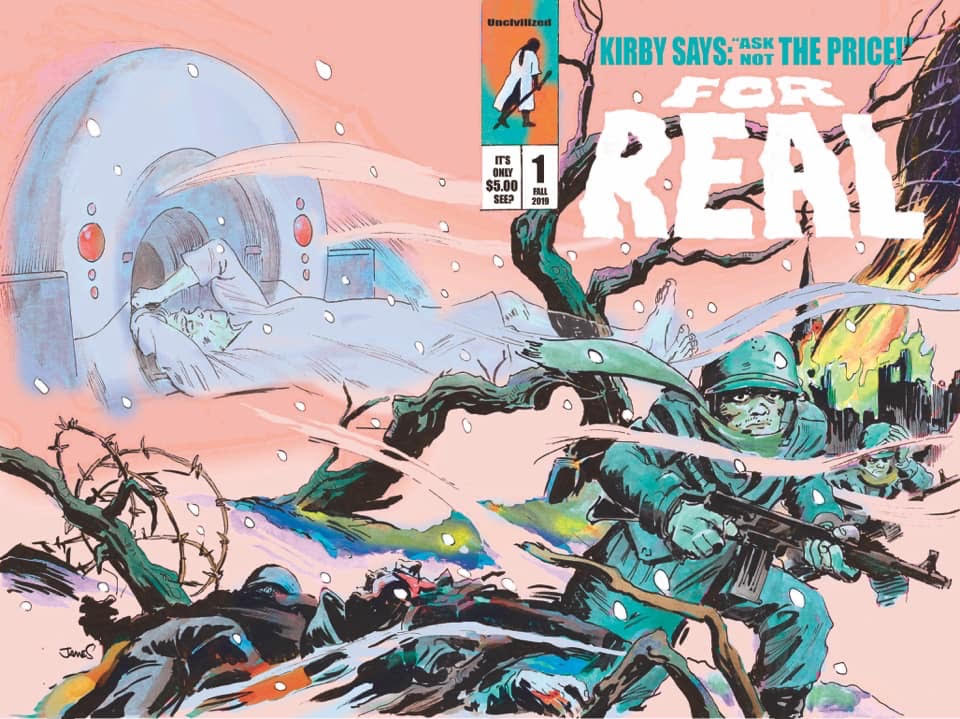
ONE. Speaking of Kirby’s wartime experience, acclaimed artist and Kirby expert James Romberger has a Kirby-themed biographical comic about to drop: For Real #1, promised from Uncivilized Books this November, which will reportedly contain:
“The Oven,” a short comics story that is a fictionalized amalgam of two little-discussed and largely undocumented parts of Kirby’s life: a harrowing encounter with Nazis in World War 2 and his treatment for cancer many years later, a story that touches on themes of PTSD, graphic medicine, courage and empathy; and “The Real Thing,” an accompanying essay by James that clarifies aspects of the story and contextualizes them with the reality of Kirby’s experiences.
James Romberger’s anthology series For Real will begin with a comic and an essay about Kirby. In shops Nov. 6, 2019.
This comic book, Romberger says, is “the first issue of what will be a continuing anthology title” that he will edit, to be published by Uncivilized Books.
I’m excited about this project, which promises to complement some other recent biographical projects: Tom Scioli’s graphic bio of Kirby (in progress), Scioli and Jean Depelley’s collaboration on “Private Kirby Adventures” (as seen in The Jack Kirby Collector #64, 2014), and Depelley and Marc Azéma’s 2017 documentary film La guerre de Kirby. Romberger is a superb artist, with a great feel for period and place and an abiding interest in Kirby.
TWO. On an academic and theoretical front, Kirby’s work figures in the recently released bilingual (French and English) anthology Abstraction and Comics/Bande dessinée et abstraction, a two-volume slipcased beauty edited by Aarnoud Rommens with the collaboration of Benoît Crucifix, Björn-Olav Dozo, Erwin Dejasse, and Pablo Turnes.
Abstraction and Comics | Bande dessinée et abstraction. La Cinquième Couche/Presses universitaires de Liège, collection ACME, 201
Abstraction and Comics is a project of the ACME research group at the University of Liège in Belgium, and jointly published by La Cinquième Couche and the University Presses of Liège. It totals nearly 900 pages, and includes essays and comics by more than fifty contributors (among them my esteemed colleagues Jan Baetens, Hugo Frey, Gene Kannenberg, Jr., Martha Kuhlman, Pascal Lefèvre, Gert Meesters, and Barbara Postema). Two essays will be of special interest to Kirby scholars and fans: “Jack Kirby: In-between the Abstract and the Psychedelic,” by Spanish scholar Roberto Bartual (author of Jack Kirby: Una Odisea Psicodélica); and “The Kirby ‘Krackle’: A Graphic Lexicon for Cosmic Superheroes,” by Argentinean scholar Amadeo Gandolfo.
There’s a ton to take in and think about in this pair of books. Recommended emphatically! My own research on collage in comics (including Kirby’s) will draw quite a bit from these pages.
It’s great to see Kirby studies flourishing internationally, and so many exhibitions and projects taking up his work. By Halloween I’ll have another such project to announce.
HAPPY KIRBY DAY! Indeed, #K i r b y I s E t e r n a l.
PS. My thanks to the great Paul Gravett for providing me updated and corrected information about the Cherbourg exhibition!


















 Kirby Studies