Category Archives: News

Kirbyvision in Glorious 3-D!

Kirbyvision: A Tribute to Jack Kirby, an exhibition now showing at the Corey Helford Gallery in Los Angeles, lovingly registers Kirby’s impact on contemporary comics, media, and culture. Curated by the Jack Kirby Museum and Research Center, in collaboration with the Helford, the show offers for sale new or recent works by more than seventy artists inspired by Kirby, alongside a historical exhibition of Kirby originals that outlines his style, techniques, and key creations. Together, the historical exhibit and contemporary tributes reaffirm Kirby’s continuing influence. I urge comics and Kirby fans anywhere within a day’s travel of Los Angeles to pay it a good, long visit (alas, it remains open through just Saturday, August 3—would that it could stay longer!). The show is free and open to the public.

I’ve experienced Kirbyvision twice myself, and hope to again. Having curated the 2015 CSUN show Comic Book Apocalypse: The Graphic World of Jack Kirby (to which the Museum contributed substantially), I have a sense of what it takes to contextualize Kirby’s art for gallery visitors. I greatly admire what the Museum has accomplished here. Of course, I can hardly be objective, since I’m a Kirby diehard (and serve on the Kirby Museum’s Board of Advisors), but I hope that the following description gives the flavor of the show and helps document it for posterity. Do know my bias, going in, but also know that this is a show you should see if you love comic art.
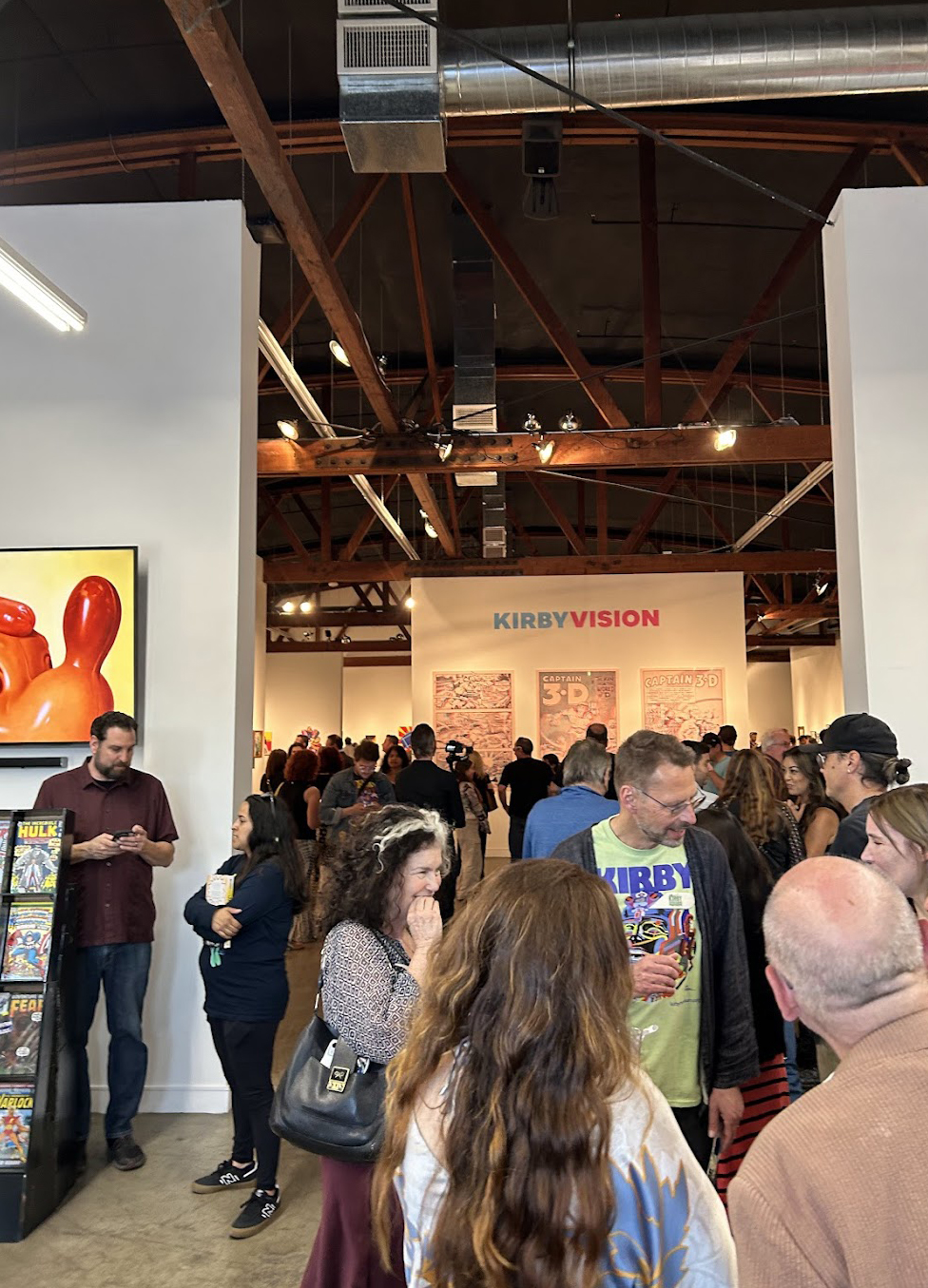
This and most of the photos that follow are by CH.

Kirbyvision opened Saturday, June 29, with a bustling reception that brought out diverse artists, collectors, fans, and members of Kirby’s family. The buzz and shared happiness that evening were fairly electrifying. I was glad to be in happy company, and enthralled from the get-go. The show is an eye-popping design experience and a triumph for the Kirby Museum, which has carried the torch since its founding in 2005 and began holding pop-up exhibitions in 2013. For years, the Museum has been seizing opportunities to demonstrate just what it can do—and I think this show, more than any previous event, does that wonderfully. So, here’s my report:
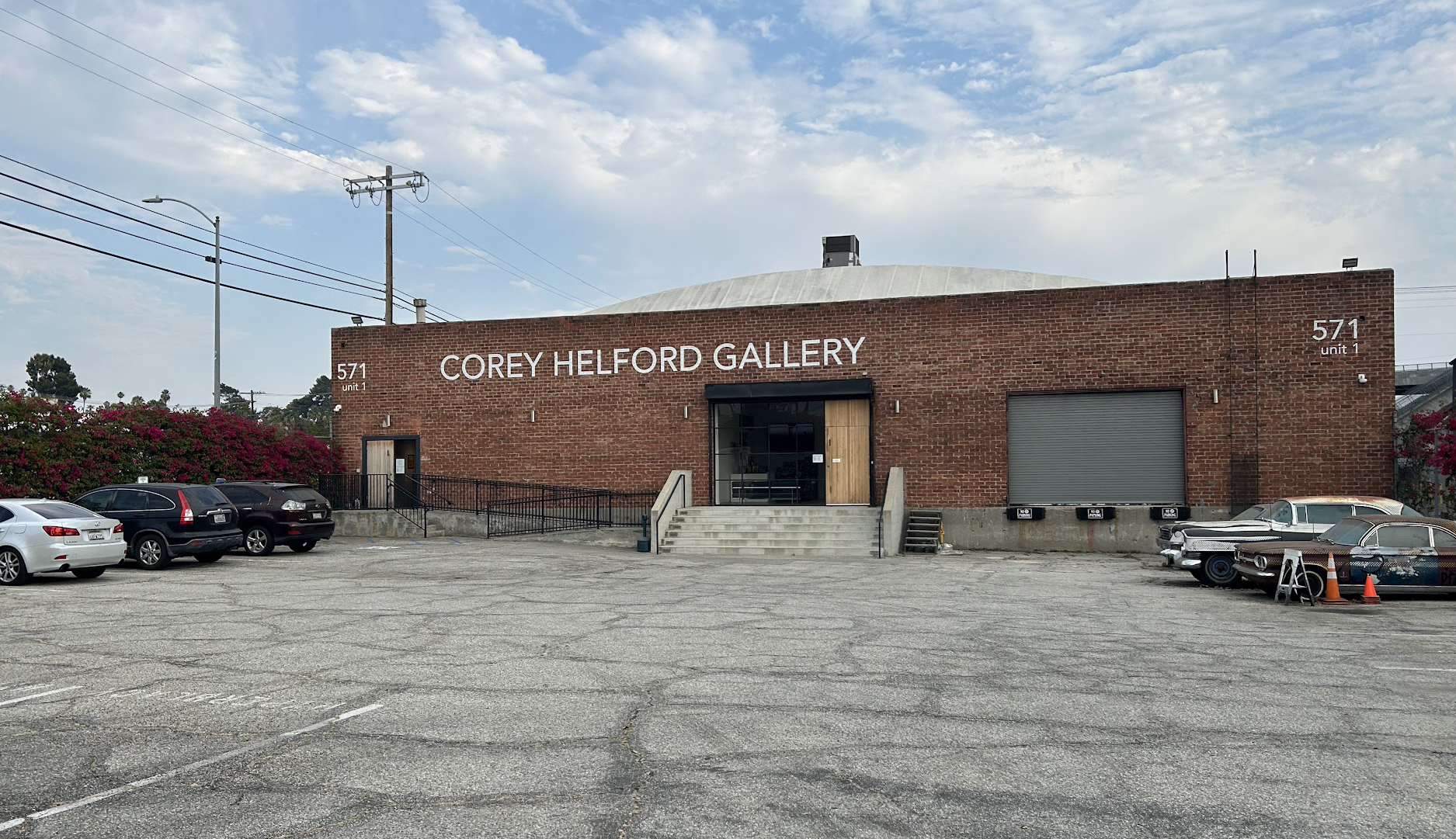
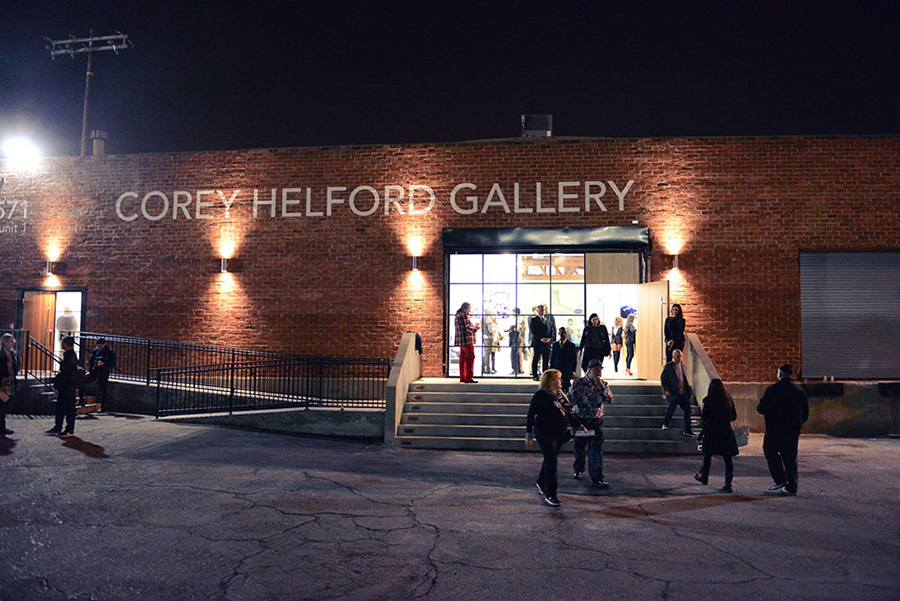
The bottom photo is not actually from Kirbyvision’s opening night, June 29, but perhaps sets the mood? From coreyhelfordgallery.com.

The Corey Helford is in eastside Los Angeles, by the L.A. River, within a district that feels postindustrial. Around it stand imposing buildings festooned with a mix of graffiti and bespoke murals. My wife Mich and I have been visiting L.A. galleries lately, and they tend to be in repurposed settings like this. The Gallery building, a block of brick surrounded by fences, runs to 12,000 square feet. Its main gallery, a vast openness, takes up about 4500 of that, while two other galleries open off to the side. Unsurprisingly, all of these are whitewalled, cement-floored, and adaptable artspaces. Kirbyvision currently occupies most of the building, though one gallery holds an exhibition by painter Bennett Slater (who renders dolls and other commercial icons with Old Master precision).
Slater, an artist frequently shown at the Corey Helford, epitomizes the gallery’s New Contemporary slant. The Helford seems to favor Surreal, Pop-inspired figurative work blending lowbrow references with exacting technique and high gloss. It has a Hi-Fructose and Juxtapoz vibe, with nods to street art and impish personal riffs on commercial design. Kirbyvision mostly fits into that wheelhouse. The bulk of the show consists of eighty-plus homages to Kirby (or genres and brands he is known for). The work on view embraces various media and ranges technically from rowdy handmade-ness to industrial sheen. Paintings and drawings are the main things, though there are also collages, digital prints, and sculptures.
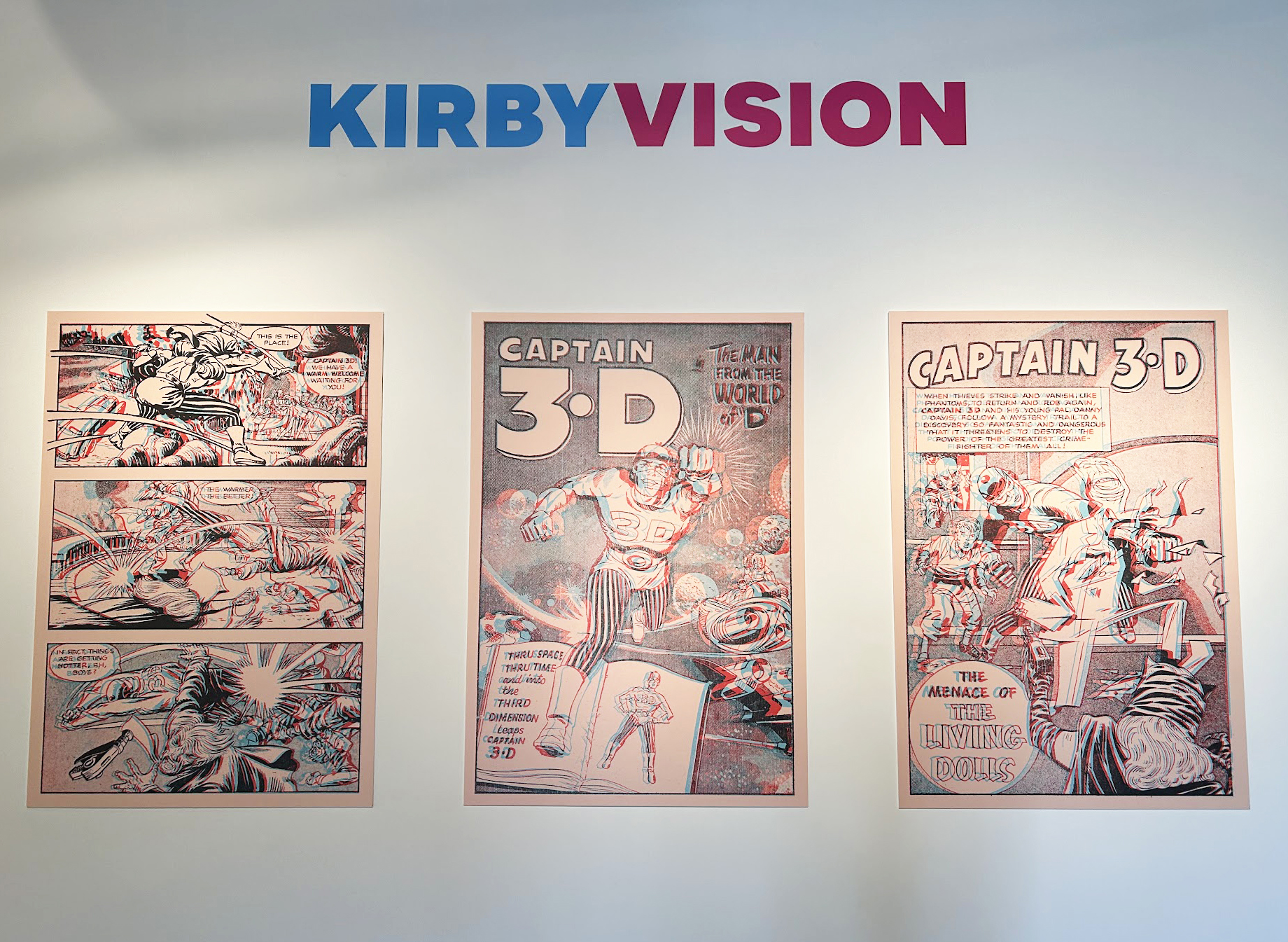
If the works on offer are mixed, the total design of Kirbyvision brings unity. The show’s main design conceit is the idea of 3-D vision, with nods to Kirby and Joe Simon’s single issue of Captain 3-D from 1953 (a then-faddish 3D comic published by Harvey). At the outset, a dividing wall in the main gallery’s entrance (which visitors skirt around to enter the gallery proper) bears a triptych of images from that comic, dramatically scaled up in very effective 3-D separation. Scanning that wall from a few paces back with the anaglyphic (red and blue) 3-D glasses freely provided by the gallery imparts a strong sense of movement. The 3-D elements represent a collaboration with stereoscopy expert Eric Kurland (founder of 3-D Space), whose gift for this kind of work can be felt throughout the show (so keep those glasses with you).
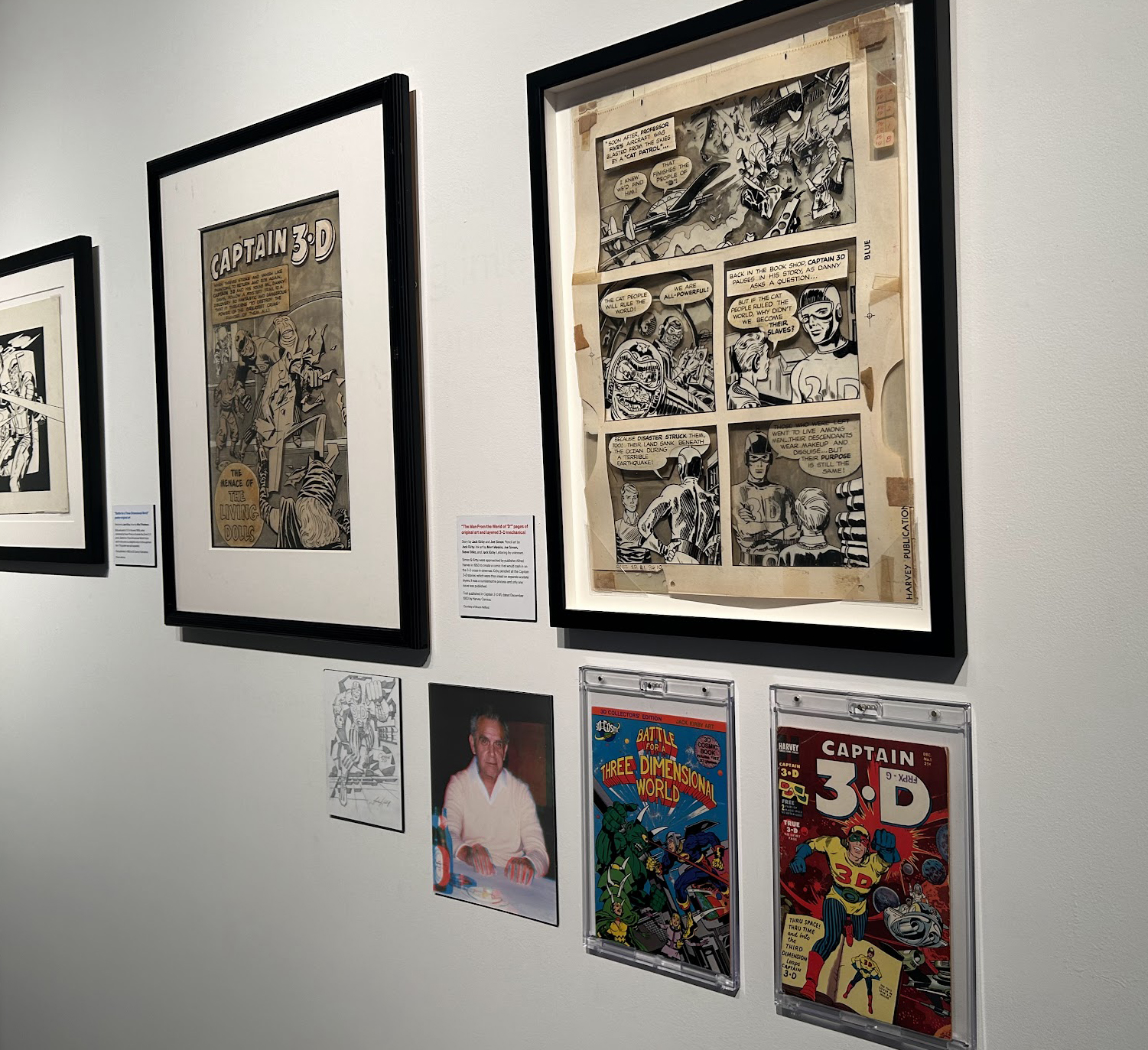
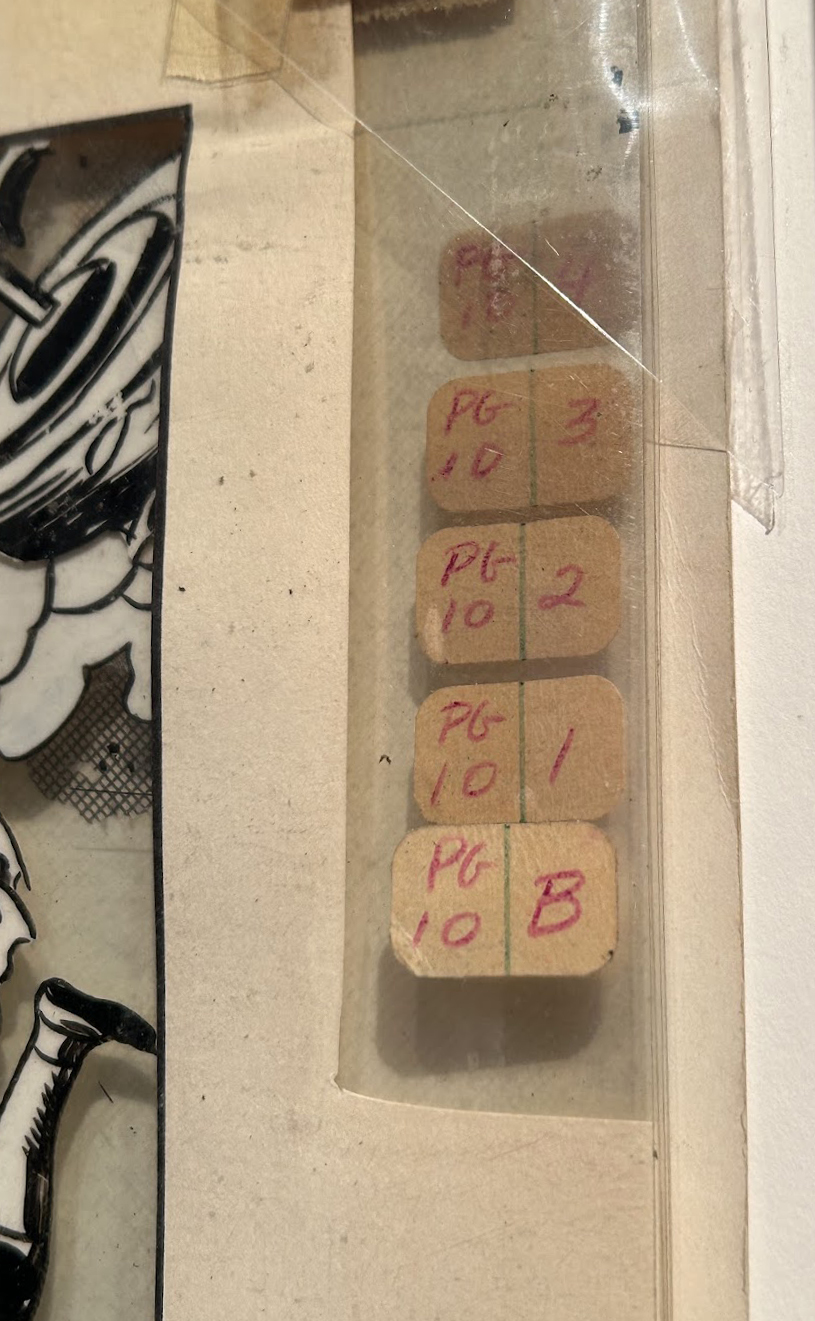
In effect, the 3-D hook gives Kirbyvision a brand identity (while suiting the Helford’s retro Pop sympathies). Displayed near the gallery entrance are two originals from Captain 3-D itself that hint at the laborious processes used to make 3D comics in the early Fifties. Those originals consist of Kirby-drawn elements separated onto layers of acetate, as well as shaded backgrounds on what appears to be Craftint paper. The originals are well preserved, yet their aged patina contrasts with the gorgeous wall-sized reproductions. This is both instructive and cool. Also displayed here are the published Captain 3-D and Kirby’s later 3D collaboration with Ray Zone, Battle for a Three Dimensional World (1982). Further in, attentive visitors will find an oversized reproduction of the entire Captain 3-D comic book (again, hold on to your glasses!).

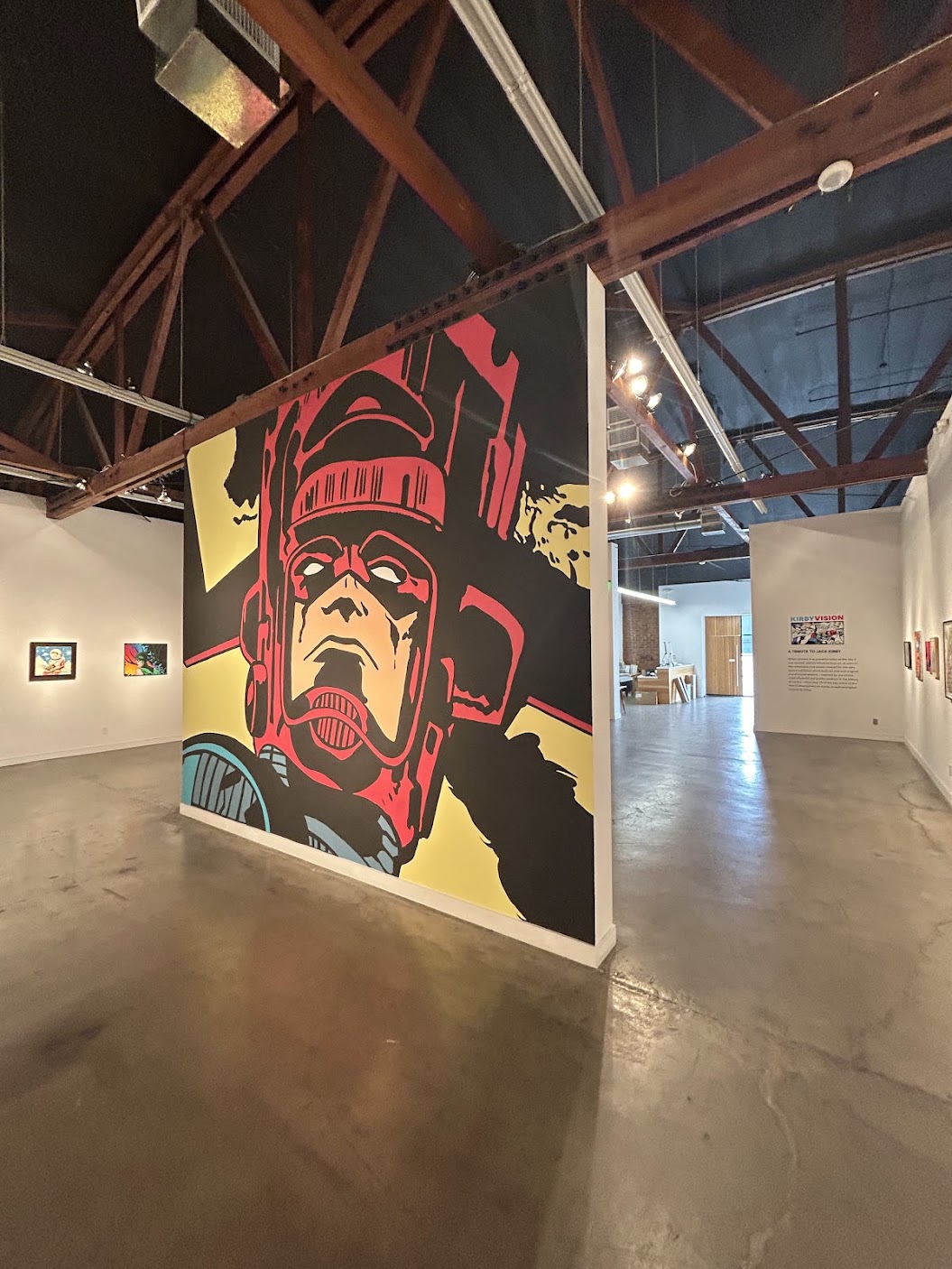
Other savvy design elements pop up across the show. A library of Kirby books is on sale in the lobby, courtesy of retailer Golden Apple Comics (and Kirby-related videos also play there, sotto voce). Just to the right of the 3-D dividing wall you’ll find a mockup of a period newsstand filled with comic books that, I gather, are free for the taking. On the night of June 29, the comics were vintage Kirby comics; for example, I saw friends leaving with mid-1970s issues of Kamandi (though when I revisited on July 12, the newsstand carried only Archie). Once you come around the dividing wall and into the main gallery space, you’ll find, on the wall’s flipside, a big mural of Kirby’s Galactus painted by the artist Skinner (seemingly based on a splash from Thor #167 by Kirby and Vince Colletta, 1969). Facing that mural, in the gallery’s center, is filmmaker and modelmaker Martin Muenier’s life-sized rendition of Thor’s Mjolnir, magnetically affixed to its anvil-like pedestal, which proved an irresistible interactive element for many visitors (myself included). In short, moving through this space is a lot of fun.

Opening night reception, June 29. I did say it was bustling!

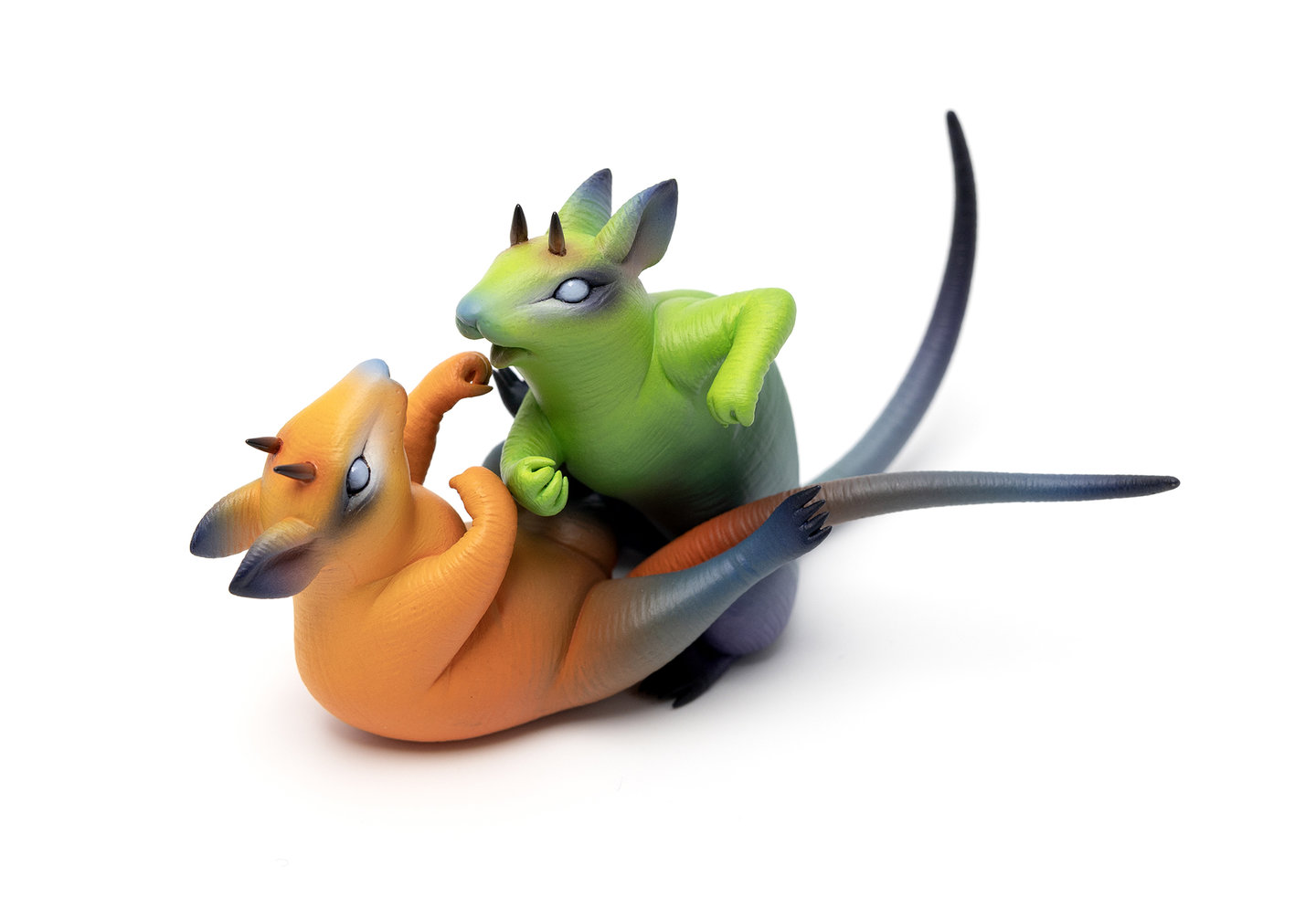
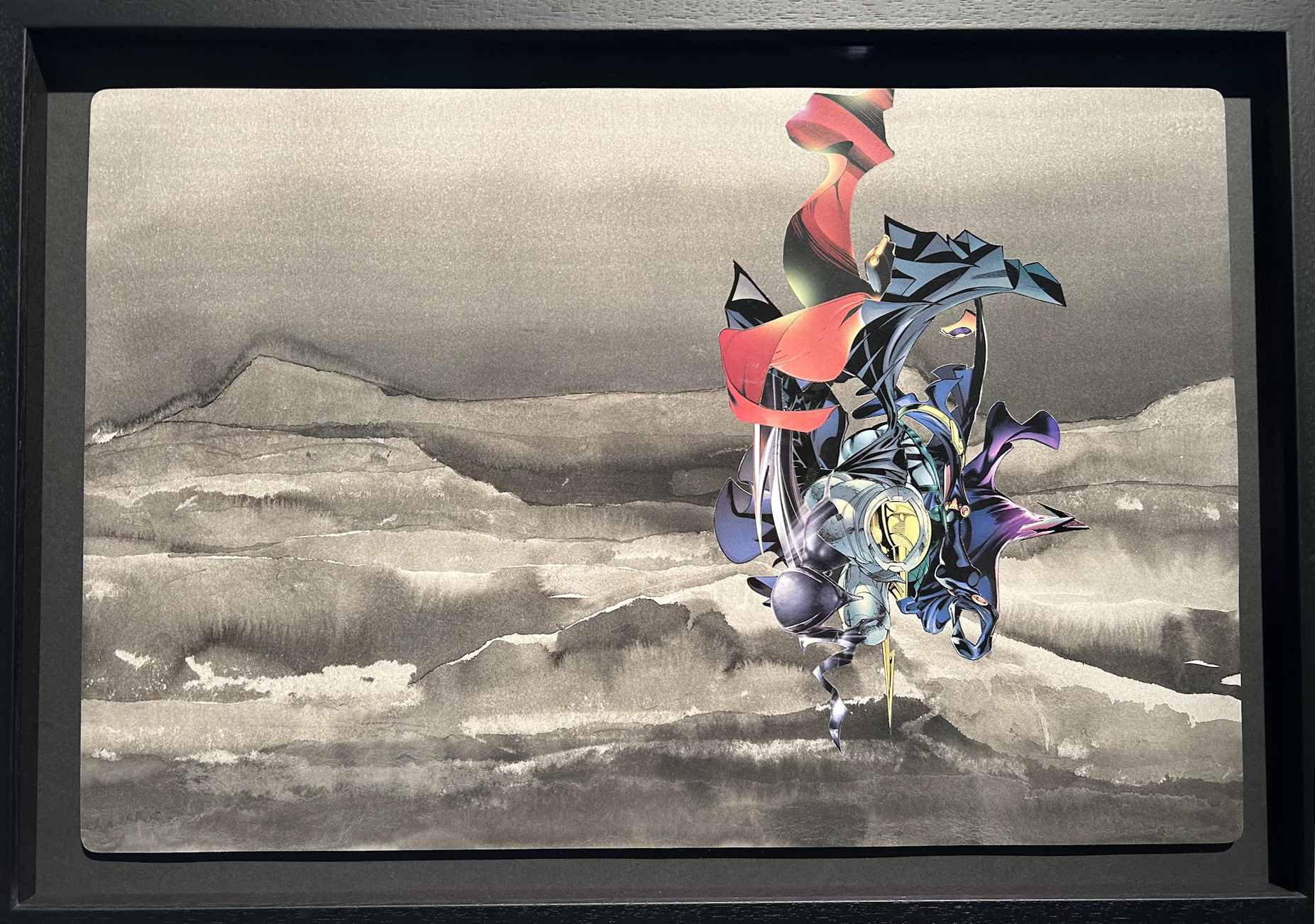
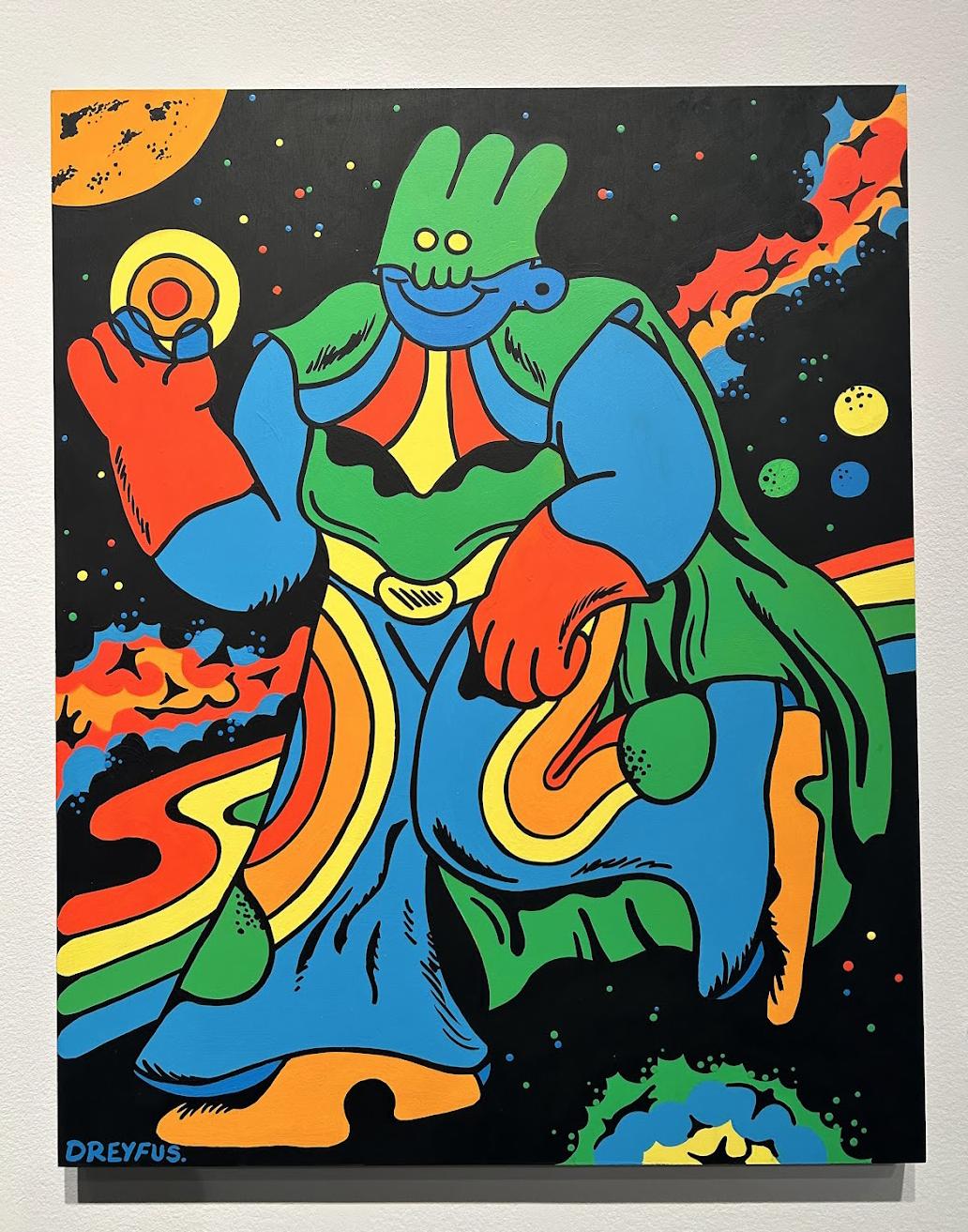
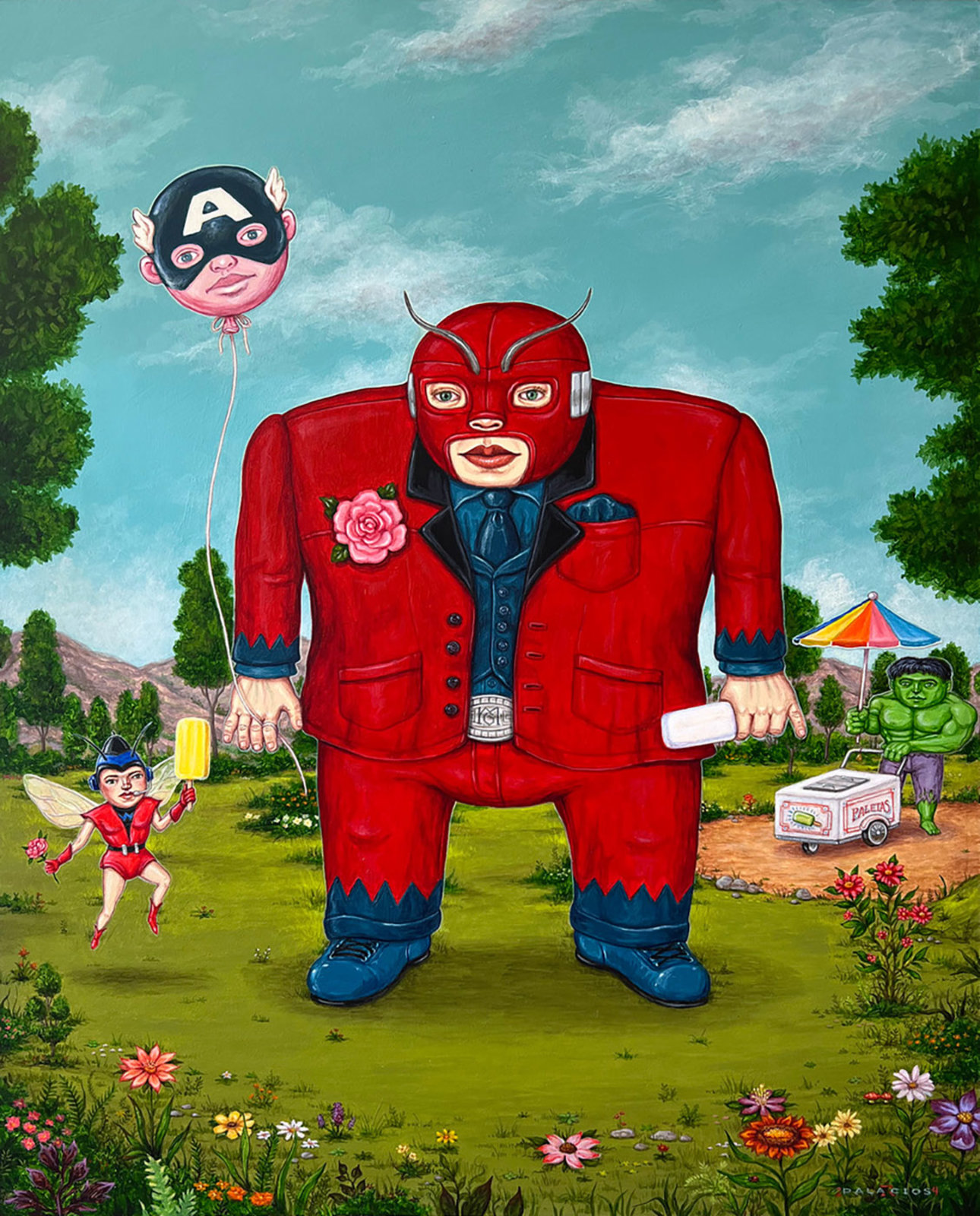
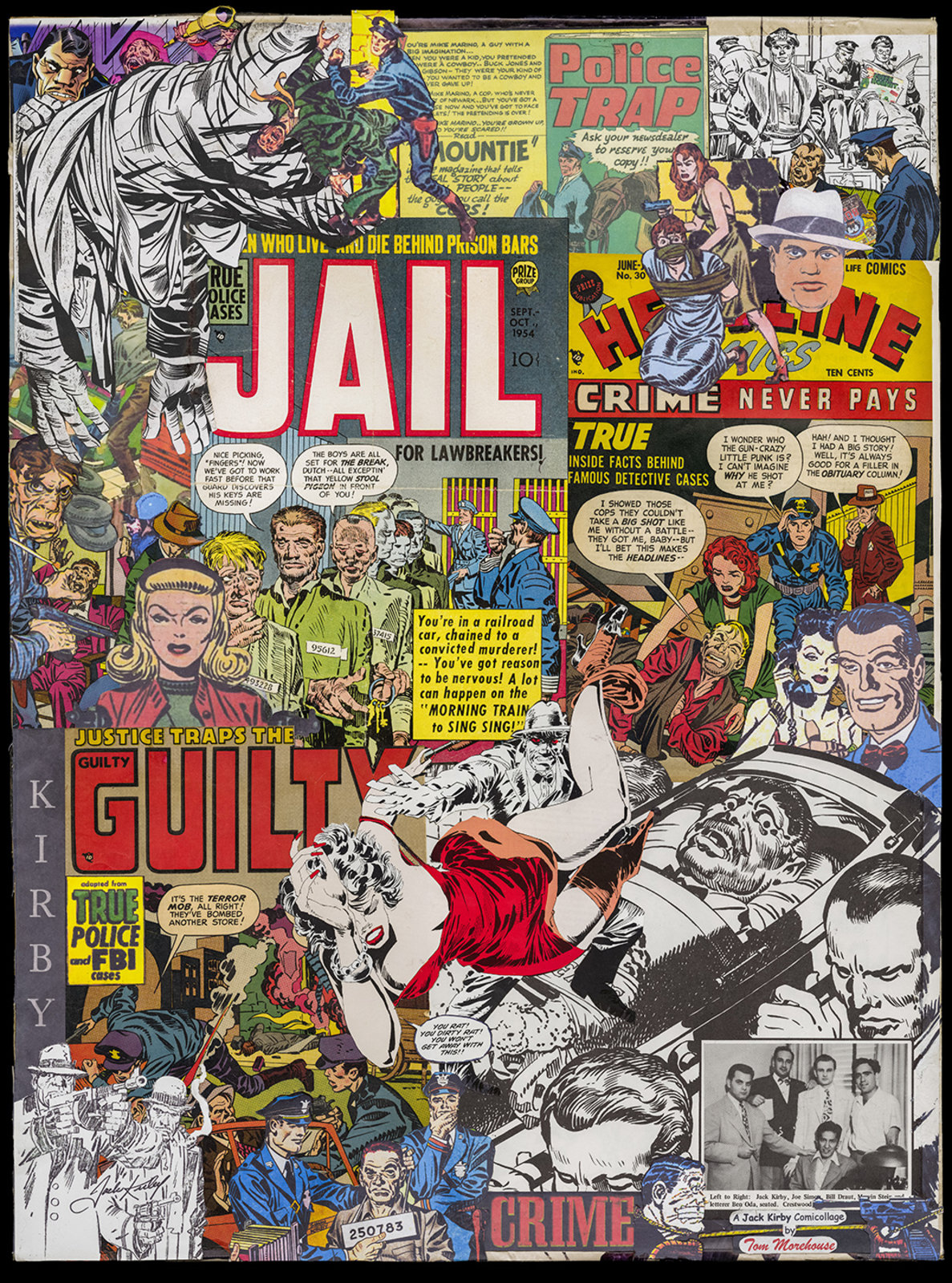
Most of Kirbyvision is presented in traditional white-cube style, with works on the walls proceeding clockwise. Some of the works are homages or détournements of recognizable images by Kirby, such as Patrick McDonnell’s Captain America canvas, The Last Superhero, or Tom Morehouse‘s collage, Kirby Crime, which mashes up images culled from decades of Kirby’s work in crime comics. On the other hand, some works are looser evocations of theme or genre that do not strive to be graphically Kirbyesque, such as Erika Sanada’s miniature ceramic Versus, with its two cute, rabbit-like critters locked in combat, or Aaron Noble’s collage The New Man, which blends swirling, cape-like elements, culled from various drawings of superhero costumes, into a hovering, abstracted shape. Some works cleave to a stylized naturalism familiar from mainstream comic books, while some are more explosively graphic, like Charles Glaubitz’s crackling acrylic and gouache drawing Teach Your Children That We Come from The Stars. Some are sober, but others playful, like Ashley DreyfusAtomic Man, a groovy, bell-bottomed hero, or Robert PalaciosGiant Man’s Day Off, a charming portrait of the Marvel icon as luchador (this and several other pieces reminded me of artists like Mark Ryden or Ivana Flores who traffic in subversive neotenic cuteness, a common enough approach nowadays). Overall, techniques on view range from rubbery cartooning to airbrushed polish, from precisely rendered surfaces (again, Slater) to frenetic painterly smudging.

(Images below of individual artworks are from coreyhelfordgallery.com unless otherwise credited.)
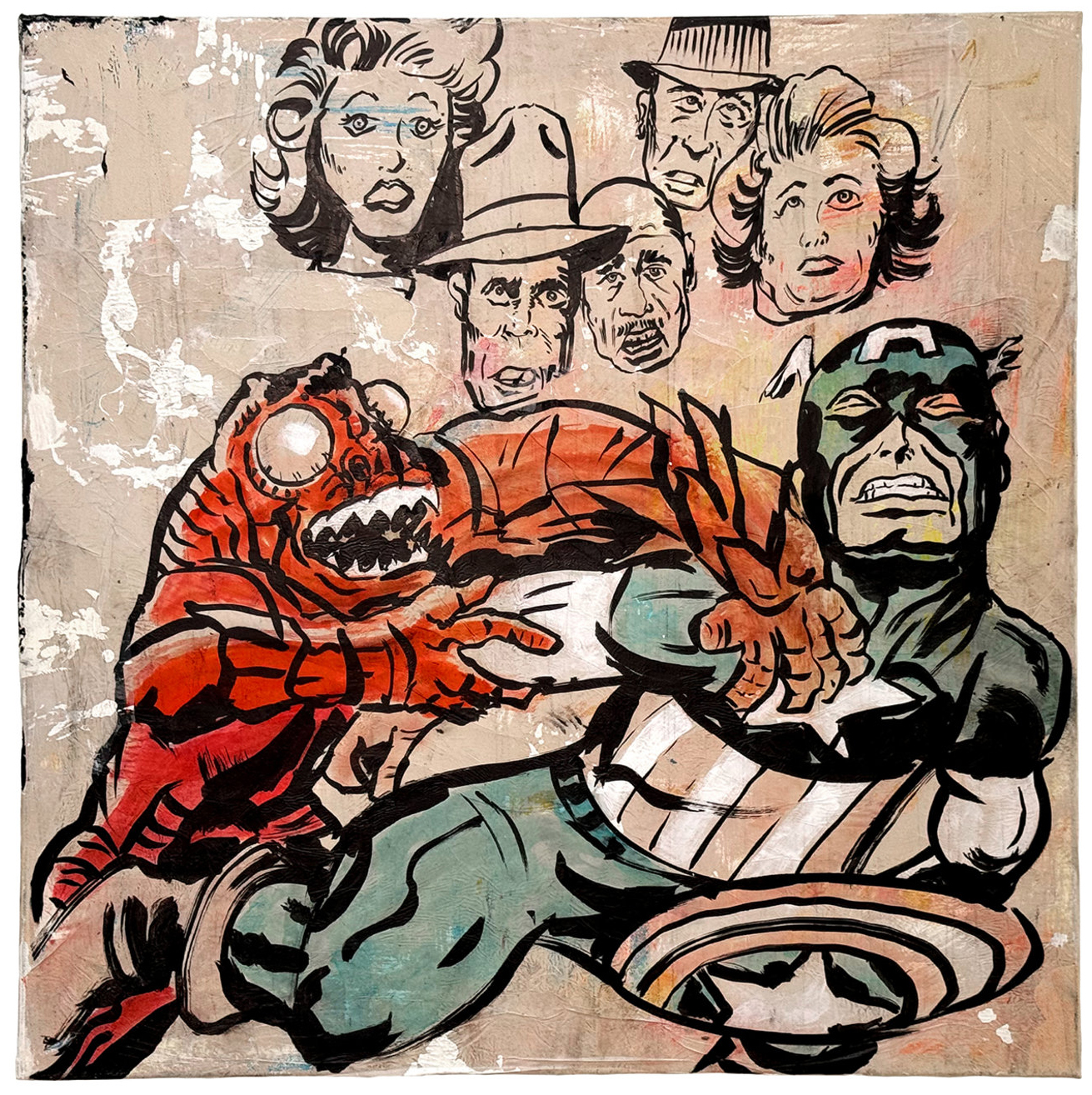
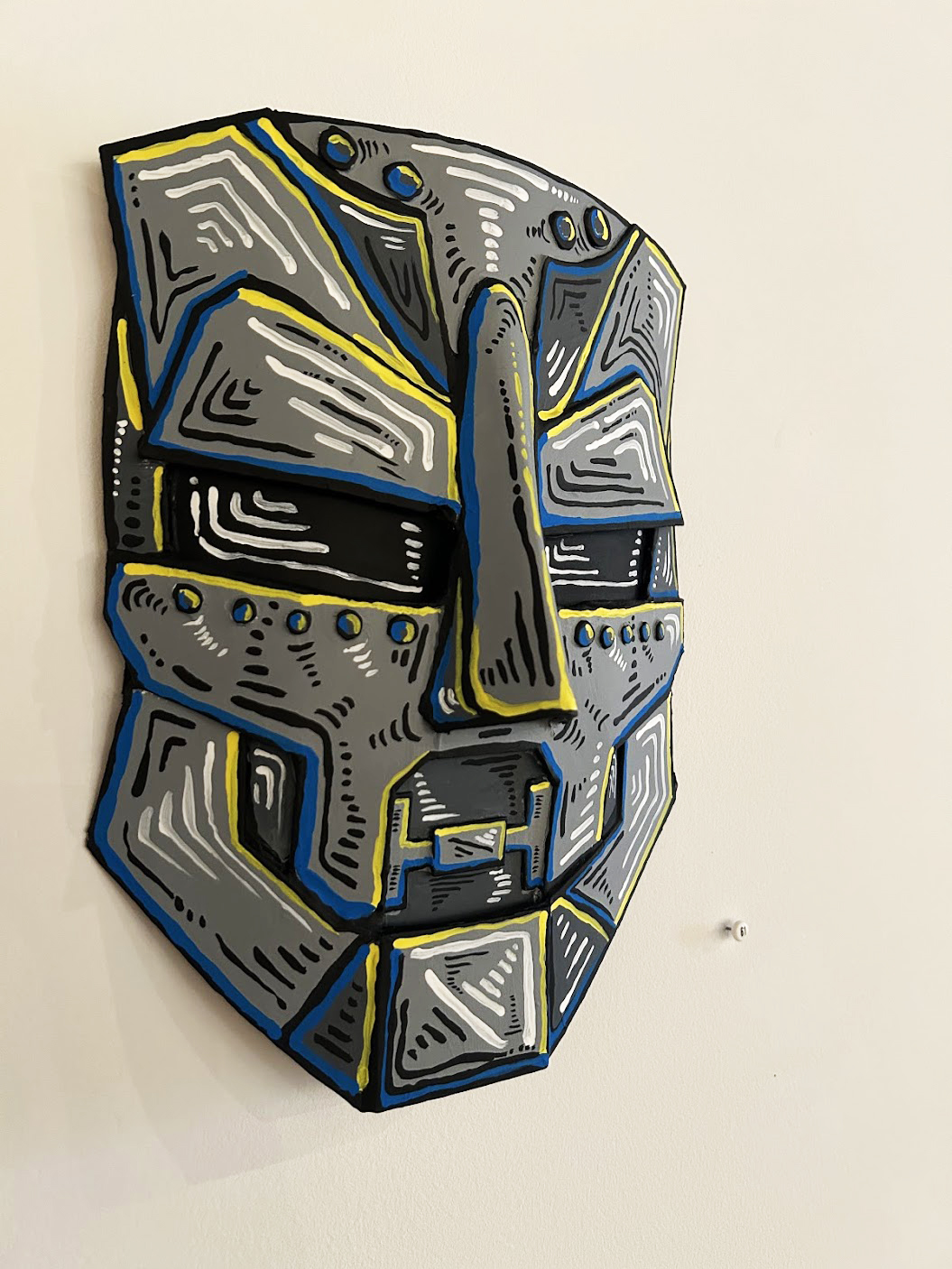
Many of my favorite pieces here depart from the Kirbyesque, or do Kirby style in odd, left-field ways that I find refreshing. These would include the life-size Dr. Doom Mask (acrylic on sculpted cardboard) by artist Nonamey; the canvas Five Cents, by Shaky Kane, which turns Kirby’s Captain America into an outsize bubblegum card; and Mark Frauenfelder’s Flower, Daughter of Googam, which bizarrely combines Flower, Kamandi’s near-nude wild-child love interest, with references to an early-1960s Marvel monster.
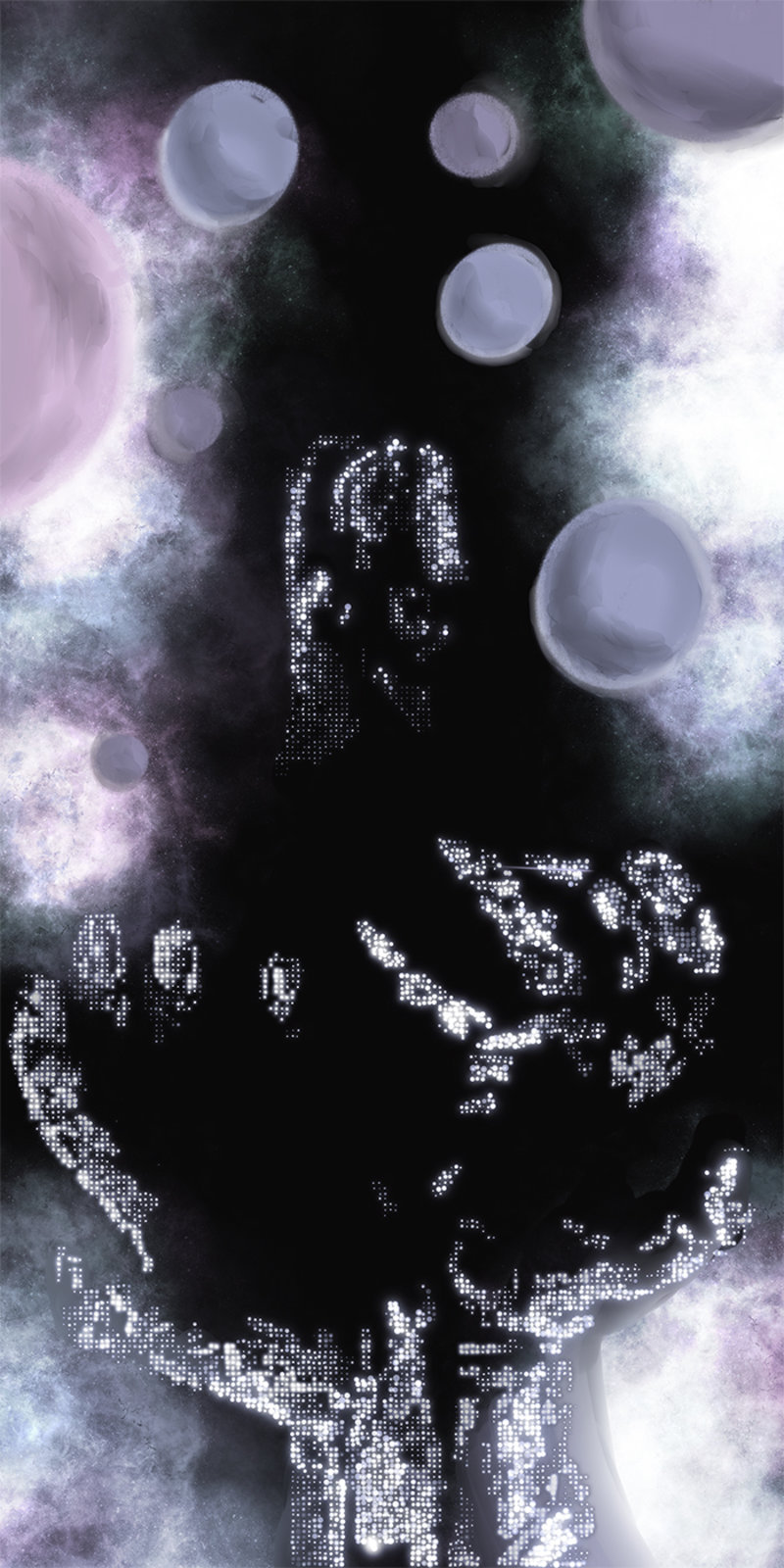
For me, one of the coolest spots in the show juxtaposes Mark Badger’s lively drawing Julius Caesar’s Ghost Appears to Brutus (a spinoff from his Kirby-inspired Caesar comics project?) and Sydney Heifler’s enigmatic digital print Rising, a dark, obscure image in which points of light (like glowing pegs on a pegboard) form a figure rising from two cupped hands, in a seeming homage to the Silver Surfer rising from the hands of Galactus. These are very different works, but their one-two punch delighted me (dig the big hands!). I’d say look out for odd moments of connection or contrast like this throughout.

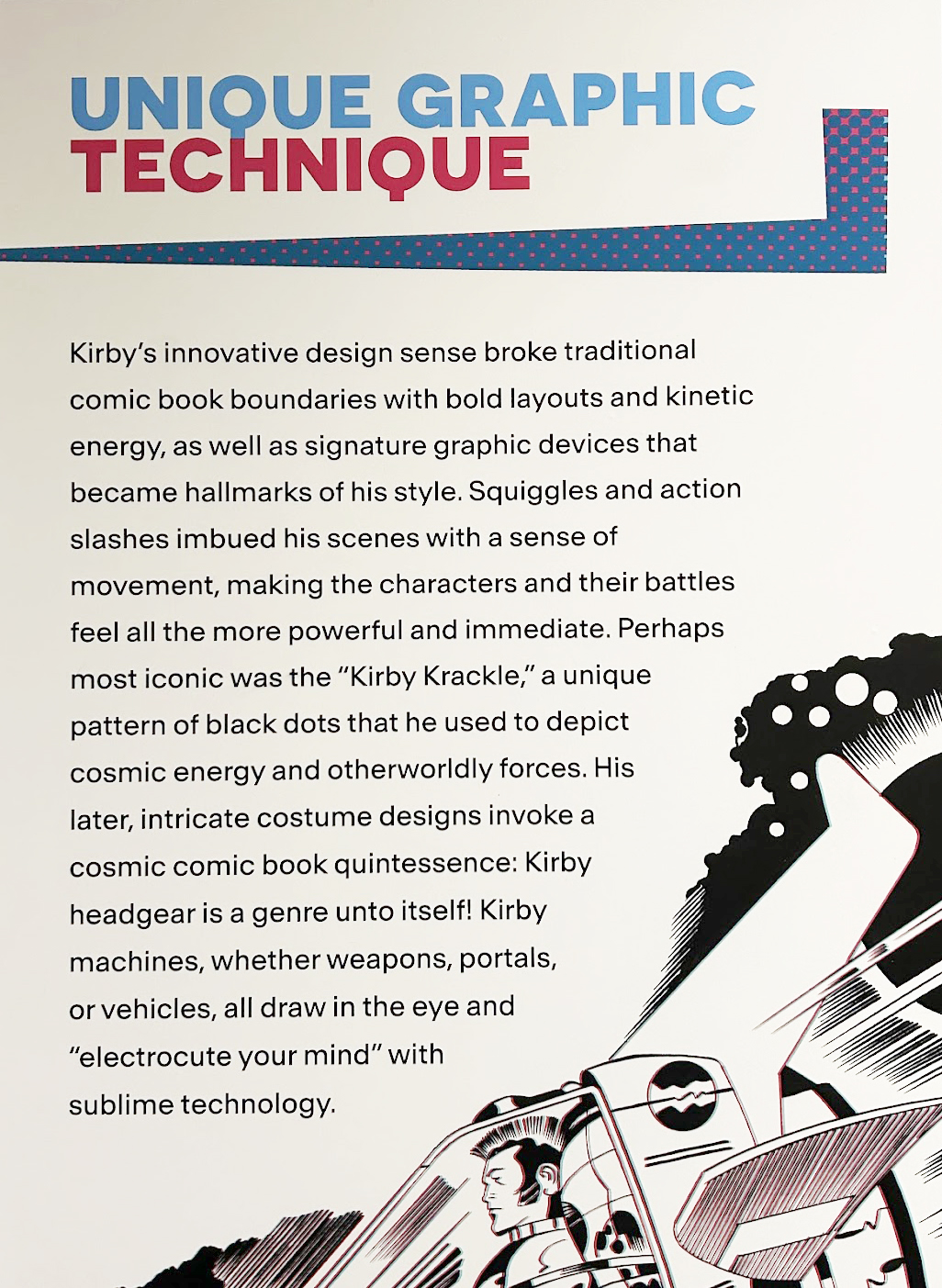
Besides paying tribute to Kirby, Kirbyvision contextualizes Kirby himself via a side gallery of Kirby originals organized by the Kirby Museum (the art on view in this side gallery, note, is not for sale). This is a smaller space, but dense with art and information. It feels distinctly museum-like, in the sense of didactic, yet also welcoming and visually sumptuous, building on the Museum’s track record of accessible pop-up exhibitions. Wall-mounted blurbs, succinct and informative, guide visitors through Kirby’s career thematically rather than chronologically. Newcomers to Kirby can learn a lot here about his graphic style, storytelling habits, range of genres, and famed titles and characters. The emphasis is on Kirby’s handiwork and the outpouring of his sensibility, not on corporate-owned IP (though there is plenty about that too).
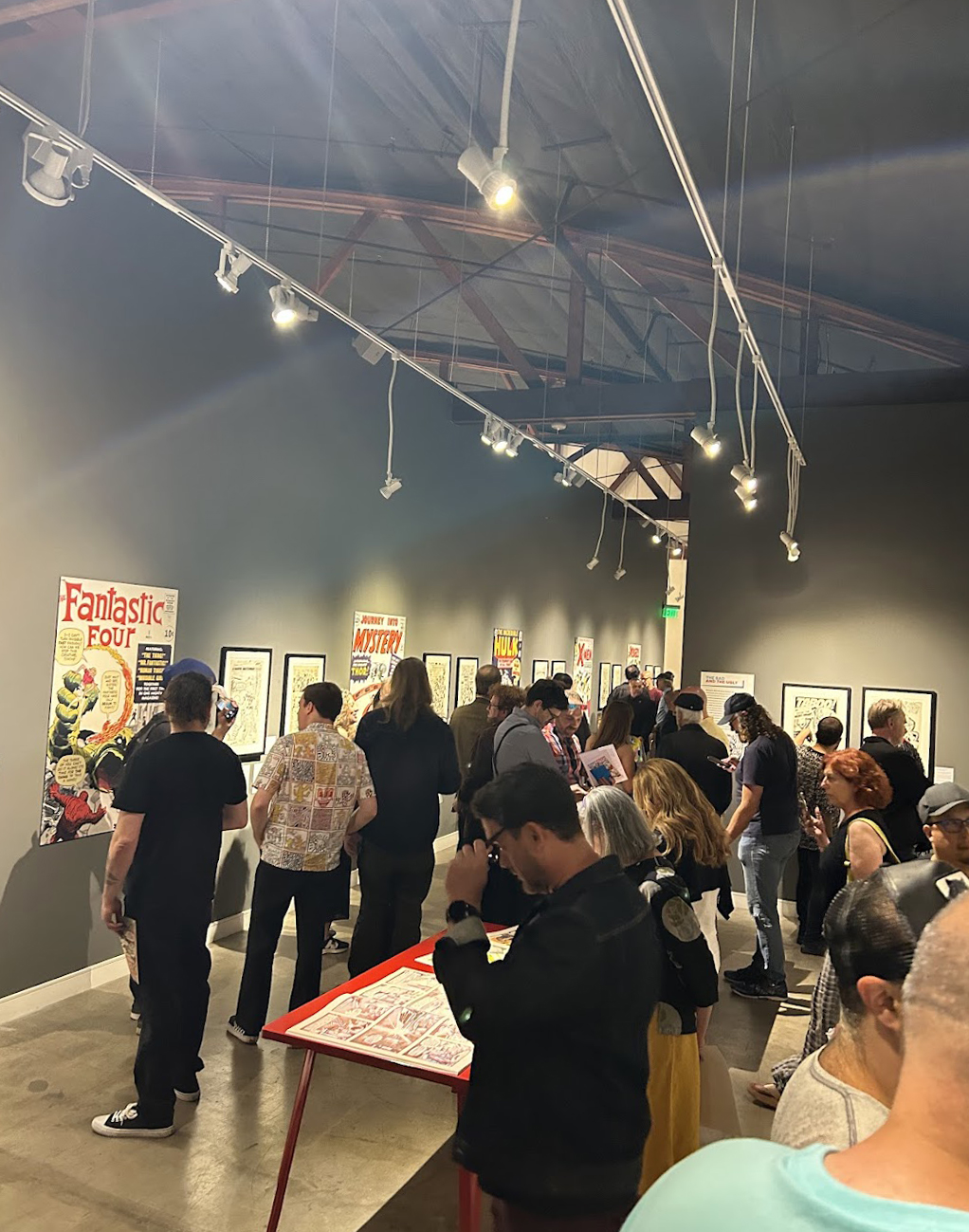
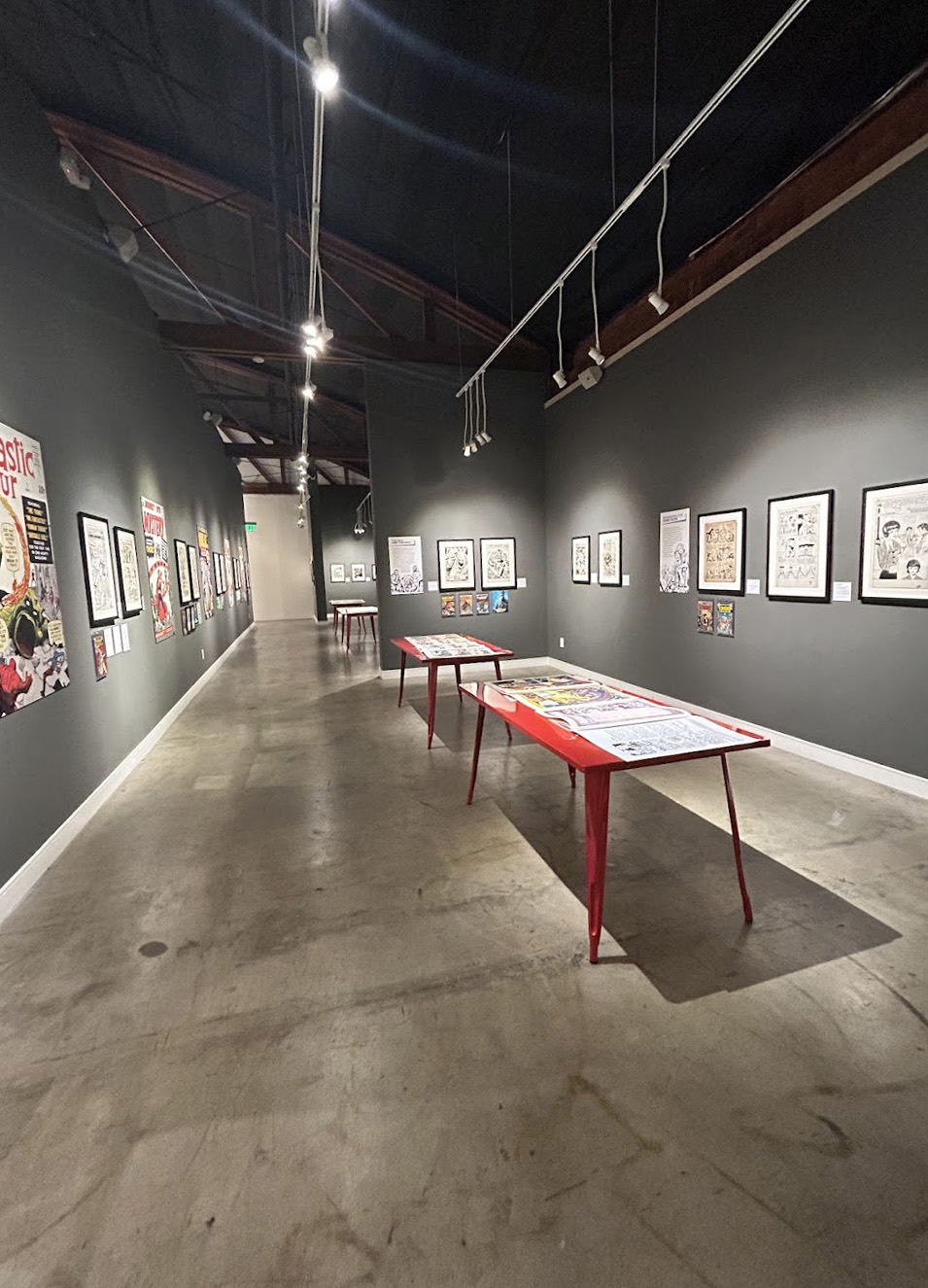
The originals, nearly fifty, are juxtaposed with reproductions of penciling process and, at the same time, images showing Kirby’s influence on screen adaptations (including the Marvel Cinematic Universe). Putting Kirby’s autographic work next to reminders of these adaptations feels like a deliberate strategy. One long wall represents well-known Marvel IP, including Captain America, The Fantastic Four, Thor, The Hulk, The X-Men, and The Avengers, while facing walls and tables lean into Kirby’s personal style and themes. The range of work shown, from 1940s to the 1980s, and from drawings to collages, suggests the arc of Kirby’s career. The genres sampled are many (and sometimes blurred), from superheroes, science fiction, and myth fantasy, to romance, crime, horror, and war. Many facets of Kirby are on display: his futurism, but then again his primitivism; his rapturous psychedelia, but then again his hard-hitting, lived-in urbanism. Various eras and collaborators are represented (among the inkers, I counted at least Dick Ayers, D. Bruce Berry, Vince Colletta, Frank Giacoia, Mike Royer, Joe Sinnott, Chic Stone, Mike Thibodeaux, and Kirby himself). Most importantly, this exhibit suggests something of Kirby’s outlook and spirit.

Along the Marvel wall.

I spent a lot of time in this historical exhibit, digging pages and spreads from, for example, Kirby’s Fourth World, 2001, “The Losers,” Kamandi, and In the Days of the Mob; three of his collages (2001, Spirit World, Captain Victory); contrasting Thors, inked by Ayers and Colletta respectively; a beautiful vintage page from “Just No Good!” (Young Romance #18, 1950), which I took to be mostly inked by Kirby; and on and on.

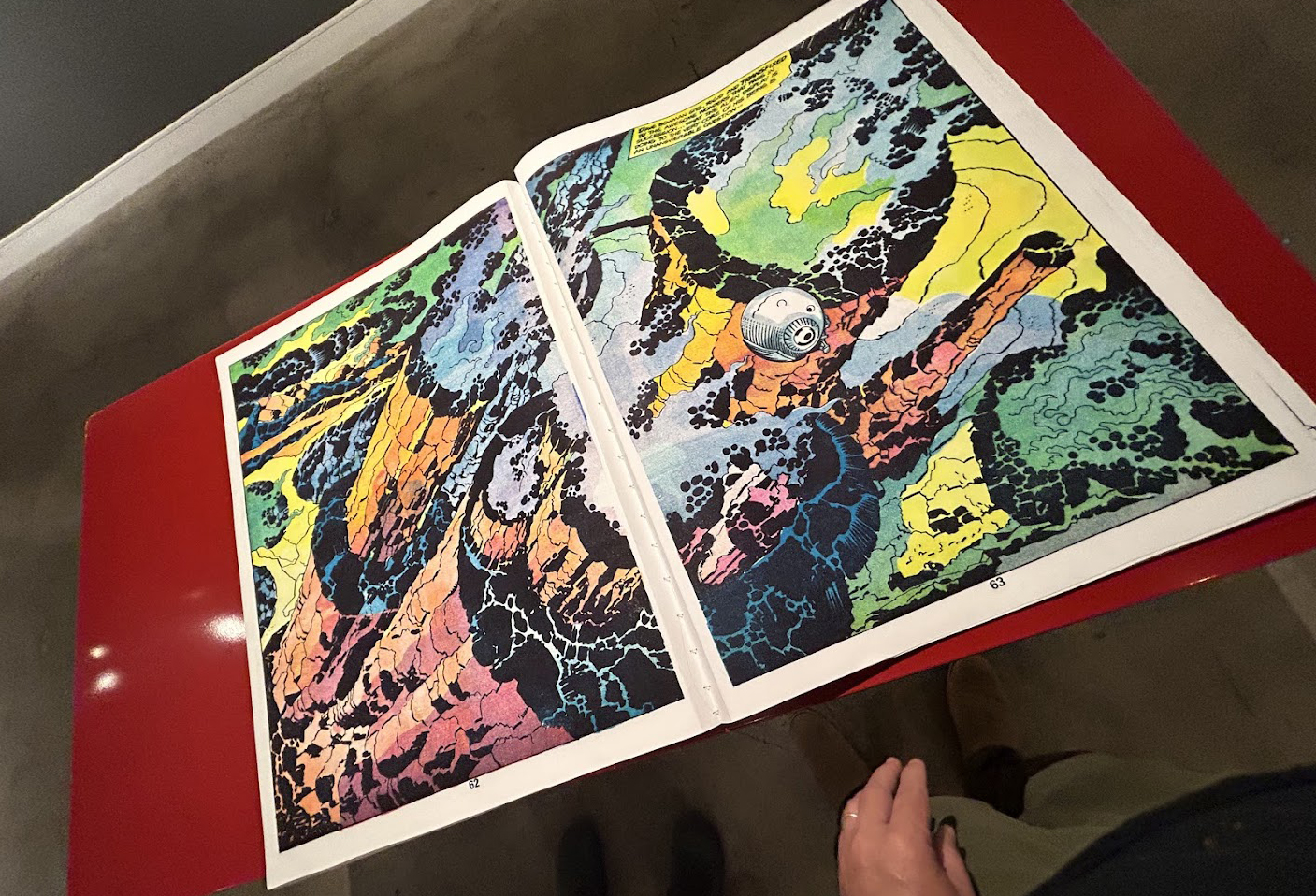
Another highlight of the side gallery is the presence, on four tables, of oversized facsimiles of Kirby comic books, complete with advertising and editorial matter as originally published. Tom Kraft, Kirby Museum President and design wizard, has been producing facsimiles like these since Kirby’s centennial in 2017. Scanning old comics at ultra-high resolution, he and his colleagues then print and bind them as enormous, durable books that visitors are welcome to flip through and read at leisure. These giant books cross the gap between comic art designed for reading and the more spectacular, scaled-up experience we typically expect in museums and galleries. They make it possible to see Kirby’s work up close as if you were a small child just learning to handle physical comics (their scale is both delightful and daunting!). On this occasion, the Museum has provided 17 by 22-inch recreations of Captain 3-D #1, Young Romance #8, Fantastic Four #48, New Gods #7, and Our Fighting Forces #152. I like this mix of famous and more obscure works. In addition, and this is the pièce de resistance, there’s a gigantic, 22 by 30-inch version of Kirby’s adaptation of Kubrick’s 2001: A Space Odyssey. This gets a table unto itself, which is good, because I spent a long time admiring its bombastic pages—some of which Kirby himself colored, in saturated, psychedelic mode. I’ve always liked the idea of exhibiting comic art in poster-sized yet readable form (an unfulfilled dream of mine for Comic Book Apocalypse), as it brings immediacy and accessibility to the gallery experience, and it’s great to see the Kirby Museum pulling this off.
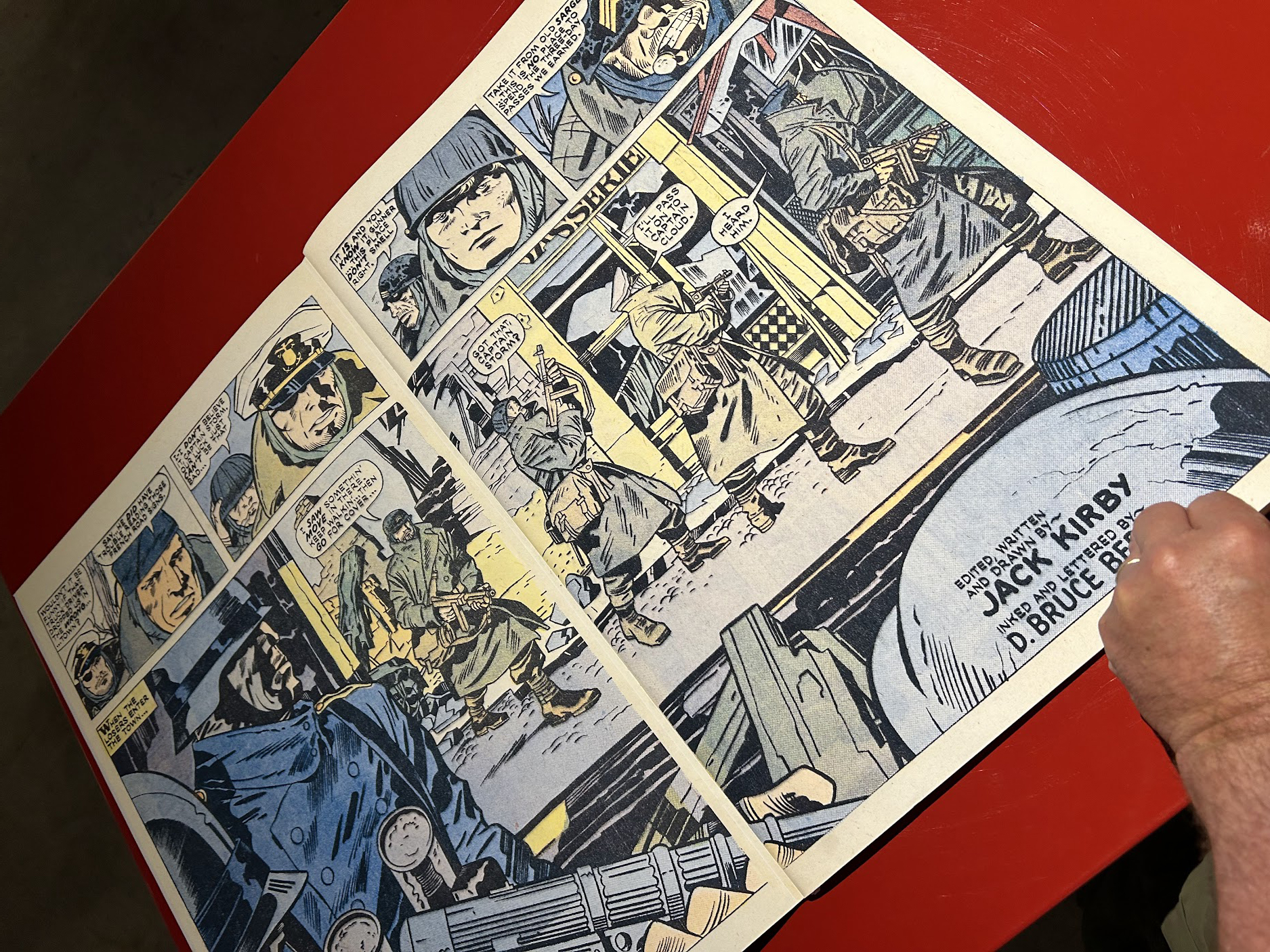
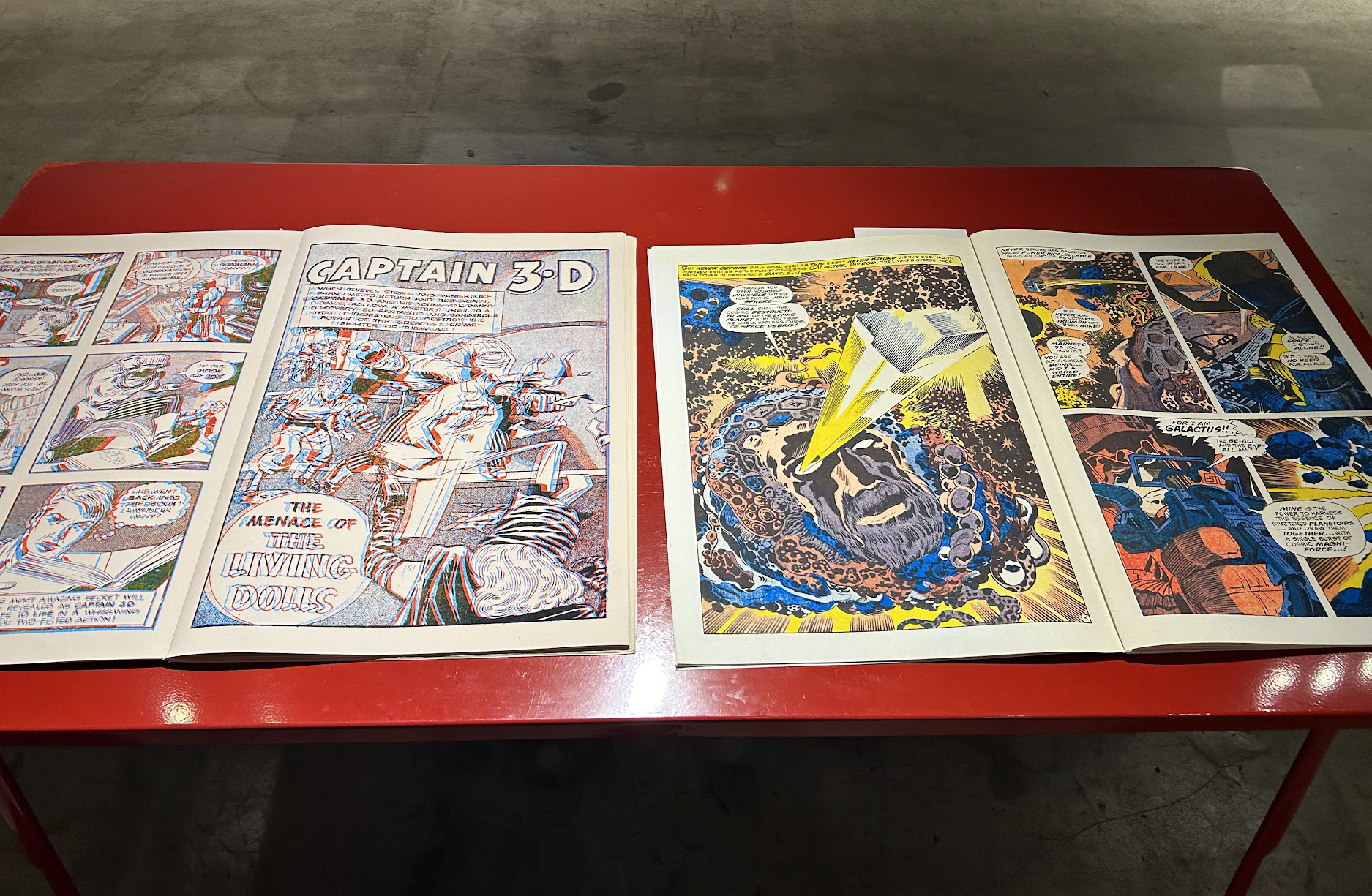
Immediacy and accessibility characterize Kirbyvision as a whole. It’s a hardworking, vivid, extravagant show that captures some of what is wonderful about Kirby, as well as his galvanic influence on comics and culture. Everyone who spends time with it will come away with different observations and favorites. Kudos to the Kirby Museum and thanks to the Corey Helford for making this happen.

Tagged , , , ,

RIP Steve Sherman (1949-2021)

I was sorry to learn that Steve Sherman — puppeteer, writer, artist, designer, and all-around creator — died last week on June 24. He was 72 years old. My deepest condolences to his loved ones, colleagues, and admirers.

Steve Sherman had a long and interesting career in film and television, on stage, and in comic books, including stints working for Filmation, Sid & Marty Krofft, Hanna-Barbera, and toy design firm Fred Adickes Associates. In the mid 1980s, he and fellow puppeteer Greg Williams cofounded Puppet Studio, a partnership that lasted for decades and included work for theme parks, cruise ships, and pop music tours as well as television (for example, ABC Weekend Specials, Beakman’s World, and Pee-wee’s Playhouse) and movies (such as Mighty Joe Young and the first two Men in Black films). Together Sherman and Williams worked with, among others, Jim Henson’s Muppets and legendary makeup artist Rick Baker, and in the mid-80s they created characters and stories for Mattel.

Steve Sherman (photo from IMDb).

Me, I came to know Steve Sherman through comic books. Specifically, I learned his name through reading Jack Kirby’s comics for publisher DC in the early to mid 1970s. I saw Sherman’s byline a lot in the letter columns of comics like Kamandi, the Last Boy on Earth and OMAC. I would also see another name, Mark Evanier, in some of those comics. What I didn’t quite realize was that Sherman and Evanier were Kirby’s two assistants, having been hired out of comic book fandom to help Jack with production and editorial duties on his DC books. They were also good friends. Evanier and Sherman had met in the late 60s through the Los Angeles Comic Book Club (which Evanier presided over), then worked together at the ill-fated Marvelmania (c. 1969-1970). Kirby, who did some work for Marvelmania, hired the two at about the time he was launching his grand Fourth World project for DC and envisioning a larger production outfit that could include other writers and artists under his editorship (a vision that never came to pass).

Text articles and letter columns by Sherman and Evanier began appearing with the second issues of Kirby’s titles Forever People, New Gods, and Mister Miracle, which went on sale in February and March of 1971. Sherman would have been twenty-one then (and Evanier just going on nineteen). Essentially, Sherman and Evanier had a ringside seat for the creation of one of the most exciting projects in American mainstream comic books of that era.

Evanier and Sherman have described their work for Kirby as minimal, since Kirby did all his own writing and drawing and held the editorial reins of most of his DC titles. But they were key parts of a team and community that afforded Kirby greater creative freedom than he had enjoyed for many years. Sherman supplied Kirby with the premise of Kamandi #29 (May 1975) and co-created the character Kobra with him. In the late 70s, Sherman and Kirby also collaborated on two treatments for SF movies that went unfilmed but later resulted in Kirby’s independent comic book projects for Pacific Comics, Captain Victory and the Galactic Rangers (1981-1984) and Silver Star (1983-1984). Both Sherman and Evanier became good friends of Jack Kirby’s family and important figures in his career story.

I believe I met Steve Sherman at more than one Kirby-themed convention event organized by Mark Evanier. I know that together Evanier, Sherman, Paul S. Levine, and I did the Kirby tribute panel at WonderCon in 2016, which I greatly enjoyed. Steve was gracious, unassuming, and friendly. Getting to talk to him then was a gift. I wish I had known him better.

Mark Evanier has a fine tribute to Steve up on his blog. Also, Mark and Steve got together for a video chat last summer that you can watch on YouTube; it’s a lovely stroll down memory lane, and a treasure trove for anyone who wants to know more about L.A. fandom in the 1960s or Kirby’s amazing early-70s period.

RIP Steve.

3 Days for 103

3 for 103 logo

Tomorrow, Friday, August 28, 2020, would have been the 103rd birthday of Jack Kirby. To honor the occasion, the Jack Museum and Research Center is holding 3 Days for 103, a three-day online event series to be streamed live to Facebook, YouTube, and Twitter. Running Friday the 29th through Sunday the 30th, from 11:00 a.m. into the evening each day,  3 Days for 103 boasts a terrifically diverse roster of guests from comics, art, film, and other fields, including colleagues, family, biographers, fans, and fellow artists. (I’m proud to be in that company: I’ll be interviewed on Saturday, Aug. 29, from 4:00 to 5:00 p.m. Eastern time.)

3 Days for 103, according to the Museum, will stream to Facebook and YouTube, and those who follow the museum on those platforms can elect to receive notifications for each event. In addition, the 3 Days for 103 events will stream to Twitter (via Periscope), but in that case, says the Museum, “there are no individual links to share”; simply follow @JackKirbyMuseum throughout the days.

The events will be promoted using the hashtag #Kirby103 — please spread the news! The Kirby Museum has the details, and full program, here: https://kirbymuseum.org/3for103/

Thanks, as ever, to the Kirby Museum for its tireless and inspired efforts!

Jimmy Olsen 133 cover

Fittingly, it was fifty years ago this past Tuesday, Aug. 25, that DC Comics published Kirby’s first teaser for The Fourth World: the epochal, idea-crammed, and fearlessly strange Superman’s Pal, Jimmy Olsen #133. Just to read that comic is to experience a sort of Kirby contact high: so amazing. It’s hard to believe it’s been half a century since The Fourth World premiered — a real milestone!

PS. Also, taking us back closer to Kirby’s roots, this week blogger Alex Jay shared more from his research into Kirby’s life — namely, images of Kirby’s World War II draft registration card. These images are revealing glimpses into Kirby’s (and New York City’s, and the USA’s) life in mid-October 1940. A lovely thing to see, especially during this special week.

PPS. Craig Fischer and I will continue our conversation about Tom Scioli’s graphic biography Jack Kirby just as soon as we can!

RIP Greg Theakston (1953-2019)

Sad news: Greg Theakston—publisher, artist, former convention organizer (The Detroit Triple Fan Fair), longtime member of Neal Adams’s Continuity Studios, Kirby inker (The Hunger Dogs; Super Powers) and Kirby scholar—has passed away at the age of 65. My condolences to his colleagues and loved ones.

Theakston published, under his Pure Imagination imprint, a great many books of vintage comics and of comics history. For me, especially early on, his books on Kirby were valuable compendiums of comics and lore, anecdote and example. Especially important to me were the two volumes of his biographical  Jack Kirby Treasury (1982; 1991), the several volumes in his Complete Jack Kirby reprint project, and the second edition (2000) of his reprint of Kirby’s classic comic strip, Sky Masters of the Space Force. While the artwork in Theakston’s comic book reprints was typically drawn from published comics that had been stripped of color through a destructive chemical process nicknamed “Theakstonizing,” and thus did not quite do justice to the comics as originally printed, these collections did the great service of filling in what had been only vague outlines in my mind before. I got a hands-on feeling for Kirby’s early work from these tomes. In addition, Theakston’s two-volume biography of Kirby, Jack Magic (2011), is well worth seeking out, peppered as it is with insights and quoted remarks drawn from his personal acquaintance with Kirby. Along with biographers Mark Evanier, Ronin Ro, the late Stan Taylor, and Ray Wyman, Jr., Theakston sought to make sense of Kirby’s life and career, even as he sought to bring evidence of that career before our eyes via reprints. Beyond Kirby, too, Theakston provided such resources as his Pure Image magazine and various “readers” devoted to generally public-domain material by classic cartoonists like Jack Cole, Lou Fine, and Wally Wood. So, Theakston did a lot, and taught me and other readers a fair amount.

True, I learned to be critical of Theakston’s books. As I see them now, they tend to be haphazardly edited and aesthetically barren; the Pure Imagination “house style” is functional but graceless. Further, the books were high-priced, and aimed strictly at a captive audience of specialists. Most vanished quickly. Theakston moved on, his books seemingly a random scattering rather than any sort of coherent pattern. (His Complete Jack Kirby was anything but.) Moreover, Theakston became a vexing figure in recent years; in 2014, he publicly accused the Jack Kirby Museum of stealing more than 3000 photocopies of Kirby’s art from him (a claim disputed by the Kirby estate itself). That dustup caused some Kirby devotees to turn away from him, shaking their heads. I was one.

I never “got” Theakston artistically. Despite his enthusiasm for Kirby, aesthetically he seemed worlds away from what excited me about Kirby’s art. I gather that Theakston was a prolific magazine and paperback cover illustrator, but the samples of his work I’ve seen strike me as beholden to pulp nostalgia in ways that interest me no longer. He inked Kirby in ways that struck me as more tame than dynamic. What’s more, I have to admit I’m a skeptic when it comes to the brand of retro glam-cheesecake-pinup art that seemed to hold him in thrall and fueled some of his longest-lived publishing efforts (The Bettie Pages; Tease). Theakston’s way with paint seemed to have more to do with that kind of Vargas/Elvgren aesthetic than the rowdy cartooning of Kirby, and, well, I’m no convert. But it would be mean and foolish of me to deny that I benefited from his nostalgia, his enthusiasm, his immersion in vintage comic and pulp art. There was a time when I snagged every Pure Imagination book on Kirby that I could, and I see a bunch of them on my shelves, right here.

My one brief meeting with Greg Theakston (which convention was that at?) led to nothing; he seemed uninterested. But that makes no difference; the important thing to me is that he showed me aspects of Kirby I had never seen before, and helped me get a clearer picture. In particular, his 1982 Kirby Treasury meant a lot to me. So, thanks to Mr. Theakston for being a Kirby studies pioneer. RIP.


RIP Stan Lee (1922-2018)

A sad day. Numerous sources have confirmed the passing, this morning, of legendary Marvel Comics writer, editor, and publisher Stan Lee (b. Stanley Martin Lieber, 1922-2018). My condolences to his loved ones and friends, and to his colleagues and fans, who were legion.

It appears that TMZ.com and The Hollywood Reporter were among the first to break the news publicly; other sources, for example the Associated PressNew York TimesLos Angeles Times, and CNN, have followed suit.

Stan Lee in the US Army, c. 1942-45

Stan Lee served in the U.S. Army Signal Corps from 1942 to 1945. Website DoDLive (www.dodlive.mil) identifies this image as simply a “U.S. Army photo.”

Lee was 95 years old. Anyone who has been following coverage of his life over roughly the past year, since the death of his beloved wife Joan Lee in July 2017, probably knows how tumultuous his final days were, marked by rumors of frailty, vulnerability, and domestic chaos. Recent images of Lee on the convention circuit have sometimes been disconcerting, as the almost mythically peppy, seemingly indefatigable Lee finally began showing signs of age and dependency. Until very recently, Lee played the part of a Pop icon with gusto, getting out in the world, engaging his fans, and burnishing his legend.

Speaking personally, I had somewhat expected Lee’s passing, as the last few months have been filled with nerve-wracking, if sometimes contradictory, reports about his status. Yet I was surprised at how shocked, and saddened, I was to hear of his death today. The news brought tears to my eyes, and I am hard pressed to say why.

I have been critical of Lee, both in my book Hand of Fire and especially since his testimony in the Marvel v. Kirby legal case. I have also been critical of his hagiographers, those who tend to describe Lee as a real-life “superhero.” When I see the usual inaccurate coverage of Lee’s career, creative work, and relationships with other creators who worked under his editorship – and I have seen that sort of glancing, thinly researched coverage this very day – I confess I seethe with frustration. What Jordan Raphael and Tom Spurgeon say at the start of their 2003 book Stan Lee and the Rise and Fall of the American Comic Book (which I consider the best single book about Lee) still applies:

Stan Lee is one of the most important figures in American popular culture. He is also one of the least understood. […]

Here is the truth about Stan Lee: he didn’t create Spider-Man or any of Marvel’s most famous characters. He cocreated them. The distinction matters, because in that distinction lies the essence of his considerable accomplishments. (ix)

This seemingly simple yet crucial caveat is still routinely swept aside when reporters reach for superlatives to put Lee’s work into context. Just what is meant by “cocreated” is something I tried to wrestle with, too tentatively perhaps, in Hand of Fire – and that is indeed a question that continues to bear upon Lee’s reputation, one that has implications for the breadth and nature of his accomplishments.

Hand of Fire seeks to split the difference between praising Lee as Marvel’s editorial architect and criticizing him for his untrustworthy, often self-aggrandizing accounts of how Marvel actually worked in its 1960s heyday. Here’s a key passage:

Of course “Stan Lee” has long served various author-functions for fans, not least the conferral of a single tone or attitude on what is, really, a shapeless amassing of decades’ worth of inconsistent, heterogeneous work. But though Lee was Marvel’s impresario and publicist par excellence in the sixties and early seventies, and though at first he contributed to the comics’ content as a scripter, polishing if not steering the work of various narrative artists, he did not solely create any enduring Marvel properties. Nor did he, in fact, serve as scenarist for many of the most celebrated Marvel comics of the mid to late sixties. By the same token, Kirby – though he provided the conceptual material, the character designs, the unmistakable graphic style, the pacing, and, eventually, the plotting and overall direction of the Marvel books with which he was linked – did not solely author any of the seminal Marvels of the period. His work was constrained and subliminally altered at the editorial level, with text that reshaped and at times redirected his plots. Furthermore, Lee’s vitalizing influence saturated Marvel and determined its editorial ethos. Kirby worked harder, but, commercially, Lee made things happen. (94-95)

This passage, which has been quoted and talked about, is one that I’m proud of, for its preciseness, its refusal to take things too simply, and its distance from the angry, intemperate things I would have said had I written Hand of Fire at a younger age. Yet during the Marvel v. Kirby case, and even since, I have not been able to convince myself that an “angry, intemperate” response was wholly uncalled-for. I tried to write the book more or less dispassionately, but since then I’ve often been passionately angry about Lee’s continued prevarications when it comes to the question of who did what at Marvel back in the sixties. It has been easy to blame Lee, or rather, hard not to blame him. He has been, after all, a Grand Old Man of American comic books (as Raphael and Spurgeon put it), a totemic figure, and one with the power to shape the way people view history. I wish he had been more forthcoming.

Some readers have told me that Hand of Fire goes too easy on Lee, or on the official Marvel history, that Lee did not contribute substantially to the comics’ content – or if he did so, then only negatively – and that he emphatically did not “steer” the work of Jack Kirby. I remain unsure of quite how to tell the story, but am convinced that Lee added considerable pizzazz, spirit, and warmth to those comics; his voice mattered. Of course I’m equally convinced of what the above says about Kirby: that Kirby provided the concepts, designs, storytelling, pacing, style, and eventually, though perhaps to some degree even at the outset, the plots of the Marvel comics he drew. The same is emphatically true of the work that the late Steve Ditko did under Lee’s editorship. The record is murky, but we do know that Lee expected Marvel’s artists to plot and to make fine decisions about pacing and storytelling, and we do know that stalwart artists Kirby and Ditko had proven their ability to create comics stories from scratch again and again prior to the Marvel explosion. Obviously, they didn’t need Lee in order to make comics – though they did need Lee to create Marvel Comics. What Lee himself had to say about the working arrangement at Marvel shifted over the years, from (sometimes) frank acknowledgment of the artists’ contributions to (sometimes) insistence that he himself had provided what was most important about the characters. In any case, the “Marvel method” of production has permanently clouded the question of who did what, who inspired what, and to what extent Lee and his artists truly worked together.

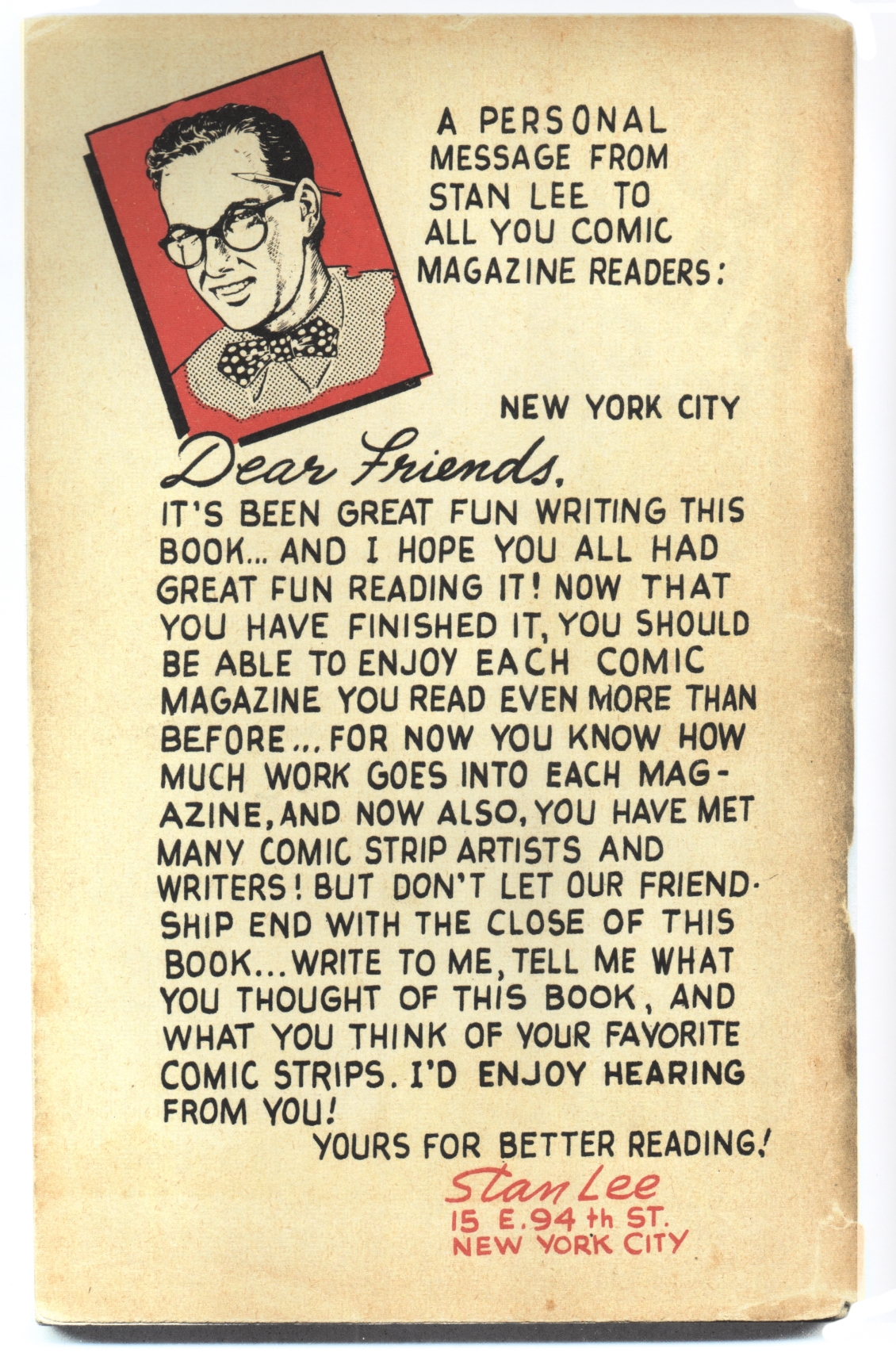
Back cover to Stan Lee's "Secrets Behind the Comics" (1947).

The back cover to Stan Lee’s 1947 book, “Secrets Behind the Comics.” As reproduced in “The Secret History of Marvel Comics,” by Blake Bell and Dr. Michael J. Vassallo (2013), page 156.

I’ve worried over these things, and felt these conflicted feelings, for quite a while, and will surely continue to feel them. Anyone paying close attention to Kirby’s career story must think about the gap between the official history (even the history adopted by Marvel in the wake of the Marvel v. Kirby settlement) and what must really have happened among the disparate talents and personalities that made possible the massively multi-authored vast narrative that is Marvel. Anyone who has delved deeply into Kirby’s story must also be have a version of Stan Lee’s story on their mind, even if that version is, like mine, conflicted.

When I was a kid, though, ah, Stan Lee’s name was one to conjure with, and his voice became as familiar as my own. I read more comics than I can count that started with this claim:Stan Lee presents

Lee’s name became part of a reading ritual; he was the figurehead of figureheads, a magic character. And to this day I have a feeling for the idea of “Stan Lee” that no amount of research has been able to quell. I was reminded of that this morning, and the feeling, oddly, hurt. Having spent the last few days pawing through some too-long-neglected boxes of comic books and reliving some of my long-ago days as a fan and collector, I may have been too-perfectly primed to be shocked by the news of his passing. News of his death sent me into a fog.

Words like charlatan and huckster cling to Lee, and comparisons to carnival barkers, or even P.T. Barnum, are never far away when Lee is the topic of talk. I understand why; frankly, those words are deserved. Lee knew this well, but he wasn’t simply a shill. A shill would have had his hour, but then faded, and fast. Lee, though, was something else. He combined the larger-than-life qualities of a Marvel hero with the affability of a beloved neighborhood character and the approachability of an old friend. Sometimes when I think of Lee, I think of his seeming mendacity and conveniently porous memory. I’ve had that version of Lee in my head for nearly thirty years and counting. But sometimes when I think of Lee, I think of being a kid with a comic book in front of him, with a whole great big world spreading out before him, and I feel, still, a certain awe and gratitude at the whole crazy business.

RIP Stan Lee. I cannot imagine my life as a reader and thinker, nor my coming of age as a comics scholar and critic, without him. As editor-impresario, Lee brought the work of Kirby and a gaggle of other disparate artists to market under one colorful banner, and in so doing enriched my life and the whole American comic book field. I don’t know if I can call Lee one of my cultural heroes – I suppose Hand of Fire tells the story of my loss of faith – but at one time he surely was, and I cannot but thank him for that. Working in tandem with other singular talents, Lee helped transform the comic book, and though his greatest period as a writer-editor spanned just a decade – only a fraction of his long career – what he helped bring to the newsstands in those days, the heady days of Kirby and of Ditko, and of the dawning Marvel Universe, was stupendous.

PS. Among the several obituaries I’ve read today, I would recommend  Jonathan Kandell and Andy Webster’s careful one for the New York Times, and Michael Dean’s excellent one at The Comics Journal. (I don’t agree with Dean’s assessment of Lee’s skill as a writer, versus Kirby’s, but it’s a lovely, insightful piece, with a ringing conclusion.)

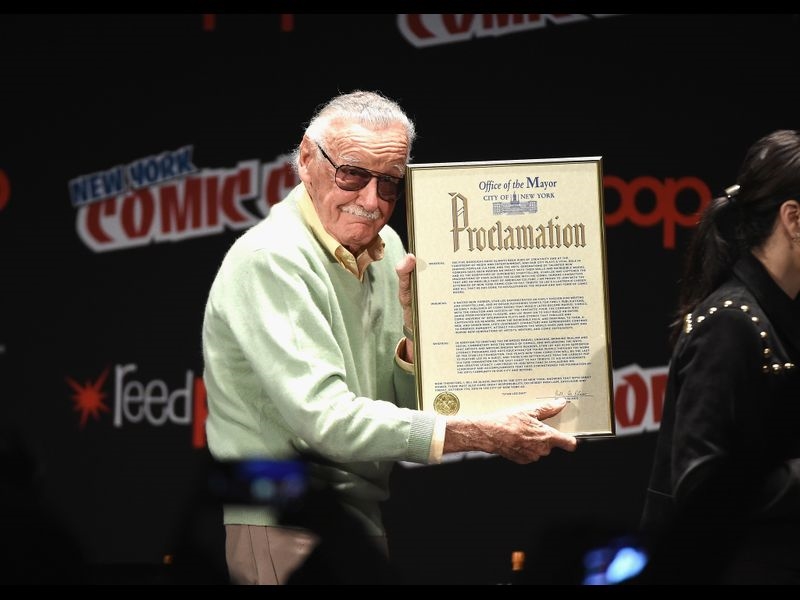
Stan Lee at Stan Lee Day, 2016

Oct. 7, 2016: Lee enjoys “Stan Lee Day” in NYC, at Madison Square Garden (Nicholas Hunt/Getty Images, obtained from the Los Angeles Times).

PPS. I just rediscovered this odd, ambivalent poem I wrote about Stan Lee years ago. I think it captures both my gratitude and my ambivalence. ‘Nuff said.